

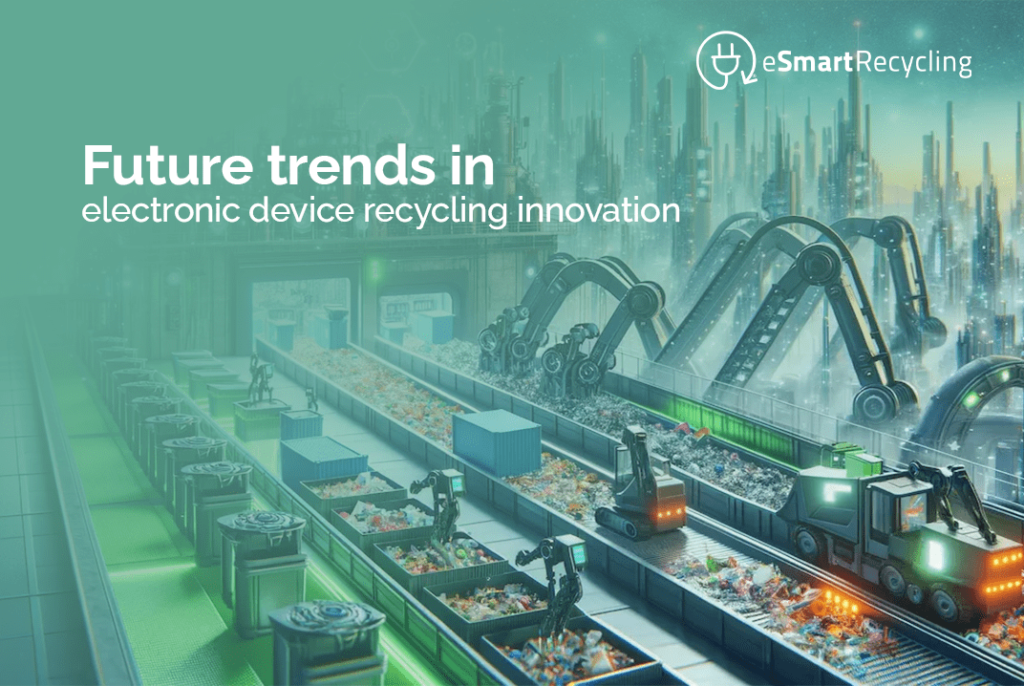
Innovation in electronic device recycling aims to reduce the amount of electronic waste that ends up in landfills and, as such, it is having a positive impact on the environment.
With the world becoming increasingly digital, the amount of electronic waste produced is only going to increase. Electronic device recycling technology is playing a critical role in helping to combat this problem, as it allows for the reuse of electronic components instead of discarding them.
There are three main trends in electronic device recycling that are on the rise.
One of the most promising trends in device recycling is the use of automated sorting systems. This technology uses sensors to scan devices and then categorize them into predefined categories.
This system is particularly advantageous because it allows for quick and accurate sorting. It can save time and money, and more importantly, reduces the amount of manual labor required. In addition, automated sorting systems are capable of performing more complex tasks, such as disassembling and sorting components for recycling.
Closed-loop recycling systems take recycling a step further by allowing for the reuse or remanufacturing of a device. This type of system is becoming increasingly popular because it allows for the reuse of components that would otherwise be discarded. This not only reduces waste but also helps to reduce production costs. This type of recycling also helps create more efficient and sustainable manufacturing processes.
To address the growing volume of electronic waste, new technologies are being developed to increase the efficiency of recycling processes. For example, AI robots are being used to identify and separate electronic components into different categories.
Additionally, new technologies are being developed that can detect the age and condition of devices to give them an accurate valuation. This information can be used to determine which parts can be recycled and which should be discarded.
The emergence of the shared economy has allowed companies to reduce waste and use existing resources more efficiently. This type of business model reduces the need for companies to buy new products, as products can be shared instead.
This type of recycling allows companies to reduce waste while allowing them to use their existing resources more efficiently.
The growing attention to sustainability and environmental protection makes the future of electronic device recycling seem promising. With the rise of innovative technologies and the emergence of the collaborative economy, more attention is being paid to the possibilities of recycling and reusing electronic components. This will not only lead to a reduction in waste but will also help to reduce the production costs of companies and individuals.
The future of electronic device recycling looks bright. As more innovative technologies are developed and the demand for environmentally friendly strategies increases, innovation in device recycling will become an important part of the global economy. With the use of automated sorting systems, closed-loop recycling systems, new technologies, and the emergence of the collaborative economy, the future of electronic device recycling looks very promising.
Fill out the form below to request your electronics recycling pickup.
We’ll coordinate the schedule logistics and follow up with next steps.

A few days ago, the news started spreading: Costco made a small change to its famous $1.50 hot dog and soda combo for the first time in four decades. Now you can choose a Kirkland water bottle instead of soda, but the price stays the same.
And of course, people had something to say about it.
There’s something satisfying about seeing something so simple stay consistent. While almost everything keeps getting more expensive or more complicated, Costco decided to stick with what already works: a good hot dog, an affordable price, and now a slightly lighter option—no big announcement. No noise. Just a small adjustment that makes sense.
At eSmart Recycling, it feels familiar.
Since 2014, we’ve been doing the same core work: we collect laptops, computers, monitors, and old electronics, we perform secure data destruction, and we give a second life to devices that still work.
No complicated steps. No confusing process. Just handling something that most people don’t want to deal with.
Because in the end, some things don’t need to be replaced to stay useful. Sometimes they just need the right handling.
Many of the devices we receive still have plenty of life left. We check them, clean them, perform a full data wipe, and a good portion ends up in the hands of kids and families who truly need them.
It’s simple. And it works.
If you have a laptop, desktop, or electronic device sitting at home that you no longer use, it’s worth pausing before putting it back in a drawer or leaving it there for another year.
There’s a good chance it can still be useful to someone else.
We take care of the entire process: pickup, secure data destruction, and refurbishment. And if something can’t be recovered, we handle responsible recycling.
That small update from Costco leaves an idea behind: some things keep working just fine, they just need a small adjustment to stay useful.
The same thing happens with technology recycling. Devices that look outdated can still have a second use when they reach the right hands.
If you have old electronics collecting dust at home or in your office, this might be the moment to move them forward.
Call us. At eSmart Recycling, we handle the pickup, ensure secure data destruction, and put those devices back into circulation when they still have life ahead of them.

Over the past few weeks, two very different companies have made headlines across the United States: Wren Kitchens, the British kitchen retailer that partnered with Home Depot, and ARC Burger, one of the largest Hardee’s franchise operators. Both have shut down operations and filed for Chapter 7 bankruptcy, a full liquidation.
When a company closes like this, the story usually centers on layoffs and disappointed customers. But there’s another layer that rarely gets attention. Behind those closures sits a massive volume of equipment: electronics, commercial furniture, digital displays, computers, point-of-sale systems, LED lighting, appliances, and more.
And too often, if no one takes responsibility for what happens next, it all ends up in landfills.
That’s the sustainability lesson few are talking about.
Unlike Chapter 11, where a company attempts to restructure and stay alive, Chapter 7 is final. Assets are liquidated to pay creditors. Everything the business owns, from office laptops to industrial refrigerators, digital menu boards, ordering tablets, security systems, and even furniture with embedded electronics, is either sold off or discarded.
In the case of Wren Kitchens, which closed its 15 East Coast showrooms, that includes full kitchen displays, interactive systems, lighting setups, and design computers.
With ARC Burger, which shut down 77 restaurants, the scale is even larger: hundreds of commercial kitchen units, digital screens, POS systems, surveillance cameras, and heavy-duty appliances.
This is not a small clean-up. It’s a wave of physical assets, suddenly without a clear destination.
Every time a retail chain or restaurant group shuts down at scale, it generates a significant amount of electronic waste.
Many of these devices contain valuable and hazardous materials. Precious metals like gold, silver, and copper. Plastics that take decades to break down. Toxic substances such as lead, mercury, and flame retardants.
When not handled properly, these materials don’t just disappear. They seep into soil. They reach water systems. They stay.
Retail and restaurant sectors generate thousands of tons of electronic waste every year from upgrades, closures, and bankruptcies. A large portion still ends up in standard landfills instead of being recovered.
This is where we come in at eSmart Recycling.
Instead of letting these assets become waste, there’s another path.
Equipment that still works, like laptops, monitors, and tablets, can be refurbished and used again. Devices that no longer function can be responsibly recycled, recovering valuable materials and reducing the need for new extraction. And anything that stores sensitive data can be securely destroyed under strict standards.
This not only reduces environmental harm but also helps companies handle closures in a more responsible and controlled way. Liquidators and operators are increasingly looking for partners who can manage this process properly.
If you were affected by the closure of Wren Kitchens or ARC Burger, hold on to any electronic equipment you may have received or purchased. Throwing it away should not be the default.
If you manage a business or leftover inventory, certified recycling is a better route than disposal.
If you are involved in bankruptcy or liquidation processes, working with a specialized recycling partner brings order to what can easily become a messy and risky situation.
Chapter 7 bankruptcies remind us that a product’s life does not end when a company shuts its doors. That moment creates a new decision point.
What happens next matters.
At eSmart Recycling, we work with companies, franchises, and individuals to handle electronic waste responsibly, from secure data destruction to refurbishment and certified recycling, aligned with R2 standards and environmental regulations.
If you have equipment you no longer need due to upgrades, closures, or liquidation, reach out.
We help you extend the life of what still works and safely recycle the rest.

On April 27, 2026, thousands of companies across the United States realized at the same time that they couldn’t access their email. Outlook has been down since early morning, and Microsoft confirmed it on its Service Health page. No es la primera vez. No va a ser la última. And it’s worth asking what this says about how we work today.
If you landed here trying to fix Outlook today, the official resources mentioned below will help you more than we will. But if you keep reading, there’s a part of the problem that sits on our side and that few companies address.
The outage started around 5 AM Eastern Time. Reports on Downdetector have stayed consistent at around 1,500 per hour, which indicates the issue is still active. Microsoft confirmed “service degradation” and published that their teams are investigating.
The symptoms are consistent:
It affects:
This is not a problem with your computer or your local network.
Three places worth bookmarking for any future outage:
We're investigating an issue where users may be experiencing intermittent issues accessing https://t.co/ZUfyjth6sU. For more information, please visit https://t.co/uSHwRmXFJZ.
— Microsoft 365 Status (@MSFT365Status) April 27, 2026
One recommendation: when the outage is server-side, don’t troubleshoot on the client side. Changing passwords, clearing cache, or reinstalling the app won’t fix anything and can sometimes make things worse when the service comes back.
Five practical things:
Having a plan before an outage matters more than improvising during one.
The first thing is to have a defined backup channel that everyone knows. If the first time your team uses Slack seriously is during a crisis, there will be friction. The second is to assign a single person to communicate updates. Without that, five people forward different information, and no one knows what to believe.
And the third, which sounds obvious but still happens: don’t send emails about an email outage.
Every time a mainstream service fails, an uncomfortable truth becomes visible: companies depend on infrastructure they don’t control. Outlook today. Slack another time. AWS, GitHub, Stripe, Zoom. All have had major outages in recent years.
That doesn’t mean the cloud is bad or that companies should go back to on-prem servers. It means technological dependency has layers, and it’s worth looking at all of them honestly. There is critical data in the cloud. There is data on the computers your team uses every day. And there is data on computers your team stopped using a year ago, sitting in a storage room or closet, waiting for someone to make a decision about them.
The first two layers get attention. The third rarely does. But that data is still there, still recoverable with modern tools, and still the responsibility of the company that generated it.
eSmart Recycling doesn’t fix outages or email issues. What we do, and what we’ve been doing from Tampa for companies in Florida and nationwide, is handle the last layer of that technological dependency: hardware you no longer use but that still contains data.
We collect laptops, desktops, servers, hard drives, and mobile devices directly from your office. We perform auditing and inventory. We physically destroy the data, complying with HIPAA, R2v3, and DoD standards. We provide a certificate of destruction and an environmental impact report. What can be refurbished is redistributed to communities with less access to technology. What can’t be recycled by components?
If your company has accumulated equipment over the years and no one has made a decision about what to do with it, that’s the conversation we actually have. Outlook will come back today or tomorrow. The laptops in your storage room have been there for months.
When you’re ready to resolve that part, contact us at info@esmartrecycling.com or call (813) 501-7768.
eSmart Recycling | 5100 Vivian Place, Tampa, FL 33619 | (813) 501-7768 | info@esmartrecycling.com
Talking with IT departments about data destruction is a consistent experience. Most have good intentions. Almost all believe they are doing the right thing. And many are operating under myths that wouldn’t survive five minutes in an audit.
This is not an attack on the field. It’s the reality of a space where information changes fast, standards get updated, and what was true seven years ago may be false today. The problem is when those myths stick, and a company in Tampa Bay discovers, in the middle of an audit, a breach, or a lawsuit, that their “data destruction” didn’t destroy anything.
These are the five myths we see most often, and why each one is a silent risk.
What many people believe: move files to the trash, empty it, and that’s it. Data gone.
The reality: deleting a file only removes the reference the operating system uses to find it. The data still physically exists on the disk until something new overwrites it. Any free recovery software can read it in minutes.
It’s like crossing out an entry in a book’s index. The page is still there. You just removed the direction to find it.
What NIST 800-88 says: deleting files does not even qualify as “Clear,” the lowest level of sanitization. To meet Clear, every storage block must be overwritten with new data.
What many people believe: a full disk format leaves everything clean, ready to resell or recycle.
The reality: a standard format (quick format) does the same as deleting files at scale. It removes the tables that index where each piece of data is, but leaves the data intact in the physical sectors. A “full format” in recent Windows versions does overwrite, but not in a verifiable way under audit standards.
The real test: if, after formatting, you can run software like Recuva or PhotoRec and recover files, you didn’t destroy anything. You just hid it poorly.
What NIST 800-88 says: formatting is not recognized as a sanitization method. For Purge level, you need verified overwriting or cryptographic erase. For the Destroy level, you need certified physical destruction.
What many people believe: restoring to factory settings equals data destruction. This applies to smartphones, laptops, and corporate tablets.
The reality: there is an important nuance here, because the answer changed in the last five years.
For modern devices with hardware encryption enabled (iPhone post-2014, Android 6 and above with file-based encryption, Macs with T2 or Apple Silicon), a factory reset deletes the cryptographic keys. Without the keys, encrypted data becomes mathematically unrecoverable. In these cases, a factory reset works as a valid sanitization.
For everything else (older Windows phones, Android devices without encryption enabled, Windows laptops with HDDs without BitLocker, pre-2015 devices), a factory reset is essentially equivalent to formatting. Recovery is possible with basic tools.
What NIST 800-88 says: a factory reset can qualify as Purge-level sanitization only if the device uses verifiable hardware encryption. If not, it is not sufficient. Your IT department must document case by case, not assume.
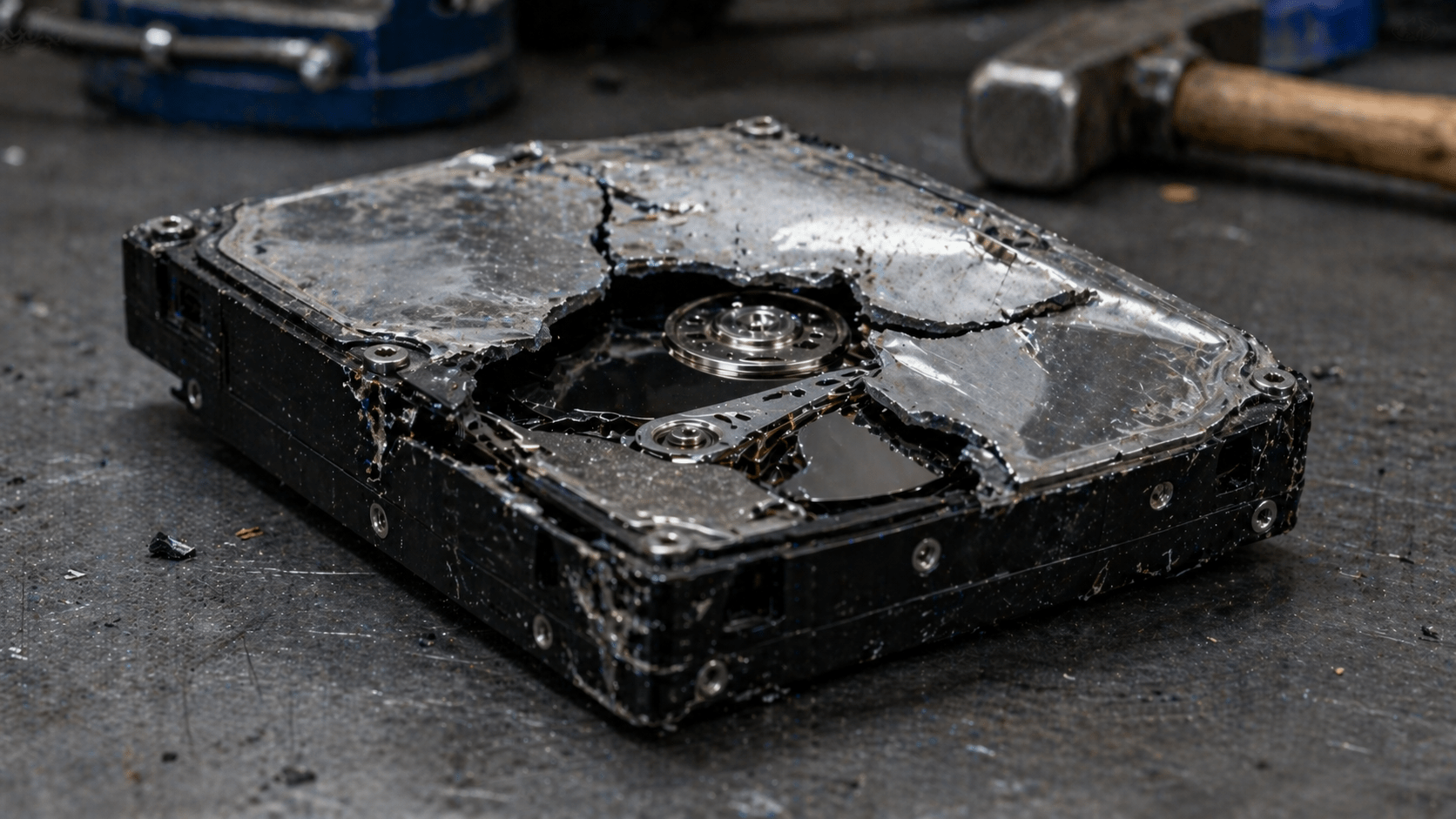
What many people believe: physically damaging a drive with a hammer, drill, or by dropping it from a height permanently destroys the data.
The reality: it depends on the level of damage and the type of drive. An HDD with magnetic platters can still be partially recovered if the platters are intact, even if the electronics are destroyed. Forensic labs can read data from magnetic fragments the size of a fingernail.
SSDs are worse. They have multiple NAND chips distributed across the board. If a single chip survives intact, it contains recoverable data. Breaking an SSD with a household hammer leaves functional chips in 7 out of 10 cases.
Beyond the security issue, hitting drives with improvised tools releases materials like mercury, lead, and cadmium. This is illegal in Florida under e-waste regulations.
What NIST 800-88 says: physical destruction must reduce the media to particles of a verifiable size. For HDDs, fragments smaller than 6 mm. For SSDs with highly sensitive data, particles smaller than 2 mm. This requires certified industrial shredders, not hammers in a parking lot.
What many people believe: a drive that doesn’t boot, mount, or show hardware errors is effectively dead. It can be thrown away without risk.
The reality: most drive failures are electronic, not in the data. An HDD with a burned motor, damaged heads, or a failed controller can still have perfectly readable data if the platters are intact. Professional recovery services like Ontrack or DriveSavers recover data from “dead” drives every day.
For SSDs, common failures like controller failure do not affect the NAND chips where data resides. A technician with specialized equipment can read the chips directly.
If your IT department discards broken drives without sanitization because “they no longer work,” it is leaving complete data in the trash.
What NIST 800-88 says: the functional state of the media does not change the obligation to sanitize. A drive that does not power on must be treated with the same protocol as an active drive: Clear, Purge, or Destroy, depending on the sensitivity of the data it contained.
Three quick questions for self-assessment:
Three “no” answers mean your company is more exposed than it thinks.
Fines for a data breach in the U.S. start in six figures and escalate quickly when HIPAA, GLBA, or SOX are involved. The cost of a certified data destruction provider fits within a typical quarterly budget.
The math is not complicated. What is complicated is unlearning myths that have circulated for years in IT departments as if they were best practices.
At eSmart Recycling, we work with companies in Tampa Bay to audit existing protocols, identify where they are operating under myths, and replace them with certified R2v3 and NIST 800-88 processes. If, after reading this, you have doubts about your own process, reach out. It is better to find the problem in a conversation than in a failed audit.
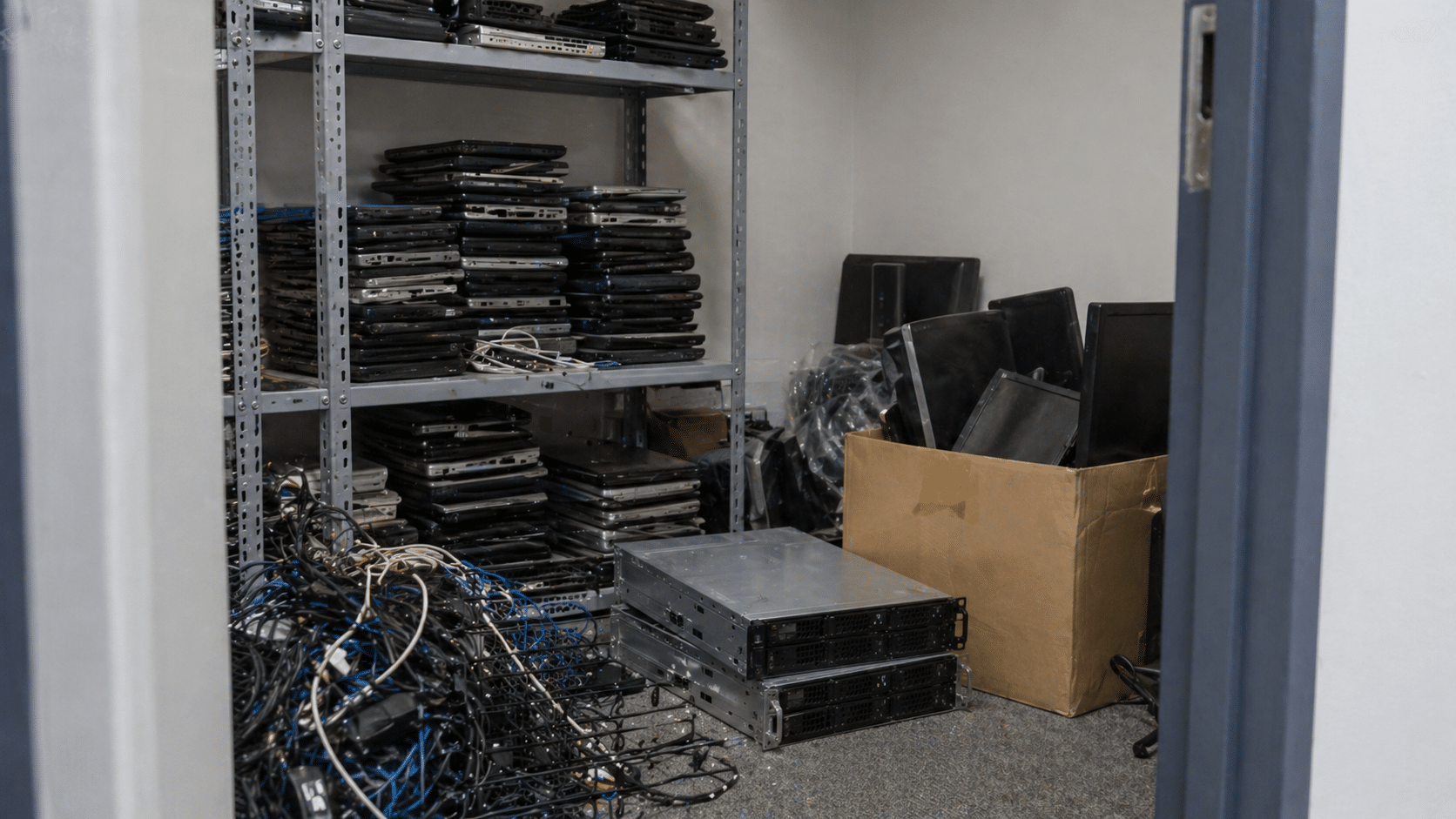
Almost no company in Tampa Bay has a formal e-waste management plan. What they have is a closet with old laptops, a rack with powered-off servers, a shelf full of cables no one knows where they came from, and a tacit agreement that “someone should do something about this at some point.”
That’s not a plan. That’s a compliance time bomb.
If your company handles customer data, equipment recorded as fixed assets, or has any regulatory obligation (HIPAA, GLBA, SOX, PCI-DSS), then it needs a documented plan. The question is not whether you need it, but how far you are from having one.
These 12 questions will tell you. Answer them honestly: every “no” is a crack where a fine or a breach can come through.
Not “more or less.” Exact number. If the answer is “like 30 or 40 laptops, I think,” there’s already a problem. Without inventory, there is no plan.
If no one is responsible, everyone is responsible. And that means nothing will get done until it’s too late.
An Excel sheet works. Formal asset management works better. What doesn’t work is relying on the IT manager’s memory.
“We run a formatter on it” is not a protocol. A protocol defines: what method is used depending on the media type, who executes it, and how it is documented.
If the answer is “it’s the same,” the protocol is broken. SSDs are not sanitized using HDD methods, and vice versa.
If you’ve never heard these terms, your auditor will use them when the time comes.
A generic certificate that says “we destroyed 50 items” is not enough to defend yourself in an audit. Every serial must be traceable.
If not, it’s not a vendor. It’s a transfer point. And your legal responsibility travels with the equipment all the way to its final destination.
Without this, you cannot prove where each drive ended up if you’re asked.
A one-page document signed by the CEO or COO. It doesn’t need to be a novel. It needs to exist.
If the answer is “they tell IT, and that’s it,” the policy is incomplete. Employees should know: where to leave it, what information to remove beforehand, and who confirms receipt.
That ratio is one of the most visible KPIs for corporate circular economy programs.
11 to 12 yes answers: your company has a functional plan. Maintain discipline and review annually.
7 to 10 yes answers: you have the foundation. The gaps are where the risks are. Identify the “no” answers and turn them into a quarterly project.
4 to 6 yes answers: you are improvising with luck. You’ve gone this long without an incident, but the probability increases every month. You need a formal plan before the end of the year.
0 to 3 yes answers: your company does not have an e-waste plan. What it has is exposure. The good news is it’s not complicated to build; the bad news is it won’t build itself.
An e-waste management plan is not an 80-page document. For a mid-sized company in Tampa Bay, it’s six well-made decisions:
Who is responsible? How inventory is tracked. What data destruction method is used? Who the certified recycling provider is. How each retirement is documented. When the plan is reviewed.
The hard part is not writing it. The hard part is executing it every time a device leaves use, not just when 50 of them pile up in a closet.
At eSmart Recycling, we help companies in Tampa Bay build the plan from scratch or audit the one they already have. If, after these 12 questions, you have more “no” answers than “yes,” reach out. The initial conversation costs nothing and usually saves far more than what a breach or a failed audit ends up costing.

The day it went into production. And the day it needs to be retired.
The first one is usually well-documented: rack number, configuration, IP address, and purpose. The second one rarely is. When it’s time to decommission servers in a company in Tampa, the uncomfortable questions show up. Who validates that the data was destroyed? What happens with drives in RAID? Do we have an auditable certification? Does the recycling vendor comply with HIPAA, GLBA, or SOX, depending on what applies?
This blog organizes the process so next time you don’t improvise. Server by server, step by step, with the standards your auditor will ask for.
A lot of people treat server retirement like a laptop with more RAM. That’s a mistake that gets expensive.
Servers have specific characteristics that change the entire sanitization process:
Treating a server with the same protocol as a laptop is the perfect recipe for a breach you won’t detect until the next audit.
NIST Special Publication 800-88 Revision 1 is the federal standard for media sanitization and the compliance base for HIPAA, GLBA, SOX, and PCI-DSS. It defines three levels:
For retired corporate servers, the practical rule is simple: if the drives are leaving your control, use Purge or Destroy. The exact level depends on data sensitivity. If you handle PHI under HIPAA, financial data under GLBA, or classified information under CMMC, Destroy is the path.
This is the workflow we follow at eSmart Recycling with clients in Tampa Bay:
Step five is the one your auditor checks first. If you don’t have certificates connecting each serial to the original server, everything else becomes questionable.
Before signing with any ITAD provider in Tampa, demand clear answers to this:
If any answer is vague, find another provider. The difference between a proper process and an improvised one is measured in fines that start in six figures when there’s a breach.
A B2B client in Tampa Bay, in the financial sector, contacted eSmart Recycling after a refresh cycle. Twelve Dell PowerEdge servers in production for six years, RAID 10 with enterprise SSDs, customer data under GLBA. The company had considered donating the servers to a regional office to extend their use.
Initial audit showed the SSDs did not support verifiable cryptographic erase and that the iDRAC consoles still had active credentials from three administrators who were no longer with the company. Donating them without full sanitization was not viable.
Final process: physical destruction of 48 SSDs at the eSmart Recycling warehouse, sanitization of iDRAC and BMC, R2v3 recycling of remaining hardware, and per-server certificates with each drive’s serial. Total time: 72 hours from pickup to documentation delivery.
Retiring servers costs time, money, and coordination. Doing it wrong costs fines, lawsuits, lost clients, and sleepless nights. The math is simple.
If your company in Tampa Bay has servers at end of life, hardware sitting from a past refresh cycle, or a datacenter being consolidated, the time to plan is now. The longer drives sit in a closet, the higher the chance someone moves them without protocol.
At eSmart Recycling, we handle everything from single-server retirements to full datacenter migrations. Audit, NIST 800-88 sanitization, serial-level certificates, R2v3 recycling, fully documented. Reach out before that closet turns into an audit finding.







Did you enjoy our latest blog articles just above?
Subscribe to receive new stories, insights, and impact updates straight to your inbox.
We’ll send you curated content about our partners, recycling strategies, success stories, and how your involvement is driving change through technology access and digital empowerment.
💡 No spam, just the smart stuff.