

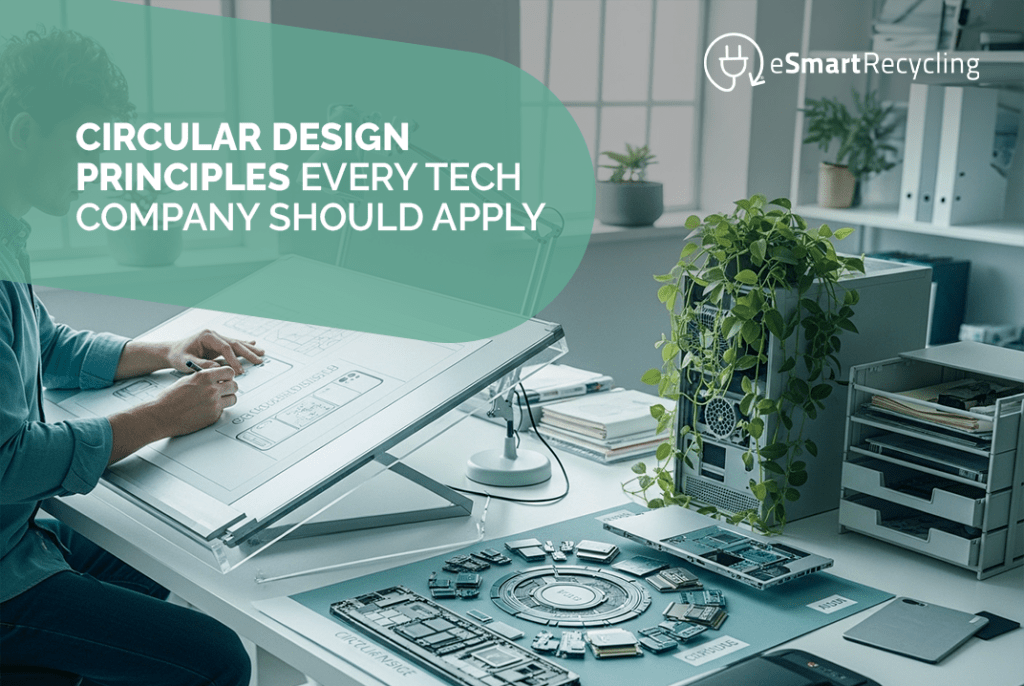
Tech companies can change the way they design products by applying the principles of circular design: reducing waste, keeping materials in use for longer, and regenerating natural systems. These three ideas help companies like ours, eSmart Recycling, extend the life of electronic devices while supporting vulnerable communities.
Circular design means creating products that are durable, repairable, reusable, and recyclable—considering every stage of the product’s life cycle: raw materials, manufacturing, use, and end-of-life.
For tech companies that make or handle devices like laptops, routers, or cables, this approach helps cut down e-waste and recover value. The U.S. Environmental Protection Agency (EPA) defines a circular economy as one that keeps products and materials in circulation for as long as possible and eliminates the idea of “waste” through smarter design.
When designing electronics, key questions include: can the device be easily disassembled? Does it contain toxic materials that make recycling harder? The Ellen MacArthur Foundation highlights eliminating waste and pollution from the design stage as a core pillar of circularity.
In practice, this might mean using recycled plastics, reducing complex fastenings, documenting disassembly processes, and setting up take-back programs for obsolete equipment.
This principle encourages design for reuse, repair, upgrade, and recycling.
Examples include laptops that let users replace batteries or drives, or routers with casings that can be reused with new boards. Some companies are also adopting “as-a-service” business models, where the manufacturer collects, refurbishes, and redeploys products to keep materials circulating.
Dell Technologies, in its circular economy roadmap, emphasizes designing for repairability, reusability, and recyclability as key steps toward its net-zero goals.
This idea goes beyond preventing harm—it’s about restoring value to ecosystems.
For technology, this could mean feeding recovered materials back into production cycles, using renewable energy in manufacturing or refurbishing processes, and reducing the footprint of resource extraction.
Adopting circular design isn’t just about environmental responsibility—it’s also good business. Reducing waste, extending product life, and returning materials to circulation help strengthen community programs like ours at eSmart Recycling while improving long-term sustainability.
Fill out the form below to request your electronics recycling pickup.
We’ll coordinate the schedule logistics and follow up with next steps.
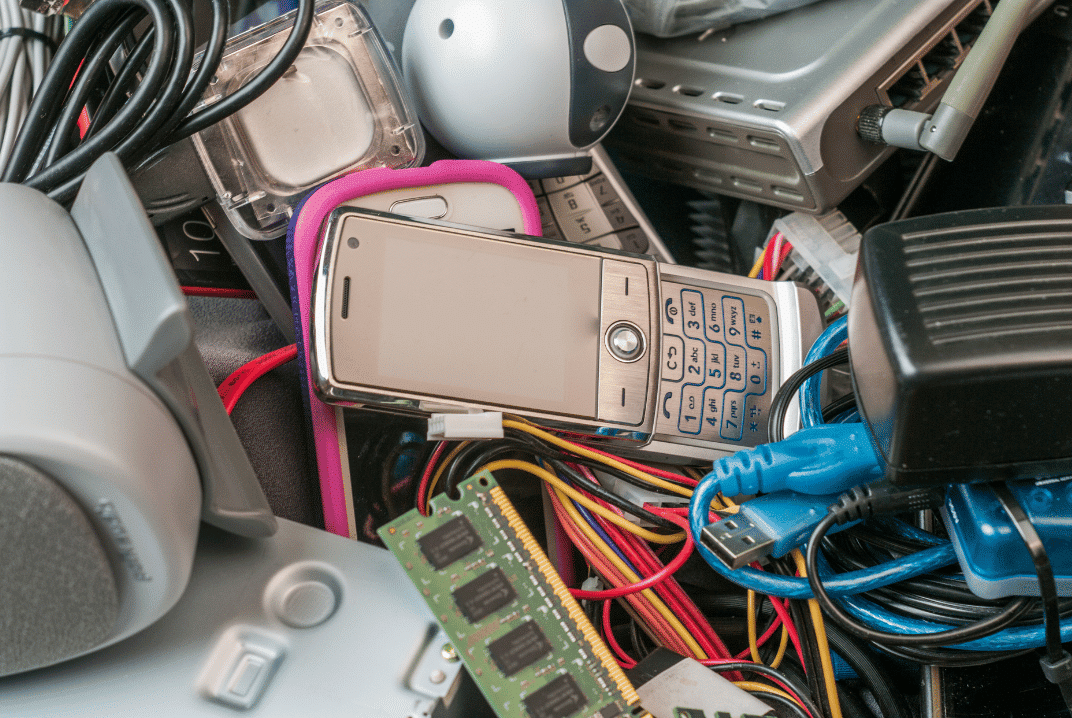
That 2015 laptop you’ve been keeping in the closet for two years weighs around 2 kilos. It looks harmless, sitting there collecting dust.
But if it ends up in a landfill, it can contaminate soil and groundwater for decades. Lead from the solder seeps out. Mercury from the screen spreads. Flame retardants in plastics slowly break down, releasing chemicals.
One laptop. Two kilos. Pollution that lasts longer than the device’s lifespan multiplied by ten.
Now multiply that by the 50 million tons of e-waste generated globally every year.
Laptops look simple on the outside. Metal, plastic, glass. But inside, there’s a complex mix of materials that shouldn’t end up in the ground.
Lead in circuit board solder. It leaches into soil and contaminates groundwater. Causes neurological problems in humans, especially children.
Mercury in LCD screens. Highly toxic. Persists in the environment and accumulates in the food chain.
Cadmium in older batteries and some components. Carcinogenic. Stays in the soil for decades.
Brominated flame retardants in plastics and circuits. Designed to prevent fires, but when they break down, they release dioxins that affect the hormonal system.
Beryllium in connectors and switches. Causes chronic lung disease when inhaled as dust.
None of these materials disappears. They remain, slowly leaking, moving through the soil, eventually reaching water sources.
Modern landfills in the United States have containment systems. Liners that prevent direct leakage into the soil. Leachate collection systems.
But no system is perfect long-term. Liners degrade over time. Leaks happen. And when they do, contaminants from e-waste start to move.
The biggest problem isn’t in Tampa or Florida. It’s in countries where e-waste ends up without regulation.
Around 80% of e-waste generated in developed countries is exported to developing countries. There, it ends up in informal landfills or is processed manually without protection.
Workers burn cables to recover copper. They inhale toxic smoke. Children dismantle circuit boards with their bare hands. The soil around these sites is so contaminated that nothing grows.
Ghana, Nigeria, India, China. Entire cities are dedicated to processing e-waste from the rest of the world. The pollution levels are so high that they affect the health of entire communities.
The ironic part of e-waste is that it contains valuable materials that get thrown away.
A ton of laptops contains more gold than a ton of gold ore. It also includes copper, silver, palladium, and platinum. Precious metals require energy and resources to extract.
When a laptop goes to a landfill, those materials are lost. More gold, copper, and silver need to be mined to produce new devices.
Proper recycling recovers these materials. They are melted, refined, and reused. The cycle closes instead of restarting over and over.
Beyond the economic value, there’s the environmental cost of mining. Extracting metals requires moving tons of earth, using chemicals, and consuming water. Recovering metals from e-waste is significantly less harmful than extracting them again.
When a laptop arrives at our warehouse in Tampa, it does not go to a landfill. It is fully dismantled.
Metals are separated by type: aluminum, copper, and steel. They go to certified smelters that process and reintroduce them as raw materials.
Plastics are also separated. Some can be recycled directly. Others require specialized processing.
Lithium batteries go to authorized hazardous material processors. They are handled under strict regulations because they can be dangerous.
Circuit boards that contain precious metals go to specialized refiners. They recover gold, silver, and palladium through controlled chemical processes.
LCD screens are processed to recover glass and safely remove mercury.
Each component has a certified destination. Nothing ends up in landfills. Everything is documented. You receive reports showing exactly how many kilos of each material were processed and where they went.
We are R2v3 certified for this reason. The R2 (Responsible Recycling) standard ensures that e-waste is handled in an environmentally responsible way at every step of the chain.
If your company has sustainability goals, e-waste is part of your environmental footprint.
Those 50 laptops sitting in a closet for two years represent around 100 kilos of material. If you recycle them properly, you prevent contamination, recover reusable metals, and reduce the need for new mining.
There’s also reputational value. Companies that document responsible e-waste recycling can include it in ESG (Environmental, Social, Governance) reports.
Investors, clients, and employees increasingly value environmental practices. Proper e-waste recycling is one of the most direct and measurable actions a company can take.
And if you work with us, you receive full documentation: weight of recycled materials, breakdown by category, and compliance certificates. Everything ready for audits or public reporting.
Not all e-waste ends up being broken down into components. Some equipment still works and can have a second life.
Through the Digital Education Foundation, we redistribute refurbished equipment to underserved communities. Laptops that a company in Tampa no longer uses can still be useful for a student without access to a computer.
We have distributed around 3,000 devices, benefiting more than 12,000 people. Those devices did not go to landfills or get dismantled. They were cleaned, reinstalled, and put into the hands of someone who needed them.
Extending the lifespan of a device is the most direct way to reduce e-waste. Before recycling, we ask: Does this still work? Can someone use it?
If yes, it gets refurbished. If not, it gets properly recycled.
If you have old laptops piling up in your company in Tampa, recycling them properly is simpler than it seems.
You don’t need to research what materials they contain or how they’re processed. You just need to call a certified provider that does it right.
We handle everything: pickup at your office, component separation, certified processing, and full documentation. You receive reports showing exactly what happened with every kilo of material.
We’re at 5100 Vivian Place, Tampa. You can contact us at (813) 501-7768 or info@esmartrecycling.com.
Those laptops in your closet are not going to recycle themselves. But you don’t need to become an e-waste expert to do the right thing.
You just need to take the step of calling. We handle the rest.

You’ve been saying for months that you’re going to recycle those old devices. Today is Monday. What if by next Friday, they’re already out of your office?
You don’t need weeks of planning or endless approvals. In one week, you can coordinate everything and get those devices out of the building.
You don’t need a detailed inventory yet. Just an estimate: 40 laptops, 15 monitors, 3 servers. It takes 30 minutes.
With that, call us at (813) 501-7768 or email us at info@esmartrecycling.com. Tell us how many devices you have and when you need the pickup.
We’ll give you a quote the same day. Total price, what’s included, and when we can schedule. Straightforward.
IT needs to confirm that data destruction meets compliance requirements. We are R2v3 certified and comply with NIST 800-88 and DoD 5220.22-M standards. That’s usually enough.
Finance needs to approve the expense. You send them our quote with a full breakdown.
Legal may want to review something. We can share the terms of service if needed.
Most companies can approve this in a day if someone pushes it forward. It’s not a complex purchase.
Once approved, you confirm with us, and we schedule for the following Friday.
Notify security if they need to authorize entry for our truck. Let facilities know if elevators need to be coordinated. Move boxes that block access to the equipment.
If some devices are in occupied offices, give a heads-up that we’ll be picking them up. Two minutes of notice avoids confusion.
We confirm the exact time on Thursday. We usually arrive between 9 and 11 AM to avoid disrupting operations.
We arrive with the truck and secure bins if needed. We go up to wherever the equipment is.
We count everything as we load. You receive a receipt with the number of items collected. You sign. The equipment leaves for our warehouse at 5100 Vivian Place.
It takes between 30 minutes and 2 hours, depending on volume.
After that, we handle the rest: full audit, physical hard drive destruction, component separation, and certified recycling. Within 7 to 10 days, you will receive certificates of destruction and environmental reports.
Assign a process owner from day one. One person is coordinating with us. It can be IT, facilities, or operations. Someone who says “I’ll take care of it” and moves things internally.
That person doesn’t do everything. They coordinate approvals, confirm with us, and notify internally. The project moves because someone pushes it.
Without a clear owner, one week turns into two, then a month, then “we’ll do it next quarter.”
One week is a comfortable time. But if you’re in a hurry, we can shorten the process.
You call on Monday, need pickup by Wednesday. We can coordinate if internal approvals are quick and the equipment is ready.
What doesn’t work well is calling on Friday, saying, “I need pickup on Monday.” It’s technically possible, but unnecessarily stressful for everyone.
Two or three weeks give you room to build a detailed inventory, evaluate resale value, and compare quotes.
More time doesn’t always mean a better outcome. But if you want everything perfectly organized, the extra time helps.
We work with your timeline. If you’re in a rush, we adapt. If you prefer two weeks, that works too.
The process feels more complex than it actually is.
You think you need a perfect inventory before starting. You think approvals will take weeks. You think coordinating pickup requires complex logistics.
The reality is simpler. You count equipment, request a quote, get approval, and schedule pickup. Each step takes hours, not weeks.
The hardest part is deciding to start.
If today is Monday and you want those devices out by next Friday, start counting now.
Then call us. We’ll give you a quote the same day and schedule based on your timeline.
We’re at 5100 Vivian Place, Tampa. (813) 501-7768 or info@esmartrecycling.com.
One week. Seven days from “we need to do something with these devices” to “they’re out of the building.”
You don’t need a perfect plan. You just need to start on Monday.

If the answer is “I don’t know” or “I guess IT,” you’ve already found the problem.
Old technology builds up because no one owns the problem. IT says it belongs to facilities. Facilities says IT needs to handle the data first. Finance says someone needs to approve the expense. Meanwhile, the equipment just sits there.
The person who makes the decision takes on real risk.
What if there was sensitive data and a breach happened? What if someone needed something from those devices later? What if the process doesn’t meet regulations?
When the risk is high and ownership is unclear, delaying the decision becomes the safest option. That 2015 laptop can sit in the closet for another two years, and no one complains.
IT’s biggest concern isn’t the space old equipment takes up. It’s a data breach.
Those laptops contain corporate emails, access to internal systems, employee information, and maybe client data. Manually deleting files doesn’t work. Formatting isn’t enough either. There is software that can recover data you thought was gone.
IT knows this. That’s why they prefer keeping equipment locked away rather than risking it ending up in the wrong hands.
The problem is that IT doesn’t always have the budget to hire certified destruction services. And even if they did, coordinating pickups and certificates isn’t a priority when they have 50 open tickets and a system down.
IT can guarantee proper data destruction. Running the full process is another story.
Facilities sees the problem in terms of wasted square footage.
That room full of old equipment could be useful for storage, a meeting room, or just open space. But it’s occupied by technology no one uses.
Facilities coordinates pickups and manages vendors. But they don’t have authority over data security or budget for specialized services.
They can move boxes around. Approving certified hard drive destruction requires involving other departments.
Someone has to pay. And that someone reports to finance.
Finance wants to know: how much does it cost? Is there a return? Is it an operating expense or capital expense? Can we deduct anything?
These are valid questions. But while finance waits for a full business case, the equipment keeps piling up in that third-floor closet.
Finance approves the expense when they have the numbers. Inventorying laptops and coordinating pickups is not part of their role.
Recycling old technology crosses multiple departments, and no one has full ownership.
IT needs to ensure data security. Facilities need to free up space. Finance needs to approve the budget. Legal needs to verify compliance. Procurement needs to hire certified vendors.
When something requires five different people to act, the project stalls. Each one waits for someone else to take the first step.
Someone needs to own the process. Not every technical step, but making sure it gets completed from start to finish.
It can be IT, facilities, operations, or even sustainability if that role exists in your company. One person says, “I’ll take care of this,” and has the authority to involve other departments when needed.
That person coordinates. They don’t do everything.
IT defines the level of data destruction required based on compliance.
Facilities coordinates pickup logistics without disrupting operations.
Finance approves the budget with a clear quote from a certified vendor.
Procurement hires the vendor that meets technical and legal requirements.
One person moves the project forward. Everyone else contributes their part. The cycle gets completed.
We’ve worked with companies in Tampa that go years with equipment piling up. Then someone takes ownership, and the problem gets resolved in two weeks.
The difference isn’t budget or urgency. It’s having someone who asks what’s missing, involves the right people, and closes the loop.
At eSmart Recycling, we make this easier. Once there’s a clear point of contact in your company, we handle the technical and logistical side: transparent quotes, pickup coordination, full inventory, certified physical data destruction, component separation for recycling, compliance certificates, and environmental documentation.
Your point of contact just needs to approve the start and sign off at the end.
If you have old technology piling up in your company in Tampa, the first step is not inventorying equipment or requesting quotes. It’s assigning an owner.
It can be a 30-day project on someone’s calendar. It doesn’t have to become a permanent responsibility. Just someone who coordinates until the equipment leaves the building and the certificates are delivered.
Once it’s done, you can make it recurring. Every six months or once a year, the same person coordinates recycling for equipment that has been retired. It becomes routine instead of a crisis.
We’re located at 5100 Vivian Place, Tampa. You can contact us at (813) 501-7768 or info@esmartrecycling.com. We work directly with whoever you assign as your point of contact and simplify every step of the process.
Those devices are not going to disappear on their own. You also don’t need five departments agreeing on every detail.
You just need someone to own the process. The rest gets handled step by step.

There are 50 laptops piled up in that third-floor closet. Or maybe 80. No one has counted them in months. Someone suggested recycling them last year, but the conversation stopped there. Meanwhile, they take up space, collect dust, and still hold data from employees who no longer even work at the company.
If this sounds familiar, you’re not alone. Companies in Tampa deal with this constantly, and most don’t know where to start.
It’s not a lack of environmental awareness. It’s not just disorganization either. The real issue is simpler: no one wants to be the person responsible for making that decision.
What if we delete something important? What if someone needs those devices later? How do we know the data was properly destroyed? Who coordinates the pickup? Do we have to pay for this?
Each question leads to another meeting that never turns into action. Meanwhile, the equipment stays there.
First, take a breath. You don’t need a perfect plan. You just need to start.
Assign an owner for the process. One person who coordinates everything. It can be someone from IT, facilities, or even finance. What matters is that someone says, “I’ll take care of it,” and follows through.
Create a basic inventory. You don’t need serial numbers yet. Just count how many laptops, desktops, monitors, printers, and servers you have. An estimate is enough.
Decide what to do with each category. Some equipment may have resale value. Others go straight to recycling. Some require certified data destruction for compliance. Group them by type and condition.
Schedule a pickup. We at eSmart Recycling handle large volumes all the time. You don’t need to move anything yourself. We pick up at your office, audit everything, and document the entire process.
Let’s be honest. The real blocker isn’t space or logistics. It’s the fear of a data breach.
Those laptops contain emails, employee files, financial information, and client data. Deleting files manually is not enough. Data recovery software can bring back information you thought was gone.
Physical hard drive destruction is the only way to guarantee that data cannot be recovered. We shred drives into pieces smaller than a coin. Literally impossible to reconstruct.
If your company handles medical, financial, or regulated data, this is not optional. HIPAA, SOX, and other regulations require certificates of destruction. We are R2v3 certified, meet these standards, and document every step of the process.
The process is more straightforward than you think.
Day 1: We coordinate pickup at your office. We bring secure bins if needed. We collect the full volume in one trip.
Day 2–3: We audit and inventory every item in our Tampa warehouse. If resale is agreed for some equipment, we evaluate and assign value.
Day 3–5: We physically destroy hard drives. We separate components for certified recycling. Metals, plastics, circuit boards—everything is processed according to environmental standards.
Day 5–7: We deliver certificates of data destruction, compliance reports, and environmental documentation. Everything ready for audits.
You don’t need to be present at every step. We handle the full process.
It depends on volume, type of equipment, and whether you need additional services like urgent pickup or specific certifications.
We work with transparent pricing. You request a quote, we give you the exact cost, you schedule, and that’s it. No surprises later.
What may seem expensive at first can save you thousands in fines if there’s a data breach, or in storage costs if you keep using valuable space.
Recycling this equipment frees more than just physical space. It frees mental space, too.
The IT manager stops worrying about that closet. Facilities recover usable square footage. Finance closes that pending inventory line. And if your company tracks sustainability goals, this contributes to ESG reporting.
Also, through the Digital Education Foundation, we redistribute refurbished equipment to underserved communities. We’ve delivered around 3,000 devices, benefiting more than 12,000 people. Your old technology can have a second life.
If you have 50 or more old computers in your company in Tampa, the first step is simple: call us and request a quote.
You don’t need everything figured out before reaching out. We guide you through the process, explain options, and help you decide what to do with each category of equipment.
We’re located at 5100 Vivian Place, Tampa. You can contact us at (813) 501-7768 or info@esmartrecycling.com.
The hardest part is deciding to start. After that, the process takes care of itself.
Those 50 laptops are not going to disappear on their own. But you don’t need a perfect plan to deal with them. You just need to take the first step.
Recycling old technology isn’t complicated. It’s a call, a pickup, and a set of certificates. Everything else gets handled along the way.
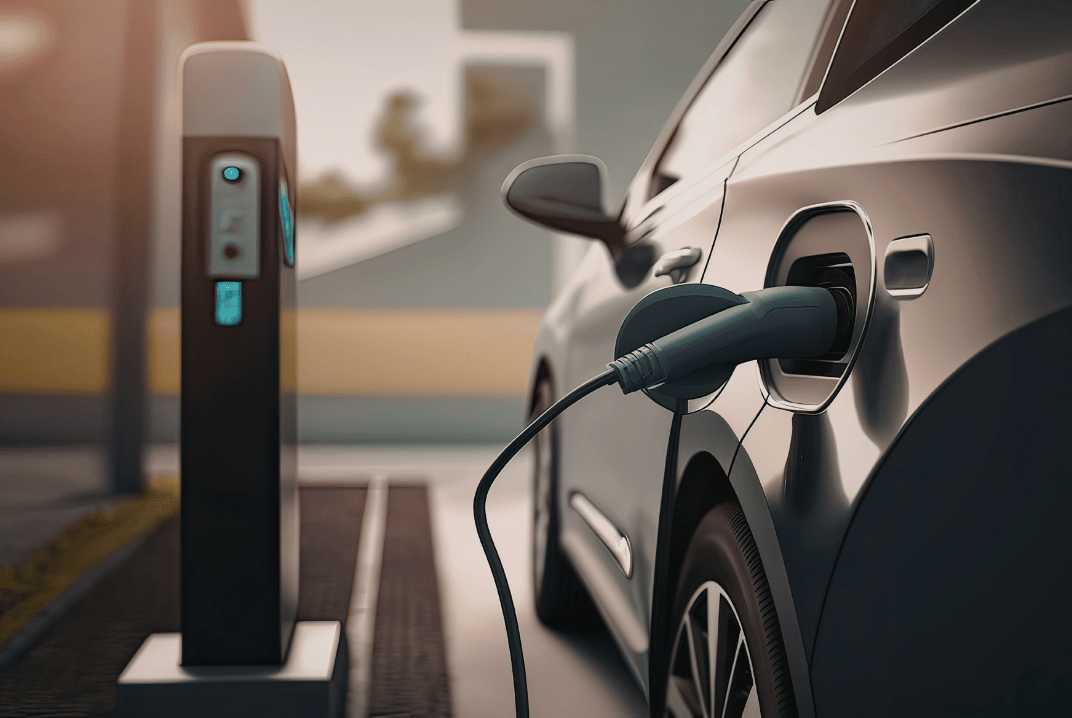
Florida sold over half a million electric vehicles by the end of 2025. In just the third quarter, one out of every eight cars sold in the state was electric. Tampa Bay is part of that trend, and it’s not slowing down.
It makes sense. Gas prices keep rising, technology keeps improving, and electric vehicles no longer feel like a risky bet. But there’s one part of the conversation almost no one has before buying: what happens to the battery when it reaches the end of its life?
This isn’t a minor detail. The battery is the most expensive component of the vehicle and also the most complex to handle at the end of its lifecycle. Here’s what you need to know before you sign.
Most manufacturers warranty their batteries for 8 to 10 years, or between 100,000 and 150,000 miles, whichever comes first. Under normal conditions, a battery can last between 10 and 15 years before its capacity drops enough to require replacement.
What changes over time isn’t that the battery suddenly stops working, but that it gradually loses capacity. A car that once reached 300 miles on a full charge might only reach 240 miles after several years. At some point, the range is no longer practical for the owner, even if the battery still technically works.
That’s when the question of what to do with it becomes real.
A typical electric vehicle battery contains lithium, cobalt, nickel, manganese, and copper, among other materials. Some of these metals are scarce and expensive to extract. Others are directly hazardous if they end up in a landfill.
The good news is that those same materials can be recovered and reused almost indefinitely through recycling. Lithium recovered from an old battery can end up in a new one. The same goes for cobalt and nickel.
The problem is that to get there, the battery has to go through a certified recycling process. And that’s where many EV owners don’t know what to do.
No. And in Florida, doing so has legal consequences.
Lithium batteries are classified as hazardous waste. They can’t go in regular trash, neighborhood recycling bins, or standard landfills. If damaged or punctured, they can cause fires that are extremely difficult to extinguish.
Hillsborough County has drop-off points for small lithium batteries, like those in laptops and phones. But large EV batteries are a different category. They require certified facilities with specialized equipment to handle them safely.
Return to the manufacturer or dealership
Some manufacturers offer end-of-life return programs. Audi, for example, has partnered with Redwood Materials to recover lithium batteries and devices. If you purchased your EV through a local dealership, it’s worth asking if they have an active program.
Recycle through a certified recycler
This is the most direct and documented route. A certified R2v3 recycler like eSmart Recycling can coordinate pickup, safe handling, and proper processing of electronic equipment, including lithium battery components. The process generates documentation you can keep as proof of responsible disposal.
Second life as energy storage
Some batteries that are no longer suitable for vehicles still have enough capacity for other uses, such as solar energy storage in homes or businesses. This is a growing market, especially in Florida where solar adoption is strong.
Because buying an electric vehicle in 2026 comes with questions that go beyond price and range. Federal tax credits ended in September 2025. Tariffs are increasing the cost of some imported models. And total cost of ownership now includes a question no one used to ask: how much does it cost to properly dispose of the battery when the time comes?
It’s not a cost you’ll face tomorrow, but it’s a real one. Some estimates place battery replacement between $5,000 and $20,000, depending on the model, although prices have dropped in recent years. End-of-life recycling also carries a cost, depending on the size of the battery and who handles it.
Knowing this before you buy is part of making an informed decision.
The global EV battery recycling market is growing fast. In January 2026, Redwood Materials opened a facility in South Carolina capable of processing the equivalent of 10 gigawatt-hours of battery waste per year.
In Florida, infrastructure for large battery recycling is still developing. There are multiple drop-off points for small lithium batteries across the Tampa Bay area, but for EV batteries, coordination needs to be done directly with certified facilities.
At eSmart Recycling, we work with all types of electronic equipment across the Tampa Bay area. If you have questions about handling battery components or electronics related to your EV, we can guide you through the available options.
Can you recycle an EV battery for free in Tampa?
It depends on the size and type of battery. Small lithium batteries often have free drop-off points at local retailers. Large EV batteries usually involve handling and processing costs. Some manufacturers absorb those costs as part of extended responsibility programs.
What happens to the battery when I sell my used EV?
The battery stays with the vehicle. The new owner assumes responsibility at the end of its lifecycle. That’s why it’s important to review battery health and charge cycle history before buying a used EV in Tampa Bay.
How fast do EV batteries degrade in Florida’s climate?
Heat accelerates lithium battery degradation. Florida is one of the states where this factor matters most. Frequently charging to 100% and leaving the car exposed to heat for long periods can shorten battery life faster than in colder climates. Manufacturers typically recommend keeping charge levels between 20% and 80% to maximize longevity.
Buying an electric vehicle in 2026 in Florida still makes sense for many drivers, especially with rising gas prices and expanding charging infrastructure across the state. But the full decision includes understanding what happens to the car—and its battery—10 or 15 years down the line.

Samsung Messages is being discontinued in 2026. If you’re still using a Samsung device and haven’t switched to Google Messages, you will soon. And that change is making a lot of people look at their old phone and think: what do I do with this now?
Some go into a drawer. Others get passed down to kids or family members. And many just sit on a nightstand while the person decides.
Here’s a straightforward breakdown of your options, and why the one most people choose is also the worst for your data security.
What most people do when they get a new phone is… nothing with the old one.
They migrate contacts, set up apps, and the previous phone gets forgotten. It ends up in a drawer, a box in the closet, or the bottom of a bag.
The problem is that the phone still has everything. Your text messages. Your Gmail account is possibly still active. Photos. Saved passwords in the browser. Banking apps that may still be authenticated.
That device isn’t harmless just because you don’t use it anymore. It’s a snapshot of your digital life from the day you stopped using it.
Trade-in for credit
Samsung and most carriers offer trade-in programs. You get credit toward your next device, and they handle the rest. If you go this route, make sure you do a factory reset AND remove your accounts before handing it over. Trade-in processes don’t always include proper data destruction.
Pass it to someone you trust
Giving it to a family member is fine, but do a factory reset first. Manually log out of every account: Google, Samsung, email, banking apps, everything. Don’t assume the reset does it all automatically.
Recycle it responsibly
This is the cleanest option if the phone is old, damaged, or just not worth passing on. At eSmart Recycling, we accept smartphones and other electronic devices, securely remove the data, and then evaluate whether the device can be refurbished and redistributed to families and students in the Tampa Bay area through the Digital Education Foundation.
Your old phone doesn’t have to become e-waste.
Sell it
Platforms like Facebook Marketplace or eBay can get you some money. Make sure data destruction is done before the phone changes hands. A factory reset alone is not enough when selling to a stranger.
If you’re handling it yourself, here’s what to do, in order:
Not directly. The discontinuation means the app stops working and is replaced by Google Messages. Your old messages from Samsung Messages may not transfer automatically, but they can still exist as cached data on the device if you haven’t wiped it.
That’s a good reason to deal with your old phone now instead of later. Data doesn’t expire or clean itself up. It stays there until something actively removes it.
Smartphones contain lithium, cobalt, gold, copper, and other materials that are valuable and potentially hazardous when they end up in a landfill. Florida has specific regulations around e-waste disposal, and simply throwing a phone in the trash is neither legal nor safe.
Recycling through a certified facility like eSmart Recycling ensures those materials are properly recovered, and the device either gets a second life or is processed without environmental harm.
eSmart Recycling is located at 5100 Vivian Place, Tampa, FL 33619. We accept phones, tablets, laptops, and other electronic devices from individuals and businesses across Hillsborough County and the Tampa Bay area.
You can drop it off during business hours or contact us to schedule a pickup if you have multiple devices.
Email us at info@esmartrecycling.com or call (813) 501-7768.






Did you enjoy our latest blog articles just above?
Subscribe to receive new stories, insights, and impact updates straight to your inbox.
We’ll send you curated content about our partners, recycling strategies, success stories, and how your involvement is driving change through technology access and digital empowerment.
💡 No spam, just the smart stuff.