

eRecycling News & articles
Join our community for exclusive insights, latest updates, and special offers delivered straight to your inbox.
Be part of the e-Revolution and subscribe to our newsletter

June 19, 2026
A printer that still works doesn’t automatically need to be replaced. The better question is whether it still has a place in your daily routine. Many printers spend years sitting in closets or garages as the way we work and study changes. If yours hasn’t been used in a long time, it may be time to decide whether it belongs in your home—or whether it’s ready for its next chapter.
Walk into almost any garage or storage closet, and there’s a good chance you’ll find a printer quietly waiting on a shelf.
The power cable is still wrapped around it. There’s probably a stack of unused paper nearby and maybe even a few unopened ink cartridges. Nothing appears to be wrong with it. If you plugged it in today, it would probably print just as it did years ago.
And yet it hasn’t been part of your routine for a very long time.
Unlike a broken appliance, a working printer creates a different kind of question. Throwing it away doesn’t seem right, but keeping it forever doesn’t feel like the perfect answer either.
Why do so many working printers end up in storage?
There was a time when printers were essential in almost every home. Homework, travel itineraries, recipes, tax documents, family photos, and permission slips all seemed to pass through them at one point.
Then, everyday habits slowly changed.
Cloud storage replaced filing cabinets. Digital signatures became widely accepted. Schools and businesses adopted online platforms, and many forms that once required paper moved to a screen instead. Even airline tickets and restaurant menus became something we carried on our phones instead of in our hands.
The printer didn’t stop working.
Our routines simply stopped asking for it every day.
That’s why so many households still own perfectly functional printers that haven’t been turned on in years. They weren’t retired because they failed. They were quietly left behind as everyday life evolved.
Should you keep a printer that still works?
The answer depends less on the printer and more on your routine.
Some families still print school assignments every week. Home offices regularly need invoices, contracts, shipping labels, or signed paperwork. Photographers, artists, and small businesses may rely on printed materials every day.
For those situations, keeping a reliable printer makes complete sense.
For many other households, however, printing has become an occasional task. A nearby shipping center, office supply store, library, or workplace may already cover those needs. If your printer hasn’t been used for several years, it’s worth asking whether you’re keeping it because it’s useful—or simply because nobody has decided what to do with it.
What should you do before recycling a printer?
Many people are surprised to learn that some printers store information.
Depending on the model, a printer may contain Wi-Fi settings, saved network credentials, print history, scanned documents, address books, or internal memory used to process print jobs. Business printers and multifunction devices often store even more information than home models.
Before letting a printer leave your home or office, it’s worth reviewing the manufacturer’s instructions to reset or erase stored data whenever that option is available.
Once that’s done, the next step is deciding where the printer should go.
At eSmart Recycling, we accept inkjet printers, laser printers, all-in-one printers, commercial office printers, and multifunction devices, along with computers, laptops, networking equipment, monitors, phones, cables, and many other electronics. Every printer is evaluated individually to determine whether it can continue serving another purpose or whether its materials should be responsibly recovered. For devices that store information, secure data handling is also part of the process.
What happens after a printer is recycled?
Many people assume the story ends once the printer leaves the house.
In reality, that’s where a different process begins.
Some printers still have years of useful life ahead of them and may be suitable for refurbishment. Others contain metals, plastics, and electronic components that can be recovered and returned to manufacturing instead of remaining in storage or ending up in a landfill.
Giving a printer a responsible destination isn’t only about clearing shelf space. It’s also about making sure the materials and information it contains are handled appropriately.
A printer that still works isn’t automatically a printer you still need.
Technology changes alongside our habits, and a device that once played an important role may quietly become something we rarely think about. That doesn’t mean it has lost its value. It simply means its purpose may have changed.
If your printer still supports your work, your business, or your family’s daily routine, it has earned its place. If it has spent years collecting dust on a shelf, it may be time to let it begin a different chapter.
Sometimes the best question isn’t “Does it still work?”
It’s “Does it still have a job to do?”

June 18, 2026
Most people would answer with their smartphone or laptop. Yet the device that quietly supports much of daily life is usually the one that receives the least attention. A Wi-Fi router connects phones, computers, TVs, security cameras, and dozens of other devices at the same time. As long as it works, nobody thinks about it. The moment it stops, the entire routine begins to change.
Try a simple exercise.
Look around your home and ask yourself which device matters the most. Your first answer will probably be your smartphone. Maybe it’s your laptop because you work from it every day. Some people might even choose the television because it’s where the family gathers at the end of the day.
All of those answers make sense. They’re the devices we interact with the most, the ones we touch, carry, and rely on from morning until night.
But there’s another device quietly sitting on a shelf, behind a piece of furniture, or next to your modem. You probably haven’t looked at it today. In fact, you may not remember the last time you thought about it at all.
Why does the smartphone feel like the most important device?
Few pieces of technology have become as central to everyday life as the smartphone. It wakes us up in the morning, checks the weather, guides us through traffic, stores our boarding passes, lets us pay for groceries, keeps us in touch with family, and captures thousands of photos along the way.
Because it’s always within reach, it naturally feels like the center of our digital lives.
Yet many of those everyday actions depend on something we rarely notice. Maps need an internet connection. Video calls rely on stable networks. Streaming music, cloud backups, smart home controls, and countless apps all work best when another device quietly keeps everything connected.
That invisible partner is the Wi-Fi router.
Why is the router so easy to forget?
The router succeeds because it stays out of the spotlight.
Unlike a phone or laptop, it isn’t designed to attract attention. Its entire purpose is to create connections between every internet-enabled device inside the house. Phones, computers, gaming consoles, streaming services, printers, smart speakers, security systems, and tablets all depend on it without ever acknowledging its role.
Then one afternoon, the connection disappears.
The television stops buffering. Video meetings freeze. Security cameras go offline. Smart speakers suddenly become silent. Even the phone in your pocket begins to lose many of the features you rely on every day.
That’s usually the moment people remember exactly where the router is located.
Where does the laptop fit into all of this?
While smartphones became the tool for quick interactions, laptops remained the place where ideas take shape.
Reports are written there. Businesses are managed there. Students complete assignments, designers edit images, developers build software, and professionals spend hours working on projects that simply feel more comfortable on a larger screen with a physical keyboard.
Rather than competing with smartphones, laptops complement them. Each device serves a different purpose, and together they create the workflow many households depend on every day.
Remove one, and adjustments become necessary.
Remove all three, and the rhythm of the day changes completely.
So, what is the most important device?
There may not be a single correct answer.
If the question is based on usage, the smartphone probably wins. If productivity matters most, many people would choose the laptop. But if the goal is keeping every connected device working together, the router quietly becomes one of the most important pieces of technology in the entire house.
Perhaps the better question isn’t which device matters most.
Perhaps it’s which one you notice only after it’s gone.
That answer says a great deal about the way modern homes work.
What happens when it’s time to replace these devices?
Eventually, every device reaches the end of its everyday role. A new phone replaces the old one. A faster laptop arrives. A more powerful router takes over as more connected devices fill the house.
The previous equipment rarely leaves immediately.
Instead, it finds a place inside a drawer, a closet, or a storage box alongside cables and accessories collected over the years. Many of those devices still contain family photos, work documents, saved passwords, network settings, or other personal information. Some still work perfectly well and could continue serving another purpose.
At eSmart Recycling, we help families, businesses, schools, and organizations throughout Tampa Bay securely manage those retired devices. Every piece of equipment goes through data handling and technical evaluation before determining whether it can be refurbished or responsibly recycled.
The answer to this question will probably be different in every home.
Some people will always choose their smartphone because it never leaves their side. Others will point to their laptop because it’s where they study, work, or create. Yet there’s another device quietly supporting all of them without asking for recognition.
The Wi-Fi router rarely appears in conversations about technology, but it makes much of modern life possible.
Sometimes the most important device isn’t the one you use the most.
It’s the one that keeps everything else connected.

June 18, 2026
Holding onto an old phone or a retired laptop rarely has anything to do with the space it takes up. These devices often hold photos, documents, conversations, and memories that have become part of our lives. They also represent a significant investment and the feeling that they might still be useful someday. Together, those reasons explain why millions of electronic devices remain tucked away in drawers and closets for years.
You’re looking for a spare battery when you come across an old smartphone you had completely forgotten about. Out of curiosity, you press the power button. The screen lights up, and within seconds, you’re looking at photos from nearly a decade ago. A few more taps reveal old conversations, family trips, birthdays, and people you haven’t spoken to in years.
In that moment, the phone stops feeling like a piece of technology.
It becomes a small time capsule.
Scenes like this happen every day in homes across the country. They also explain why getting rid of old technology often feels much harder than expected, even when those devices haven’t been used in years.
What are we really holding onto?
At first glance, it looks like we’re keeping an old phone, a laptop, or a digital camera.
In reality, we’re often holding onto the moments that happened while those devices were part of our lives. A laptop may contain the first résumé we ever wrote, college assignments, or thousands of family photos. A smartphone may hold years of conversations, contacts, and milestones that helped shape important chapters of our lives.
That’s why an old phone rarely feels like an ordinary object.
Its value isn’t measured by the materials it’s made from. It’s measured by the memories attached to it.
Even when those files have already been backed up somewhere else, the original device often carries an emotional weight that’s difficult to explain.
Why do we always think we’ll need it someday?
Almost every forgotten device shares the same story.
“I’ll keep it… just in case.”
The decision makes perfect sense. Technology represents a meaningful purchase, and if a device still works, keeping it feels like the responsible choice. Maybe a family member will need it. Maybe it will become a backup computer. It may be useful for a future project.
Then life moves on.
A newer phone replaces the old one. A faster laptop arrives. The internet provider installs a new router. The previous device quietly moves from the desk to a drawer, from the drawer to a closet, and eventually into a storage box.
Without realizing it, many households begin building a quiet collection of technology that no longer plays a role in everyday life.
Does the information stored inside make it even harder?
Absolutely.
Many people know their old devices still contain personal information, but they aren’t sure how to remove it safely. Family photos, financial records, work documents, saved passwords, emails, and personal accounts may all remain inside a laptop or smartphone that hasn’t been powered on in years.
That uncertainty often delays the decision.
Leaving the device in a drawer feels easier than figuring out what to do next.
The problem is that time doesn’t erase the information stored inside. Even after years of sitting untouched, those files are often still there, waiting for someone to decide their future.
When do we finally notice how much we’ve accumulated?
For many people, the answer is simple.
During a move.
Or while cleaning out a garage.
Or when renovating a home.
That’s when forgotten smartphones, dusty laptops, retired Wi-Fi routers, external hard drives, and boxes full of tangled cables suddenly return to view. What seemed like a single forgotten device turns out to be years of technology quietly stored away.
It’s also the moment when one question naturally comes to mind.
Do I really need to keep all of this?
At eSmart Recycling, we hear that question every day. Families and businesses throughout Tampa Bay often arrive with boxes filled with electronics they’ve been meaning to sort through for years. Every device undergoes secure data handling and technical evaluation to determine whether it can be refurbished or responsibly recycled.
Perhaps the reason it’s so difficult to let go of old technology has very little to do with technology itself.
A smartphone represents a chapter of life. A laptop may hold years of work, learning, creativity, and family memories. Even an old Wi-Fi router can remind us of the time our home first became filled with connected devices.
Keeping those items for a while is perfectly understandable. The challenge begins when “for a while” quietly turns into years, and drawers slowly fill with devices that have already completed their purpose.
The next time you discover an old phone at the back of a drawer, you probably won’t just remember the moments you shared with it.
You may also start thinking about what the next chapter should be.

June 18, 2026
Moving has a way of bringing forgotten technology back into view. As closets, drawers, and storage shelves are emptied, old phones, Wi-Fi routers, laptops, cables, and printers suddenly reappear. These forgotten devices tell the story of how our technology changes over time—and they also remind us that every piece of tech eventually needs a new destination.
Moving to a new home has an unexpected side effect.
As furniture is pulled away from the walls and storage boxes come down from the highest shelves, objects that haven’t been touched in years suddenly return to everyday life. A forgotten box in the back of a closet. A drawer that hasn’t been opened since the last renovation. A shelf where old electronics quietly waited while newer devices took their place.
Before long, technology you had completely forgotten about is sitting on the floor, waiting to be packed.
It’s a familiar scene. Almost everyone who has moved recognizes it.
Why do so many devices resurface during a move?
Moving changes the way we look at our belongings.
Instead of seeing individual objects, we begin noticing everything we’ve accumulated over the years. Electronics often become one of the biggest surprises.
Every phone upgrade, every new laptop, and every internet service replacement usually leaves another device behind. Rather than leaving the house immediately, those devices are placed in a drawer or closet with the idea that they might be useful someday.
That “someday” often turns into several years.
Packing everything into boxes simply forces us to ask a question we’ve postponed for a long time.
Do I still need to keep all of this?
Which five devices almost always come back?
1. The smartphone you replaced years ago
It usually appears inside a drawer alongside old chargers and headphones that no longer match any current device. Many people kept it because it still worked or because it contained photos, messages, and personal files they never got around to organizing.
2. The old Wi-Fi router
Changing internet providers or upgrading home networking equipment often leaves an older router behind. After a few years, it’s easy to forget where it came from or why it was saved in the first place.
3. The laptop kept “just in case”
It handled work projects, school assignments, family photos, and countless everyday tasks before a newer computer took its place. Even after years in storage, many of these laptops still contain important documents and personal information.
4. The famous box of cables
Almost every household has one.
Inside are HDMI cables, USB cables from different generations, power adapters, charging bricks, extension cords, and connectors whose original purpose is impossible to remember. Somehow, that box survives every move.
5. The printer that quietly retired
For years, it was an essential part of the home office. Then digital signatures, cloud storage, and paperless workflows became more common. The printer was unplugged one day with every intention of using it again, but it never returned to the desk.
What do these forgotten devices have in common?
Each one represents a different chapter of daily life.
An old phone may still hold photos from family vacations. A laptop might contain the first résumé someone ever wrote or documents from a business that no longer exists. Even an outdated router reminds us of the moment the household first became filled with connected devices.
That emotional connection explains why these devices often remain in storage long after they stop being useful.
At the same time, many still contain sensitive information. Personal documents, saved passwords, financial records, work files, and private photos often remain stored on devices that haven’t been powered on for years.
A move becomes the perfect opportunity to decide what deserves to stay and what has already completed its purpose.
What should you do after the move?
Once the boxes are unpacked, it’s surprisingly easy to place those forgotten devices back into another closet and promise to deal with them later.
Many people do exactly that.
However, spending a little time sorting through old electronics can free up valuable storage space while ensuring that personal information is handled responsibly. Some devices may still have useful life left, while others contain materials that can be properly recovered instead of remaining forgotten for another decade.
At eSmart Recycling, we help households, businesses, schools, and organizations throughout Tampa Bay responsibly manage retired electronics. Smartphones, laptops, routers, printers, monitors, cables, and many other devices go through secure data handling and technical evaluation before determining whether they can be refurbished or responsibly recycled.
Moving doesn’t just change your address.
It also gives you the chance to rediscover pieces of your own digital history.
The forgotten phone tucked away in a drawer, the dusty laptop sitting on a shelf, and the mysterious box of cables all represent moments when new technology entered your life and quietly pushed something older aside.
Some of those devices still hold valuable memories. Others may still be useful. Many are simply waiting for someone to decide what comes next.
The next time a move uncovers a pile of forgotten electronics, the most interesting question may not be “Why did I keep this?” but “What should its next chapter be?”

June 18, 2026
Yes, you could spend a day without them. But that day would look very different from the one you’re used to. Your smartphone, Wi-Fi router, and laptop quietly support dozens of everyday activities, from the moment you wake up until the end of the day. Their importance becomes obvious only when they are no longer there.
It’s seven o’clock on a weekday morning in Tampa Bay, and a simple experiment is about to begin. For the next 24 hours, your smartphone stays in a drawer, the Wi-Fi router remains unplugged, and your laptop never leaves its bag.
At first, it doesn’t sound like much of a challenge.
Then the morning starts.
The alarm never rings because it was set on your phone. You wake up later than expected and instinctively reach toward the nightstand, only to remember the experiment. There’s no weather forecast before getting dressed, no overnight messages waiting to be read, no traffic update before leaving the house. The day continues, but it already feels slightly unfamiliar.
That’s when something interesting happens.
You don’t necessarily miss the devices themselves. You miss the small habits that quietly formed around them over the years.
How many times do you use your phone without realizing it?
Most people think of their smartphone as a communication device, but it quietly handles much more than calls and messages. It serves as an alarm clock, calendar, GPS, digital wallet, camera, music player, authentication key, calculator, flashlight, and gateway to countless services.
Many of those interactions last only a few seconds. They happen so naturally that they almost disappear from memory. Few people could accurately estimate how many times they unlock their phone during a typical day because the gesture has become part of everyday life.
Without it, none of those activities would become impossible. They simply require different solutions. Looking up directions takes longer. A quick payment becomes less convenient. A reminder stored inside an app no longer appears at the right moment. Small adjustments begin adding up until the rhythm of the day feels noticeably different.
Why does the Wi-Fi router become important only when it stops working?
By the time you return home, the second part of the experiment begins.
The router is still unplugged.
The television struggles to load a movie. Security cameras lose their connection. A scheduled video call never starts. Smart speakers remain silent, and several connected devices simply wait for a signal that never arrives.
The Wi-Fi router has an unusual role inside most homes. It does its job without asking for attention. As long as everything works, it’s easy to forget that it’s even there.
Yet that small box quietly coordinates much of the digital activity happening inside the house. It connects computers, streaming devices, phones, tablets, gaming consoles, printers, and countless smart home products that many families now rely on every day.
Its absence quickly reminds us how connected modern life has become.
Does the laptop still matter in a mobile-first world?
For years, many people believed smartphones would eventually replace laptops.
Instead, each device found its own purpose.
Phones became the perfect tool for quick interactions, while laptops remained the preferred space for work that requires focus, larger screens, and the ability to manage multiple tasks at once.
Presentations are built there. Reports are written there. Businesses are managed there. Students complete assignments, designers create content, and professionals spend hours working on projects that simply feel more comfortable on a computer.
Even households where every family member owns a smartphone often continue sharing one or more laptops because they support activities that benefit from a keyboard, a larger display, and greater processing power.
During this experiment, many of those tasks would simply have to wait.
So… could you really spend a day without these three devices?
The answer is still yes.
People lived for generations without smartphones, wireless internet, or laptops.
The more interesting question is how many routines would quietly change during those twenty-four hours.
You might postpone a virtual meeting, delay responding to an important email, struggle to access documents stored online, or discover that a recipe, boarding pass, or medical appointment was saved inside a device that’s no longer available.
None of these situations would ruin the day on their own.
Together, however, they reveal how deeply these technologies have become woven into everyday life.
Perhaps that’s why replacing them isn’t always as simple as buying something new.
What happens after these devices leave your daily routine?
Every device eventually reaches a point where it is replaced by something newer.
The smartphone moves into a drawer. The laptop is stored in a closet “just in case.” The old router ends up inside a box filled with cables that nobody remembers collecting.
Months become years, and those forgotten devices begin telling the story of how technology accumulates inside our homes.
Many still contain family photos, financial information, work documents, passwords, or personal files. Some continue working perfectly well and could serve another purpose. Others have reached the end of their useful life but still contain valuable materials that deserve proper recovery.
At eSmart Recycling, we receive these devices every day from homes, businesses, schools, and organizations throughout Tampa Bay. Each one goes through secure data handling and technical evaluation before determining whether it should be refurbished or responsibly recycled.
Every device deserves a thoughtful ending, just as it once played an important role in someone’s everyday life.
The question that opened this article seemed simple: Could you spend a day without these three devices?
After following that experiment from morning to night, the answer remains yes. Yet it also becomes clear that our routines have quietly adapted to the presence of these technologies over many years.
Your phone, router, and laptop are more than electronic devices. They help organize schedules, connect families, support education, enable remote work, and make hundreds of everyday tasks feel effortless. Their greatest achievement may be that they work so seamlessly we rarely stop to notice them.
That same familiarity often explains why old devices remain stored away long after they’ve been replaced. A forgotten laptop may still hold years of memories. An old smartphone may contain personal information. A router that once connected an entire household becomes another object sitting on a shelf.
Technology shapes our daily lives while we use it, but its story doesn’t end when we unplug it.
Choosing what happens next is part of that story, too.

June 8, 2026
If your earbuds have stopped charging, it may be worth checking a few things before replacing them. In many cases, the issue is related to the charging case, the charging contacts, or normal battery wear over time. And when it finally comes time to part with them, earbuds can be recycled alongside other electronics you no longer use.
Earbuds have one major advantage over most devices: they’re small, lightweight, and easy to carry everywhere.
They also come with a small drawback.
Because they’re so easy to carry, they tend to become part of everyday life without us giving them much thought.
They travel in pockets, backpacks, gym bags, and car cup holders. They come to work, on trips, and on daily walks. That’s why it feels a little surprising when one suddenly stops charging. It worked perfectly yesterday, and today it seems to have completely given up.
The first reaction is usually the same. Try a different cable. Switch outlets. Check the case. Give it one more try.
And honestly, that makes sense. Sometimes the problem is exactly one of those things.
What usually happens when an earbud stops charging?
The most common causes are often less dramatic than people expect.
Over time, dust and debris can build up on the charging contacts where the earbuds connect to the case. It’s a normal consequence of carrying them around every day.
The charging case can also be part of the story. After all, it contains a battery too, and that battery works every time you use your earbuds.
Then there’s simple battery aging. Earbuds go through hundreds of charging cycles during their lifetime. Eventually, the batteries begin holding less energy than they once did. The same thing happens with phones, tablets, laptops, and virtually every portable electronic device.
The moment earbuds stop being part of the routine
When people stop using their earbuds, they rarely make a big decision about them.
Most of the time, they end up in a drawer.
What’s interesting is that they rarely end up there alone.
At eSmart Recycling, we see the same situation all the time. Someone decides to clean out a room, organize a closet, or clear space in a home office. They start looking for an old laptop or monitor and end up discovering much more than they expected.
Old smartphones show up. Forgotten tablets. Charging cables. Power adapters. Routers. Keyboards. Accessories from devices that haven’t been used in years.
And somewhere in that collection, there is often a pair of earbuds that quietly disappeared from daily life a long time ago.
Small electronics have a remarkable ability to stay with us simply because they take up so little space.
Can earbuds be recycled?
Yes, and many people are surprised to learn that.
Even though they are small, earbuds contain batteries and electronic components that should be handled properly when they reach the end of their useful life. The same applies to the charging case.
Many people associate electronics recycling with computers, monitors, or printers. In reality, a large portion of the devices we receive are everyday electronics and accessories that gradually accumulated over the years.
That’s why it’s common to find earbuds in the same box as old phones, tablets, chargers, and cables.
What should you do with earbuds you no longer use?
If they still work, they may be useful to someone else.
If they have reached the end of their lifespan, they can be recycled along with other electronics you have stored at home.
And if you haven’t looked through that drawer in a while, there’s a good chance your earbuds aren’t the only devices waiting there.
Why does only one earbud stop charging?
It can be caused by dirty charging contacts, battery wear, or issues with the charging case.
Can the charging case stop working too?
Yes. The case contains electronic components and its own battery, so it can experience wear over time.
Do earbuds contain rechargeable batteries?
Yes. Most earbuds use lithium-ion batteries.
What other devices does eSmart Recycling accept?
We accept computers, laptops, phones, tablets, monitors, printers, routers, cables, chargers, and many other electronic devices.
Where can I recycle earbuds in Tampa?
You can bring them to eSmart Recycling along with other electronics for proper end-of-life management.
Earbuds are often one of the first things people find when they start going through old electronics at home. And more often than not, they become a reminder of something bigger: how much technology we keep long after we’ve stopped using it.
June 8, 2026
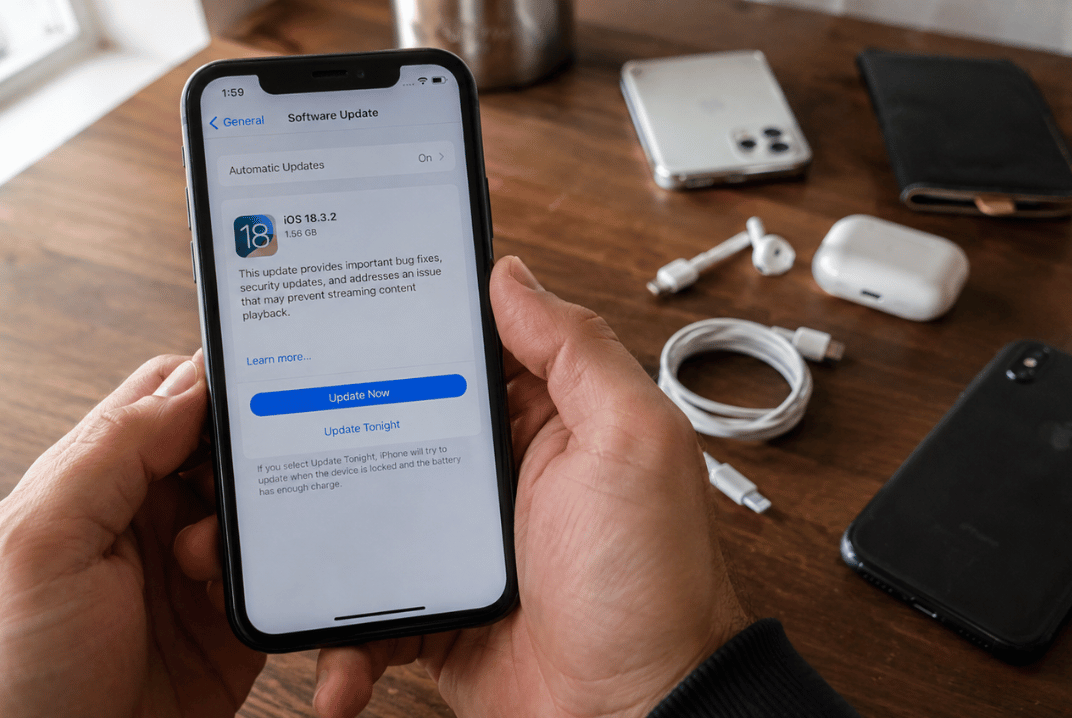
Users of the iPhone XR, iPhone XS, and iPhone XS Max discovered something new when Apple introduced iOS 26: those models are no longer included on the list of compatible devices. These phones will continue serving their owners just as they did before, but the new features arriving with iOS 26 will be available on newer models. The announcement also opens an interesting conversation about the lifespan of technology and what happens to devices when it’s time to move on.
The scene repeats itself every year.
Apple unveils a new version of iOS. New features appear. Videos start circulating. Screenshots fill social media. Then someone opens Google and types a very simple question:
“Is my iPhone compatible?”
This year, many owners of the iPhone XR, XS, and XS Max found themselves checking that list a little more carefully.
Which iPhones are compatible with iOS 26?
Apple confirmed that iOS 26 will be available for the iPhone 11 lineup and newer models.
That means the iPhone XR, iPhone XS, and iPhone XS Max have reached the end of a long chapter in Apple’s update cycle.
And honestly, that is a pretty impressive run.
The iPhone XR arrived in 2018. Since then, it has received years of software updates, security improvements, design changes, and new features. For a smartphone, that is a remarkably long lifespan.
What changes for people using these models?
The answer is simpler than many expect.
The phone you had yesterday is still the phone you have today.
Your photos are still there. Your messages are still there. Your apps continue working, and the device continues handling the tasks it performs every day.
The difference is that the new features introduced with iOS 26 will be reserved for devices that support the update.
For many users, that does not immediately change their daily routine.
In fact, plenty of people continue using their phones for years after their last major software update because the device still does exactly what they need it to do.
How long can an iPhone last after its final major update?
That depends on how it is used.
Some people mainly rely on their phones for calls, messaging, email, and photos. Others use them for work, content creation, or more demanding applications.
What makes this interesting is that a device’s useful life often extends well beyond its update cycle.
A phone can continue being a reliable companion simply because it still performs the tasks that matter to its owner.
That helps explain why iPhone XR devices remain common in homes, offices, schools, and small businesses.
What usually happens when people replace their phones?
A familiar image comes to mind.
A drawer.
Inside are old chargers, mystery cables, and often one or two smartphones that worked perfectly well when they were put away.
Every new generation of devices adds a few more to that collection.
Phones tend to stay stored because they contain photos, account access, documents, and years of personal memories.
That is why people often take time to back up their information before deciding what comes next.
Some devices are passed along to family members.
Some become backup phones.
Many find a second life through technology reuse programs.
Others enter electronics recycling streams where valuable materials and components can be recovered and used again.
Why does this news matter?
Because it reflects something larger about the way we use technology.
Devices stay with us for years. They collect memories, conversations, contacts, and daily habits.
Every major software update becomes a reminder of that relationship.
The story is not just about software.
It is also about how long we keep our devices, how we extend their usefulness, and what choices we make when it is finally time for something new.
Does my iPhone XR still work if it does not receive iOS 26?
Yes. The device continues performing its everyday functions and can remain useful for many common tasks.
Is the iPhone XS still good for daily use?
For many users, absolutely. It depends on the apps and activities that are part of their routine.
How can I check which iPhone model I have?
You can find it under Settings > General > About.
Which iPhones support iOS 26?
Apple confirmed compatibility beginning with the iPhone 11 family and newer models.
What can I do with an iPhone I no longer use?
You can keep it, pass it along to someone else, donate it, or send it through a certified electronics recycling program.
Perhaps the most interesting part of this story is that many phones continue serving a purpose long after they leave someone’s pocket. Some help another user. Some contribute materials that can be recovered and reused. And quite a few are still waiting in that familiar drawer, sitting next to cables that seemed important enough to save years ago.
May 24, 2026
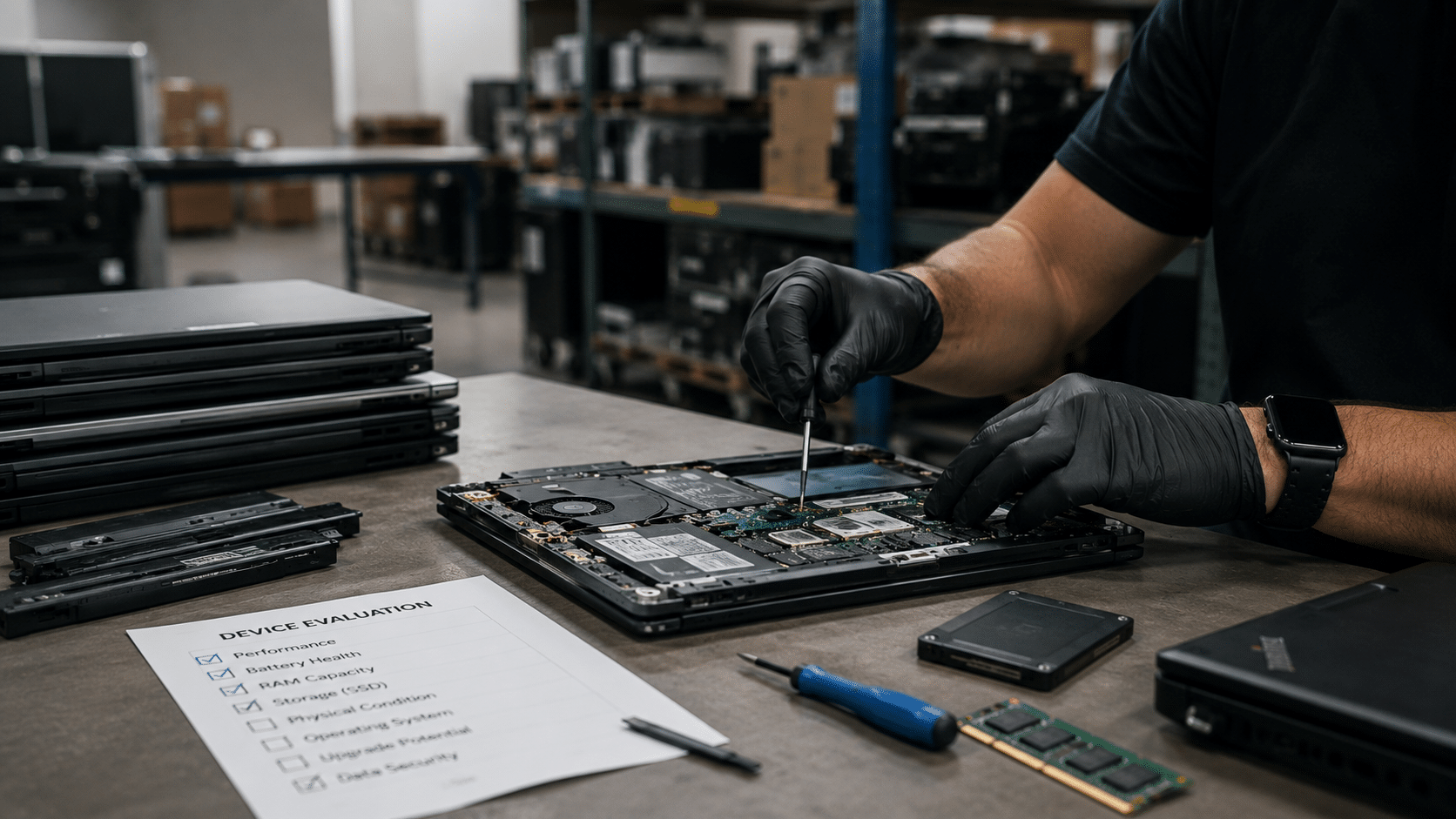
Extending the life of corporate laptops can help reduce costs before replacing an entire fleet. In many Tampa Bay companies, replacing a battery, upgrading RAM, or installing a new SSD can keep devices running for another one to three years. Recycling usually enters the conversation when the hardware starts creating constant issues, compatibility problems, or risks related to the data still stored inside those devices.
In a lot of offices, the situation starts pretty quietly. A couple of laptops get stored “for now,” then old chargers start piling up, disconnected docking stations appear, and a few monitors nobody uses anymore end up in the same corner. A few months later, that small area turns into an improvised storage room full of technology where nobody is completely sure what still works, what contains sensitive data, and what should already be removed from circulation.
That is usually when the IT team gets the question: Should these devices be repaired, or is it finally time to recycle them?
When is it worth extending the life of a corporate laptop?
Most corporate laptops have an average lifespan of three to five years, although many business-grade models can last longer with proper maintenance.
And in many cases, the issue is not the entire laptop. It is one specific component limiting performance.
An outdated SSD can make an otherwise solid laptop feel painfully slow. A degraded battery can affect an employee’s entire workday even when the rest of the hardware still performs well. The same thing happens with devices still running on 8GB RAM, while current corporate software demands much more than it did a few years ago.
In those situations, extending the laptop’s life can absolutely make financial and operational sense.
Especially when finance teams are reviewing budgets, and IT managers need to justify why certain devices can remain in use without affecting productivity.
What signs show it is finally time to recycle?
Some laptops start showing warning signs long before they completely stop working.
Devices taking several minutes to boot up, fans running constantly, failed software updates, or employees avoiding certain programs because they already know the system will freeze again.
Then another issue appears, and it is usually more serious: the information still stored inside those devices.
We receive corporate laptops that still contain active logins, financial documents, internal files, and customer data sitting inside drives that have spent years forgotten inside closets or office storage rooms.
That is why this decision rarely depends only on the physical condition of the device.
It also depends on operational risk and how much control the company still has over its information.
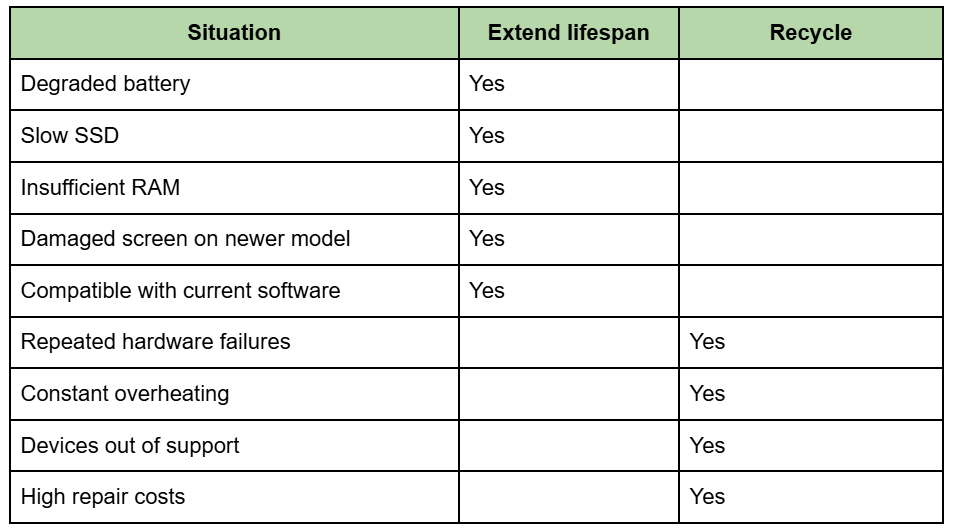
Once several of those issues start appearing together, the conversation usually changes pretty quickly.
How do IT managers usually make this decision?
In Tampa Bay, we see this situation all the time. Companies keep devices stored away for years because they technically still “work,” even though they already create operational problems every single day.
And there is an important difference there.
A laptop can still power on perfectly, but it no longer makes sense for a modern corporate environment.
Most IT managers end up evaluating four main things:
- Repair costs
- Compatibility with current software
- Employee productivity
- Risks related to stored data
Once several of those factors start declining at the same time, extending the device’s lifespan usually stops making sense for the company.
Where do we enter the process?
We help companies manage the full lifecycle of corporate devices, from pickup and inventory to secure data destruction.
Some organizations still reuse part of their fleet after simple upgrades. Others need to remove hundreds of laptops before a technology refresh, office relocation, or internal audit.
In both situations, we work with:
- Asset inventory
- Corporate pickups
- Secure data destruction
- Certificates of destruction
- R2v3 and HIPAA processing standards
- Responsible reuse evaluations
And yes, many times we find devices that could remain in service after basic maintenance. That is why reviewing equipment before recycling still matters.
The problem with storing laptops “just in case.”
Technology stored for too long slowly loses traceability.
Nobody remembers who last used the laptop. Nobody knows exactly what information was left inside. And the longer devices stay outside inventory systems, the harder it becomes to reconstruct what happened to each one.
That is usually when urgency starts showing up.
Because at that point, it is no longer only about freeing up office space. It becomes a question of recovering control over assets, information, and internal processes.
How long can a corporate laptop last?
Most corporate laptops last between three and five years, although many business models can continue operating longer with proper maintenance.
Is replacing RAM and batteries worth it?
Yes. In many cases, those upgrades can extend a laptop’s useful life by one to three additional years.
Do we offer corporate pickups in Tampa Bay?
Yes. We coordinate corporate pickups throughout Tampa and other areas of Tampa Bay.
What do we do with the data before recycling?
We apply secure data destruction processes and provide certificates once the process is completed.
What happens to laptops that still work?
Depending on the evaluation, some devices may continue being used or enter responsible reuse programs.
Corporate laptops rarely become useless overnight. Usually, the process happens gradually: small performance issues start appearing, some devices get stored away “to review later” and, by the time they show up again, they have already spent years collecting dust, data, and space inside the office.
Extending the life of those devices can help significantly when the hardware still performs well, and the costs continue making sense for the operation. But eventually, storing aging equipment starts creating more disorganization, less control over information, and more wasted time for IT teams.
And in most companies, that conversation arrives much earlier than people expect.
May 24, 2026
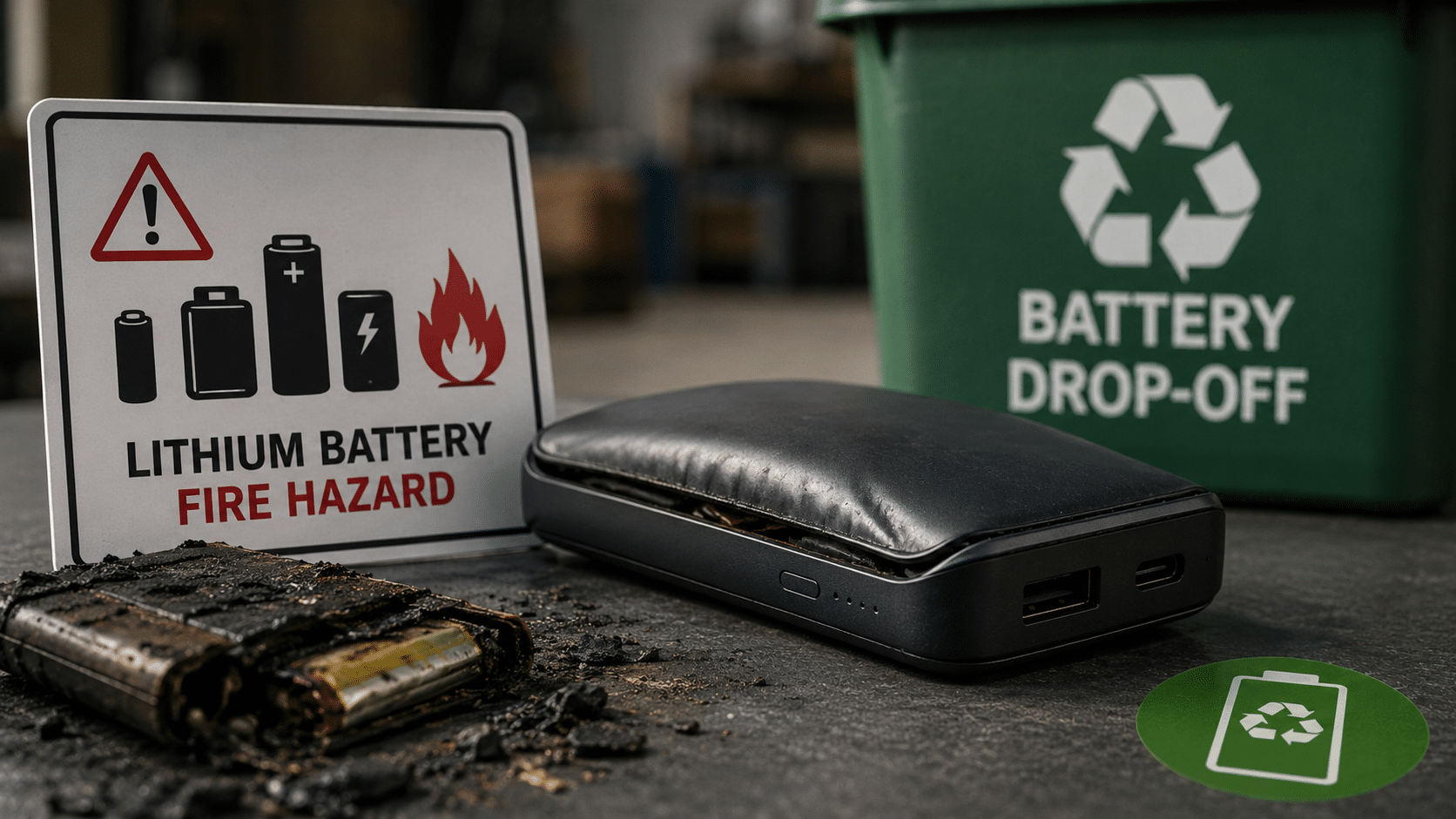
A power bank thrown into regular trash is a documented fire hazard. The lithium battery inside can trigger a chain reaction called thermal runaway when compressed inside a garbage truck or buried in a landfill. In Tampa Bay, Hillsborough and Pinellas County both have free drop-off locations for rechargeable batteries. At our warehouse at 5100 Vivian Place, Tampa, we also accept them as part of the electronics recycling process.
That swollen power bank that no longer charges. The one with the deformed casing that has been sitting in a drawer for months, because throwing it away feels wrong, but you also do not know exactly where to take it. That is the most dangerous one of all.
Why can a power bank in the trash start a fire?
The lithium battery inside a power bank stores chemical energy. When that battery suffers mechanical damage, like the type caused when garbage is compacted inside a truck, it can trigger what is known as thermal runaway: a chain reaction where heat creates more heat until the cell releases toxic gas, catches fire, or explodes.
Thermal runaway is a chain reaction where heat inside the battery generates even more heat until the cell ignites or violently ruptures. According to FAA testing, these fires can exceed 1,000°F (538°C). The gases released are toxic and flammable.
What makes power banks particularly dangerous compared to other devices is that their purpose is to store the highest possible amount of energy in the smallest possible space. More energy density means more risk if the cell fails.
In 2025, 448 publicly reported fires were recorded at waste and recycling facilities across the United States and Canada, surpassing the previous record of 430 in 2024 and nearly 25% above the annual average of 360 fires. Lithium batteries embedded in everyday consumer products have become the leading cause of fires at these facilities. Amdea
Some batteries can spark and ignite fires when crushed inside garbage or recycling trucks. These fires endanger workers, destroy expensive equipment, and ruin perfectly recyclable materials. euronews
How to know if your power bank has reached the end of its lifespan
Not all old power banks are dangerous in the same way. These are the clear signs that yours should no longer stay in a drawer.
Physical signs of deterioration:
- Swollen or deformed casing: the internal cell is generating gases. This is the most urgent warning sign.
- Excessive heat during charging: a healthy battery charges at room temperature.
- No longer holds a charge: if it retains less than 20% of its original capacity, its lifecycle is over.
- Chemical or metallic smell: indicates that internal gases are escaping.
Swollen or deformed casing: the internal cell is generating gases. This is the most urgent warning sign.
Excessive heat during charging: a healthy battery charges at room temperature.
No longer holds a charge: if it retains less than 20% of its original capacity, its lifecycle is over.
Chemical or metallic smell: indicates that internal gases are escaping.
Problems happen when users do not recognize warning signs such as swelling, excessive heat, or visible damage, or when devices are exposed to extreme temperatures, physical stress, or compression. Awareness Days
A swollen power bank should not be stored, charged, or thrown into regular trash. It should be taken directly to a damaged battery disposal location.
Drop off in Tampa with us
If the power bank comes together with other devices you are discarding, such as laptops, tablets, or phones, we accept everything at 5100 Vivian Place, Tampa, FL 33619. No cost, no sorting by type, and no special preparation required.
What you should not do with a damaged power bank
Two common mistakes that increase the risk:
- Try opening it or manually removing the battery. Hillsborough County explicitly warns residents not to attempt to remove or dismantle these batteries. A damaged cell handled without specialized equipment can trigger immediate ignition.
- Storing it indefinitely. A swollen battery stored in an enclosed space, especially during Tampa’s hot summers, has a higher risk of spontaneous failure. Heat accelerates internal degradation.
Try opening it or manually removing the battery. Hillsborough County explicitly warns residents not to attempt to remove or dismantle these batteries. A damaged cell handled without specialized equipment can trigger immediate ignition.
Storing it indefinitely. A swollen battery stored in an enclosed space, especially during Tampa’s hot summers, has a higher risk of spontaneous failure. Heat accelerates internal degradation.
Frequently asked questions about power banks and battery recycling
Can I throw a power bank into curbside recycling?
No. Rechargeable lithium batteries can explode when compressed, so they should never be placed in curbside recycling or regular trash containers. They require a designated drop-off location. ITU AbsorbTech
Is a swollen power bank urgent, or can I wait?
It is urgent. A deformed casing means the internal cell is actively generating gases. The longer it sits, the greater the risk of spontaneous ignition, especially in high temperatures.
Do you only accept power banks or also other battery-powered devices?
We accept power banks together with all other e-waste: laptops, phones, tablets, cables, and printers. Everything can be dropped off together in Tampa.
Is there a cost for dropping off a power bank at county locations?
At Hillsborough Community Collection Centers and Pinellas battery drop-off locations, rechargeable battery disposal is free for residents with a county-issued ID.
What happens to the materials inside the power bank after I drop it off?
Lithium cells are processed to recover lithium, cobalt, nickel, and copper. Those materials return to the manufacturing cycle for new batteries and electronic components.
That drawer has more than one old power bank in it. The hardest part is already done if you made it this far. The next step is taking it somewhere safe, not storing it.

May 24, 2026
Companies across the Tampa Bay metropolitan area have different options depending on the county where they operate. Hillsborough has the most accessible processes for businesses based in Tampa. Pinellas has specific monthly events for businesses, with variable costs depending on volume. Pasco offers occasional events mainly focused on residents, leaving businesses in the northern part of the metro area with fewer local alternatives. An R2v3-certified provider like eSmart Recycling covers all three counties with scheduled pickups and complete documentation.
Your headquarters matters less than it seems when it comes to recycling corporate equipment. What matters is understanding which options your company has based on where it is located, and which of those options generate the documentation you need for compliance.
What options does your company have depending on the county where it operates?
Hillsborough County: the most direct option for companies in Tampa
Hillsborough County Community Collection Centers are available for residents, but businesses are not authorized to use them. That eliminates the county’s free route for any company.
The county’s electronics recycling contract requires that data be securely erased and destroyed. What it does not require is documentation for the client company proving that process, because the program is designed for residents, not organizations with compliance requirements.
For a company in Tampa, Seffner, Brandon, or Plant City, the most direct route is a certified provider with a local presence in the county. We are located at 5100 Vivian Place, Tampa, FL 33619, with pickup capabilities throughout Hillsborough County. The process includes serialized inventory tracking, certified data destruction, and chain of custody reporting.
Hillsborough summary: no public channel for businesses, with full coverage available through R2v3-certified providers in Tampa.
Pinellas County: monthly events for businesses, with conditions
Pinellas County hosts electronics and chemical collection events specifically for businesses on the second Wednesday of every month. Businesses must qualify as a Very Small Quantity Generator (VSQG) of hazardous waste, meaning they generate less than 220 pounds of hazardous waste per month.
That covers many small businesses, but not companies retiring an entire laptop fleet or clearing out an IT room that has accumulated equipment for years. In addition, pricing is negotiated with the contractor Republic Services and subject to change, so businesses are advised to call (813) 319-3400 before attending to confirm fees and packaging restrictions.
The volume limitations and lack of data destruction documentation make this channel insufficient for companies with HIPAA, PCI-DSS, or security audit requirements. For organizations in St. Pete, Clearwater, or Largo, the only option that generates certificates of destruction with serial-number traceability is an R2v3-certified provider.
Pinellas summary: monthly events available for small businesses, without certificates of data destruction and with volume limits.
Pasco County: the county with the least corporate infrastructure
Pasco County organizes mobile hazardous waste and electronics collection events on an occasional basis. Those events charge a $5 fee for desktop computers, laptops, and monitors.
Pasco’s permanent disposal facilities accept electronics at two hazardous waste collection centers. However, none of these channels are designed for corporate-scale volumes or provide data destruction documentation.
For companies in Wesley Chapel, Land O’ Lakes, Lutz, or Zephyrhills, the gap is noticeable. The county’s public infrastructure serves residents. Businesses with accumulated equipment and compliance requirements need a provider that comes directly to them.
Pasco summary: no structured corporate channel, occasional resident-focused events, and no data destruction documentation.
What all three counties have in common
The pattern is consistent: public programs are designed for residents or very small volumes and do not provide documentation of data destruction. For any company with more than ten devices to remove, or with audit requirements, the only route that closes the process with verifiable documentation is an R2v3-certified provider operating across the metropolitan area.
We coordinate pickups across Hillsborough, Pinellas, and Pasco as a single process. If you have equipment in more than one county, we collect everything in one route and consolidate all documentation into a single report.
Frequently asked questions about corporate recycling in Tampa Bay
Does eSmart Recycling collect equipment outside Hillsborough County?
Yes. We coordinate pickups across Hillsborough, Pinellas, and Pasco. You can contact us at eSmart Recycling Contact Page or by calling (813) 501-7768 to schedule service from your location.
How many devices do I need to request a pickup?
There is no fixed minimum. We work with everything from small batches to full fleets. Volume determines logistics, not whether we can assist you.
Do county events provide certificates of data destruction?
In Hillsborough, Pinellas, and Pasco, public e-waste programs do not issue certificates of destruction with serial-number traceability. That documentation is generated exclusively by an R2v3-certified provider.
How long does the process take from pickup request to receiving documentation?
In most cases, between 24 and 48 hours from pickup to issuance of the certificate of destruction.
What happens if my company has equipment in more than one county?
We coordinate everything as a single process. We handle the multi-location pickup route and consolidate all documentation into one unified report.
Three counties, different rules, same problem: nobody wants to be responsible for that batch of laptops when it shows up during an audit. Contact us, and we will handle it from wherever you are.
May 24, 2026
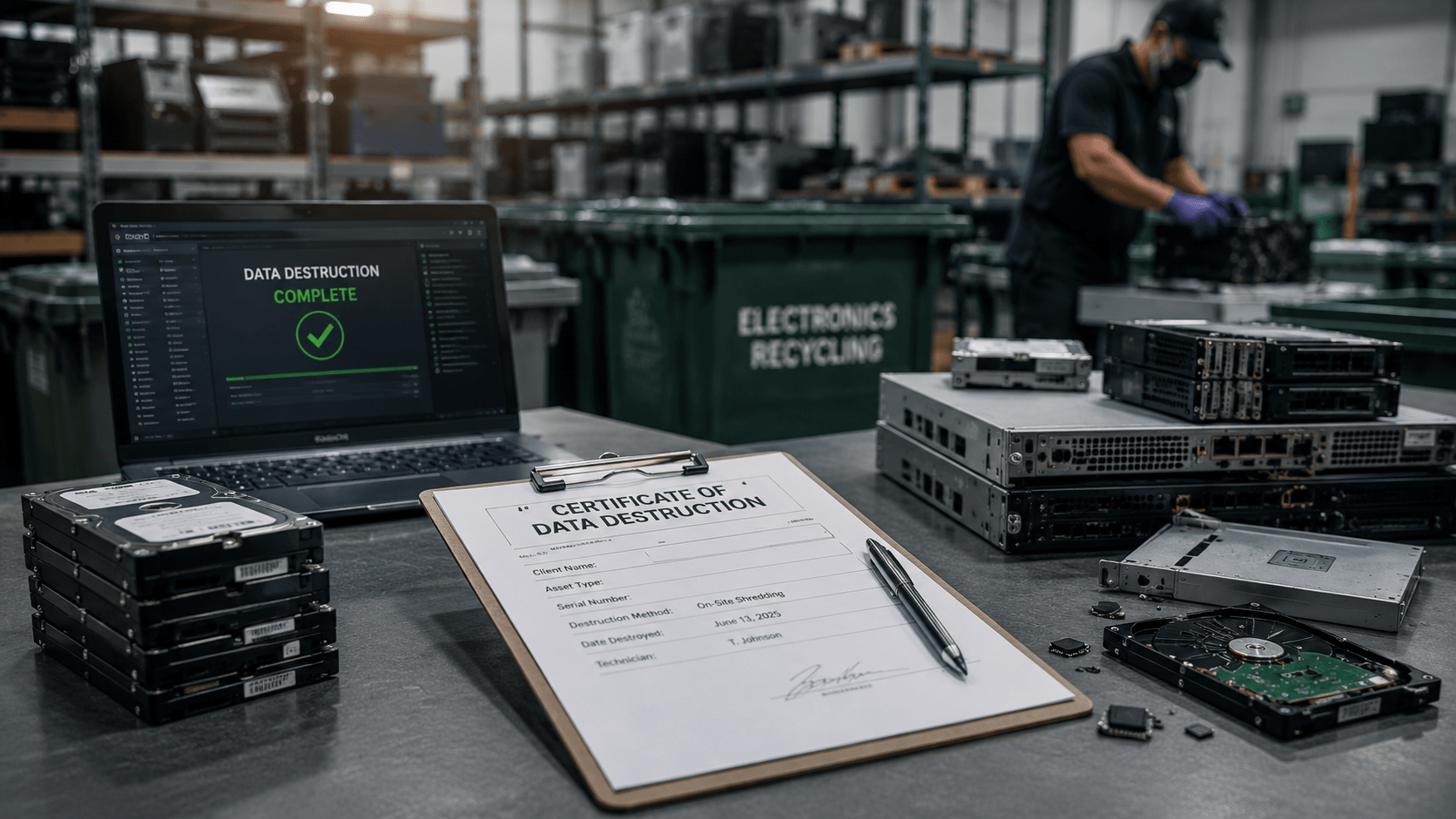
R2v3 is the most rigorous standard for corporate electronics recycling, developed by Sustainable Electronics Recycling International (SERI). It certifies that a provider protects the data stored on incoming devices, handles hazardous materials properly, and subjects its operations to annual independent audits. For a company in Tampa Bay, choosing a recycler without R2v3 means taking on a level of data risk that certified documentation is designed to eliminate.
That retired server has been sitting in the back room for nine months. Nobody touched it because nobody wants to be responsible for what happens next. That is exactly the moment when your vendor’s certification stops being a procurement detail and becomes the only thing protecting your company during an audit.
What does an R2v3 certification actually audit?
R2v3 requires recyclers to identify and track the materials and equipment they process, prioritize reuse and refurbishment before recycling, maintain certified environmental and health-and-safety management systems, and comply with all applicable labor, environmental, and data security laws.
R2v3-certified facilities also undergo strict annual audits performed by an independent third-party certification body. These audits verify that the company follows industry best practices for data security, electronics recycling, and sustainability.
What that means in practice is simple: this is not a certification a company earns once and hangs on a wall forever. Every year, an outside auditor reviews the entire process. If the provider changes how it handles materials or data and no longer meets the requirements, the certification can be revoked.
Companies regularly hand over old computers without properly wiping them, send servers to recyclers without verifying destruction methods, or dispose of hard drives without considering the sensitive information stored inside them.
Every one of those mistakes has consequences. Cybercriminals and identity thieves actively search for improperly discarded IT assets, monitoring e-waste collection points and online auctions. Some even pose as electronics recyclers.
The numbers behind that risk are very real. The average cost of a data breach in U.S. companies reached $10.22 million in 2025, marking a 9% increase and a new record high.
Documented cases include:
- Morgan Stanley was fined $60 million by the OCC after improperly decommissioned data center equipment containing unencrypted customer information was found on devices that should have been destroyed.
- The UK National Health Service (NHS), where hard drives containing patient data from a dismantled server were later sold on eBay, resulting in a £325,000 fine.
Morgan Stanley was fined $60 million by the OCC after improperly decommissioned data center equipment containing unencrypted customer information was found on devices that should have been destroyed.
The UK National Health Service (NHS), where hard drives containing patient data from a dismantled server were later sold on eBay, resulting in a £325,000 fine.
In both situations, the failure point was the same: a vendor without a certified process capable of proving exactly what happened to each device after it left the company.
This is the part every IT manager should fully understand before speaking with legal teams or the CFO.
An R2v3-certified recycler generates:
- Serialized inventory reports: every device is logged by serial number before processing.
- Certificates of data destruction: linking each drive to its destruction method, date, and responsible technician.
- Chain of custody reports: documenting every stage from pickup to final downstream processing.
- Environmental impact reporting: measuring recovered materials and avoided CO₂ emissions, useful for ESG reporting.
Serialized inventory reports: every device is logged by serial number before processing.
Certificates of data destruction: linking each drive to its destruction method, date, and responsible technician.
Chain of custody reports: documenting every stage from pickup to final downstream processing.
Environmental impact reporting: measuring recovered materials and avoided CO₂ emissions, useful for ESG reporting.
A recycler without certification may provide little more than a receipt. That is not enough protection during a compliance audit or regulatory investigation.
How to verify whether a Tampa Bay provider has an active R2v3 certification
SERI maintains a public searchable directory of accredited facilities worldwide. Any company can verify whether a recycler currently holds an active certification, which facility is certified, and when that certification expires.
At eSmart Recycling, we are listed there. If you have doubts, verify it before you call.
What is the difference between R2v3 and the previous R2:2013 standard?
In 2020, SERI introduced R2v3 as a significantly more comprehensive version of the standard, focused on improving downstream accountability, strengthening data security, and aligning ITAD practices with circular economy goals. All companies certified under R2:2013 were required to migrate to R2v3 before 2024 to maintain certification.
Does R2v3 cover data destruction or only material recycling?
Both. R2v3 requires secure data sanitization processes that comply with regulations such as HIPAA while also establishing strict procedures for handling hazardous electronic materials.
How many R2v3 recyclers operate in Tampa Bay?
Very few. The certification requires ongoing annual audit and maintenance costs, which naturally filters out vendors without formal operational processes. Checking the SERI directory before choosing a recycler is one of the simplest ways to reduce risk.
Does a small company really need an R2v3-certified provider?
Yes. Data risk does not scale with company size. A hard drive containing customer information from a ten-person business can create the same type of breach exposure as one from a thousand-person corporation. The provider’s certification matters regardless of how many devices you recycle.
How can we schedule a pickup with eSmart Recycling in Tampa?
You can contact us directly through eSmart Recycling Contact Page or by calling (813) 501-7768. We coordinate pickups across Tampa Bay and provide full documentation once the process is complete.
That server sitting in the back room is not going to disappear on its own. But the documentation proving who processed it and how absolutely can show up during an audit. Reach out to us, and we will help you handle it correctly.
May 24, 2026
Old USB cables, HDMI cords, chargers, and extension cords all require a specific recycling process. Throwing them in the regular trash can contaminate soil and water with lead, cadmium, and PVC. In Tampa Bay, you can drop them off at eSmart Recycling’s warehouse at 5100 Vivian Place or request a pickup for larger volumes. You do not need to sort them by type or prepare them in any special way.
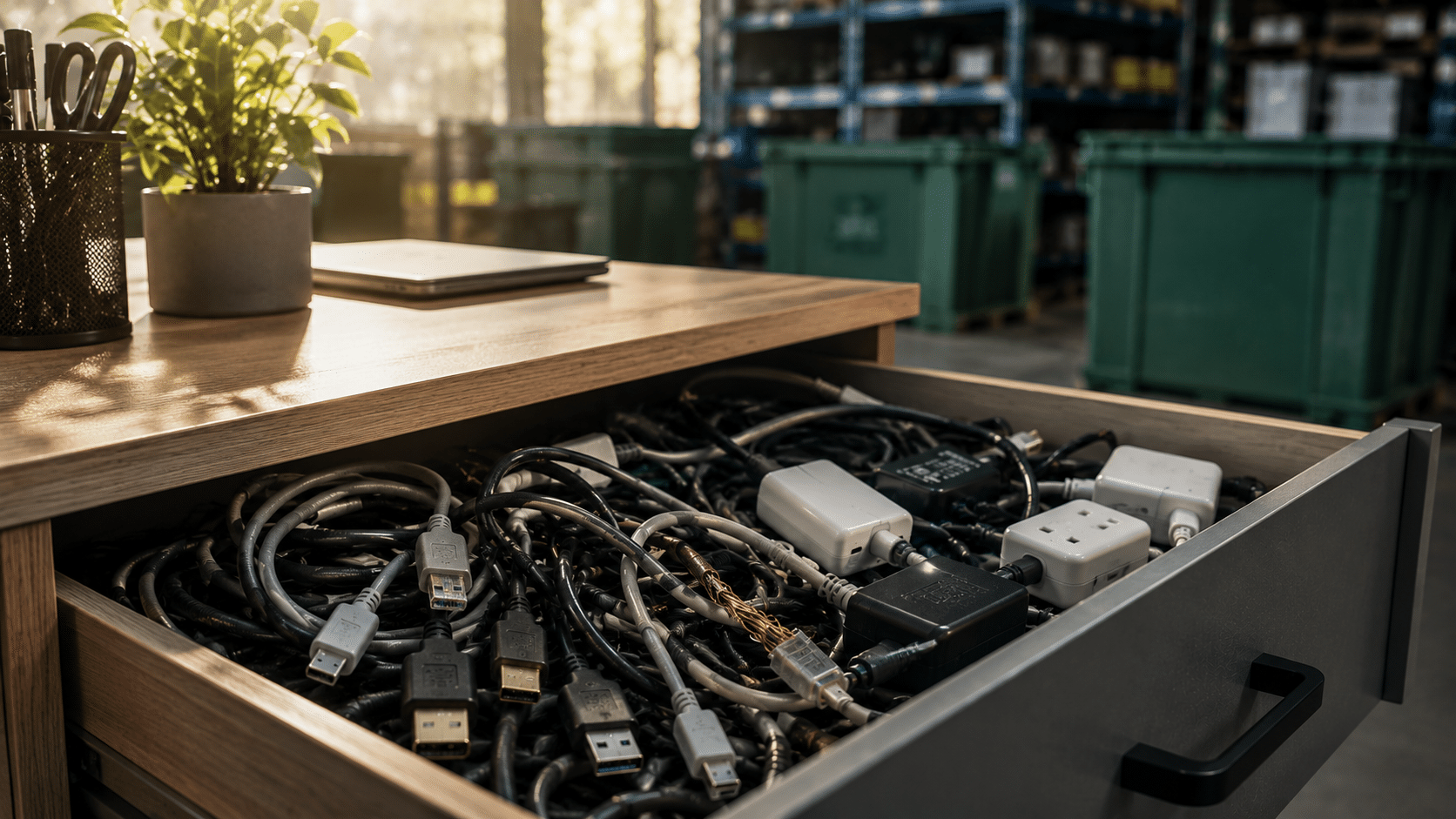
That drawer everyone has. The one full of cables you no longer recognize, the phone charger you replaced two years ago, three HDMI cables from different eras, and an extension cord that barely works anymore. They stay there because throwing them away feels wrong, but you also do not know what to do with them.
Why cables should not go in the regular trash
The plastic coating around most cables, typically made from polyethylene or PVC, can release contaminants such as lead and dioxins when exposed to heat and landfill conditions.
PVC can take 30 years or more to break down and eventually fragments into microplastics that end up in soil and water systems. That means the phone cable you used in 2019 could still be sitting in a landfill decades from now.
Curbside recycling programs are also not designed to handle cables. Tossing them into standard recycling bins can damage sorting machinery and contaminate other recyclable materials.
What is inside a cable that is worth recovering?
More than most people realize.
Most USB cables, HDMI cords, Ethernet cables, chargers, and power cords contain copper inside, a material that can be recycled indefinitely without losing its properties.
According to the United Nations’ Global E-waste Monitor 2024, the metals found in global e-waste streams, including copper, gold, iron, and rare earth elements, are worth an estimated $91 billion.
A June 2025 analysis by McKinsey projected a global copper shortage of 3.6 million metric tons by 2035 and identified e-scrap as one of the largest underused sources of recoverable copper. Every cable recycled correctly is copper that returns to the production cycle instead of remaining buried underground.
What types of cables does a certified recycler in Tampa Bay accept?
At eSmart Recycling, we accept:
- USB cables of all types: USB-A, USB-C, Micro-USB, Lightning
- HDMI cables, DisplayPort cables, and video adapters
- Laptop, tablet, and phone chargers
- Ethernet and networking cables
- Extension cords and power strips
- Audio cables and computer accessories
There is no need to separate or clean them. We receive them exactly as they are.
How to drop off or schedule cable recycling in Tampa Bay
Option 1: Direct drop-off
You can bring your cables directly to our warehouse at:
5100 Vivian Place, Tampa, FL 33619
There is no cost. Whether you have one cable or an entire box full, the process is the same.
Option 2: Scheduled pickup
If your business has a large volume of cables and electronic equipment for recycling, you can schedule a pickup. We coordinate removal directly from your office or warehouse anywhere in Tampa Bay, including documentation of the recycling process.
Can I recycle cables together with other devices?
Yes. Cables are processed together with the rest of your e-waste, including:
- Laptops
- Monitors
- Printers
- Routers
- Keyboards
- Computer accessories
You do not need to separate shipments. If you are recycling complete devices along with loose cables, we process everything together.
Frequently asked questions about cable recycling in Tampa
Are cables really considered e-waste, or can I place them in normal recycling bins?
They are considered e-waste. Cables contain metals such as copper and coatings that may include hazardous chemicals. They should not go into curbside recycling bins.
How many cables do I need before it is worth bringing them in?
There is no minimum requirement. You can bring a single cable or a full box.
Does eSmart Recycling charge for cable drop-off?
No. Cable and accessory drop-off at our Tampa warehouse is free.
What happens with the data stored in smart chargers or intelligent cables?
Most cables do not store data. If you have concerns about devices with integrated storage, such as certain USB hubs, we audit them before processing.
Do you accept damaged or broken cables?
Yes. Even broken cables still contain recoverable materials. You do not need to bring only working cables.
That drawer is not going to clean itself out. But you also do not have to make the process complicated. Bring the cables. We handle the rest.

April 29, 2026
A few days ago, the news started spreading: Costco made a small change to its famous $1.50 hot dog and soda combo for the first time in four decades. Now you can choose a Kirkland water bottle instead of soda, but the price stays the same.
And of course, people had something to say about it.
There’s something satisfying about seeing something so simple stay consistent. While almost everything keeps getting more expensive or more complicated, Costco decided to stick with what already works: a good hot dog, an affordable price, and now a slightly lighter option—no big announcement. No noise. Just a small adjustment that makes sense.
The same idea, done right
At eSmart Recycling, it feels familiar.
Since 2014, we’ve been doing the same core work: we collect laptops, computers, monitors, and old electronics, we perform secure data destruction, and we give a second life to devices that still work.
No complicated steps. No confusing process. Just handling something that most people don’t want to deal with.
When something still works
Because in the end, some things don’t need to be replaced to stay useful. Sometimes they just need the right handling.
Many of the devices we receive still have plenty of life left. We check them, clean them, perform a full data wipe, and a good portion ends up in the hands of kids and families who truly need them.
It’s simple. And it works.
Before you store it again
If you have a laptop, desktop, or electronic device sitting at home that you no longer use, it’s worth pausing before putting it back in a drawer or leaving it there for another year.
There’s a good chance it can still be useful to someone else.
We take care of the entire process: pickup, secure data destruction, and refurbishment. And if something can’t be recovered, we handle responsible recycling.
What connects it all
That small update from Costco leaves an idea behind: some things keep working just fine, they just need a small adjustment to stay useful.
The same thing happens with technology recycling. Devices that look outdated can still have a second use when they reach the right hands.
If you have old electronics collecting dust at home or in your office, this might be the moment to move them forward.
Call us. At eSmart Recycling, we handle the pickup, ensure secure data destruction, and put those devices back into circulation when they still have life ahead of them.

April 28, 2026
Over the past few weeks, two very different companies have made headlines across the United States: Wren Kitchens, the British kitchen retailer that partnered with Home Depot, and ARC Burger, one of the largest Hardee’s franchise operators. Both have shut down operations and filed for Chapter 7 bankruptcy, a full liquidation.
When a company closes like this, the story usually centers on layoffs and disappointed customers. But there’s another layer that rarely gets attention. Behind those closures sits a massive volume of equipment: electronics, commercial furniture, digital displays, computers, point-of-sale systems, LED lighting, appliances, and more.
And too often, if no one takes responsibility for what happens next, it all ends up in landfills.
That’s the sustainability lesson few are talking about.
What does Chapter 7 really mean?
Unlike Chapter 11, where a company attempts to restructure and stay alive, Chapter 7 is final. Assets are liquidated to pay creditors. Everything the business owns, from office laptops to industrial refrigerators, digital menu boards, ordering tablets, security systems, and even furniture with embedded electronics, is either sold off or discarded.
In the case of Wren Kitchens, which closed its 15 East Coast showrooms, that includes full kitchen displays, interactive systems, lighting setups, and design computers.
With ARC Burger, which shut down 77 restaurants, the scale is even larger: hundreds of commercial kitchen units, digital screens, POS systems, surveillance cameras, and heavy-duty appliances.
This is not a small clean-up. It’s a wave of physical assets, suddenly without a clear destination.
The hidden impact: corporate e-waste
Every time a retail chain or restaurant group shuts down at scale, it generates a significant amount of electronic waste.
Many of these devices contain valuable and hazardous materials. Precious metals like gold, silver, and copper. Plastics that take decades to break down. Toxic substances such as lead, mercury, and flame retardants.
When not handled properly, these materials don’t just disappear. They seep into soil. They reach water systems. They stay.
Retail and restaurant sectors generate thousands of tons of electronic waste every year from upgrades, closures, and bankruptcies. A large portion still ends up in standard landfills instead of being recovered.
The circular economy opportunity
This is where we come in at eSmart Recycling.
Instead of letting these assets become waste, there’s another path.
Equipment that still works, like laptops, monitors, and tablets, can be refurbished and used again. Devices that no longer function can be responsibly recycled, recovering valuable materials and reducing the need for new extraction. And anything that stores sensitive data can be securely destroyed under strict standards.
This not only reduces environmental harm but also helps companies handle closures in a more responsible and controlled way. Liquidators and operators are increasingly looking for partners who can manage this process properly.
What can you do as a consumer or business?
If you were affected by the closure of Wren Kitchens or ARC Burger, hold on to any electronic equipment you may have received or purchased. Throwing it away should not be the default.
If you manage a business or leftover inventory, certified recycling is a better route than disposal.
If you are involved in bankruptcy or liquidation processes, working with a specialized recycling partner brings order to what can easily become a messy and risky situation.
What happens next matters
Chapter 7 bankruptcies remind us that a product’s life does not end when a company shuts its doors. That moment creates a new decision point.
What happens next matters.
At eSmart Recycling, we work with companies, franchises, and individuals to handle electronic waste responsibly, from secure data destruction to refurbishment and certified recycling, aligned with R2 standards and environmental regulations.
If you have equipment you no longer need due to upgrades, closures, or liquidation, reach out.
We help you extend the life of what still works and safely recycle the rest.

April 27, 2026
On April 27, 2026, thousands of companies across the United States realized at the same time that they couldn’t access their email. Outlook has been down since early morning, and Microsoft confirmed it on its Service Health page. No es la primera vez. No va a ser la última. And it’s worth asking what this says about how we work today.
If you landed here trying to fix Outlook today, the official resources mentioned below will help you more than we will. But if you keep reading, there’s a part of the problem that sits on our side and that few companies address.
What’s happening now
The outage started around 5 AM Eastern Time. Reports on Downdetector have stayed consistent at around 1,500 per hour, which indicates the issue is still active. Microsoft confirmed “service degradation” and published that their teams are investigating.
The symptoms are consistent:
- Login loops
- Failures after 2FA
- Messages stuck in the outbox
- “Too many requests” errors
It affects:
- Outlook web
- Desktop client
- Mobile app
- Third-party clients connecting via Exchange
This is not a problem with your computer or your local network.
Where to check official status
Three places worth bookmarking for any future outage:
- Microsoft Service Health page — the official report directly from Microsoft. It updates as the investigation progresses.
- Downdetector — aggregates real-time reports. Useful to confirm the problem isn’t just on your end.
- Microsoft 365 Status on X — Microsoft posts quick updates when there are major incidents.
We're investigating an issue where users may be experiencing intermittent issues accessing https://t.co/ZUfyjth6sU. For more information, please visit https://t.co/uSHwRmXFJZ.
— Microsoft 365 Status (@MSFT365Status) April 27, 2026
One recommendation: when the outage is server-side, don’t troubleshoot on the client side. Changing passwords, clearing cache, or reinstalling the app won’t fix anything and can sometimes make things worse when the service comes back.
What to do in the meantime
Five practical things:
- Confirm it’s widespread. Before spending time trying to fix it, check the status page.
- Switch to a backup channel. Slack, Teams, WhatsApp, SMS. Whatever your team already uses.
- Document the outage window. Take screenshots of the status page with timestamps. If there are later SLA or compliance issues with clients, that evidence helps.
- Notify your clients proactively. A short message through another channel prevents them from thinking you’re ignoring them.
- Avoid mass password changes. When teams get frustrated, they try to reset everything. In a server outage, that solves nothing.
How to communicate with your team when email is not an option
Having a plan before an outage matters more than improvising during one.
The first thing is to have a defined backup channel that everyone knows. If the first time your team uses Slack seriously is during a crisis, there will be friction. The second is to assign a single person to communicate updates. Without that, five people forward different information, and no one knows what to believe.
And the third, which sounds obvious but still happens: don’t send emails about an email outage.
What these outages remind us
Every time a mainstream service fails, an uncomfortable truth becomes visible: companies depend on infrastructure they don’t control. Outlook today. Slack another time. AWS, GitHub, Stripe, Zoom. All have had major outages in recent years.
That doesn’t mean the cloud is bad or that companies should go back to on-prem servers. It means technological dependency has layers, and it’s worth looking at all of them honestly. There is critical data in the cloud. There is data on the computers your team uses every day. And there is data on computers your team stopped using a year ago, sitting in a storage room or closet, waiting for someone to make a decision about them.
The first two layers get attention. The third rarely does. But that data is still there, still recoverable with modern tools, and still the responsibility of the company that generated it.
This is where we can actually help
eSmart Recycling doesn’t fix outages or email issues. What we do, and what we’ve been doing from Tampa for companies in Florida and nationwide, is handle the last layer of that technological dependency: hardware you no longer use but that still contains data.
We collect laptops, desktops, servers, hard drives, and mobile devices directly from your office. We perform auditing and inventory. We physically destroy the data, complying with HIPAA, R2v3, and DoD standards. We provide a certificate of destruction and an environmental impact report. What can be refurbished is redistributed to communities with less access to technology. What can’t be recycled by components?
If your company has accumulated equipment over the years and no one has made a decision about what to do with it, that’s the conversation we actually have. Outlook will come back today or tomorrow. The laptops in your storage room have been there for months.
When you’re ready to resolve that part, contact us at info@esmartrecycling.com or call (813) 501-7768.
eSmart Recycling | 5100 Vivian Place, Tampa, FL 33619 | (813) 501-7768 | info@esmartrecycling.com
July 8, 2024
Are you looking for ways to make your business more sustainable? Have you heard of the concept of zero waste? In this article, we will delve into zero waste and show you how to achieve it in your business.
What is zero waste?
Zero waste is a concept aimed at eliminating waste from the production chain. This means that all materials, processes, and systems are designed to avoid the generation of waste. The zero waste concept also focuses on minimizing environmental impacts, especially those associated with waste production and disposal.
Why is zero waste important?
Zero waste is important because it can reduce the environmental impact of businesses. It not only reduces waste but also saves resources and optimizes production. Since waste reduction is a sustainability measure that can result in cost savings, it is also important for a company’s bottom line.
How to achieve zero waste in your business
Here are some steps you can take to achieve zero waste in your business:
-
Gain management support
Securing the support and commitment of management is essential for successfully implementing zero waste management in your business. Management must align with the plan’s goals and objectives and help guide the company towards the zero waste mission.
-
Evaluate your current operations
Before starting to implement a zero-waste plan, it is crucial to evaluate your current operations. This will help you identify areas for improvement to move towards zero waste. Consider all production processes and supply chain activities, and look for opportunities to reduce waste.
-
Design a zero-waste plan
Once you have evaluated your current operations, it’s time to design a plan. The plan should include concrete steps and performance metrics. Consulting the success stories of other companies can help create your zero-waste plan.
-
Engage employees
Engaging employees at all company levels is important for successfully implementing a zero-waste plan. Employees can offer valuable insights, ideas, and suggestions. They can also play a crucial role in the implementation and maintenance of the plan.
-
Monitor and continuously improve
Once your zero waste plan is in place, it’s important to monitor your results and continuously improve. Regularly evaluate your outcomes and look for areas of improvement. Analyzing data can help you identify trends and opportunities to enhance performance.
The future of zero-waste
Admittedly, zero waste can seem like an impossible goal. However, it is a goal worth striving for. It can reduce the environmental impact of businesses, improve efficiency, and save costs.
By following the steps outlined above, you can move your business towards zero waste. Good luck!
October 27, 2025
Reducing electronic waste (e-waste) in your office is not only environmentally responsible, but it also improves your company’s reputation, reduces security risks, and can even save money. Here’s how to get there with clear steps, examples, and real data.
What “zero e-waste” means in the office
A zero e-waste office is one that:
- Donates or reuses fully functional devices instead of discarding them.
- Guarantees secure data destruction on old hardware.
- Recycles electronic components that can’t be used anymore.
- Avoids unnecessary purchases and chooses equipment that can be repaired or upgraded.
Why does it make sense for businesses
Key facts
- In 2022, only 22.3% of global e-waste was properly collected and recycled, leaving millions of tons unmanaged.
- If countries increase collection rates to 60% by 2030, global benefits could exceed US$38 billion, including improvements in health, environment, and resource recovery.
- Businesses lose billions every year by discarding precious metals found in devices, such as copper, gold, silver, and palladium.
Benefits for your company
- Reduced legal and privacy risks (from sensitive data stored in old devices).
- A stronger image with clients, investors, and employees.
- Real savings by extending equipment life cycles.
- Compliance with state regulations that ban or limit the landfilling of electronics.
Step by step: how to build a zero e-waste sanctuary office
1. Audit and map your equipment
Make a full inventory: desktops, laptops, printers, routers, batteries, cables, old phones, and more. Include inactive or stored devices.
At eSmart Recycling, we help companies carry out this audit, identifying which devices can be reused and which require recycling.
2. Set policies for use, repair, and replacement
- Create rules for preventive maintenance and extend the life of devices.
- Always evaluate whether repair is a better option before buying new.
- Prioritize models with interchangeable parts and longer manufacturer support.
Every year, we give thousands of devices a second life. Some are refurbished for someone else to use, while others are responsibly recycled.
3. Donation and reuse
If a device still works, its best destination is reuse. At eSmart Recycling, about 30% of the revenue from collections is invested in repairing and donating devices. Thanks to this, we’ve already delivered over 3,000 computers to children and families in communities with limited access to technology, benefiting more than 12,000 people.
4. Responsible recycling when devices reach the end of life
- We use certified processes that guarantee secure data destruction, meeting standards such as HIPAA.
- Devices are dismantled piece by piece to recover metals, plastics, and other components, keeping them out of landfills.
5. Internal education and culture
A zero e-waste office also depends on its people. We help companies train their teams so they know how to handle unused equipment and where to deposit it.
6. Measuring results and transparency
We issue certificates of destruction and environmental/social reports for companies that work with us. This way, every partner can show measurable results and include them in sustainability reporting.
What we’ve learned supporting companies
After more than a decade, we’ve seen that most offices accumulate devices that sit unused for years. When companies recycle with us, they not only free up space but also help more people gain access to computers and digital education.
Turning your office into a zero e-waste sanctuary is not just an ideal; it’s achievable and comes with real benefits. The key is taking concrete steps: auditing, extending use, donating, recycling properly, and educating your team. At eSmart Recycling, we’re ready to support your company in making this happen.
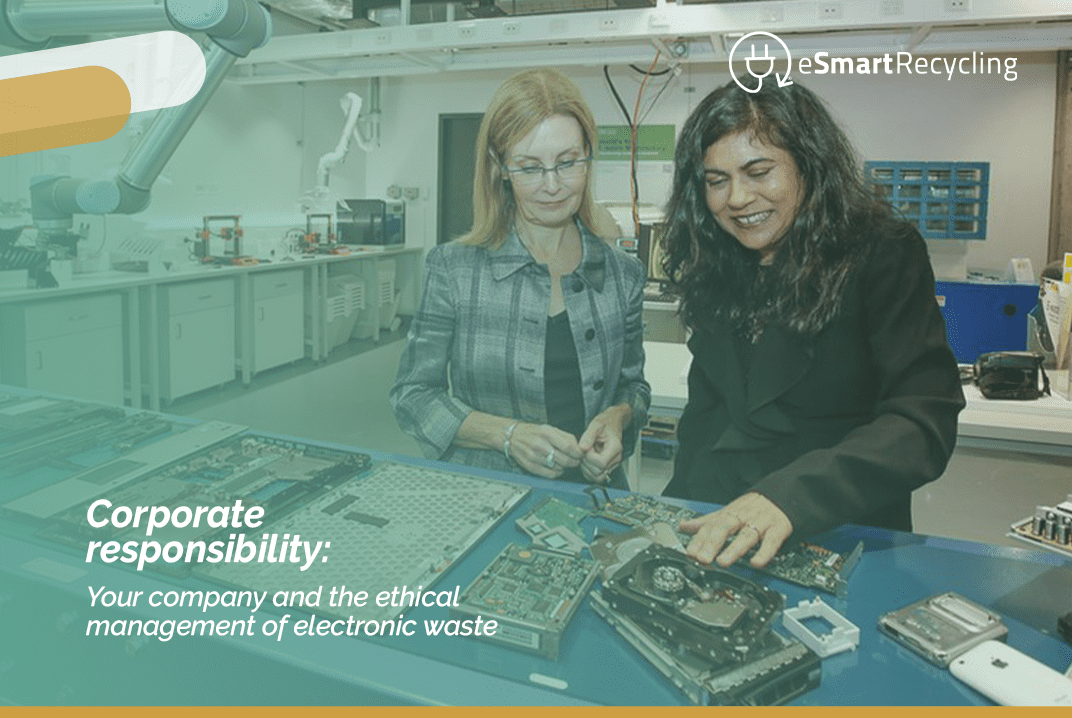
April 25, 2024
As technology develops at a breakneck pace, electronic waste, or e-waste, is becoming an increasingly significant problem. The growing reliance on digital devices has resulted in many electronic waste from businesses ending up in landfills. However, more and more companies are realizing the importance of proper electronic waste management. It’s essential to demonstrate corporate responsibility and make a real difference. Please read to learn how your company can implement its ethical electronic waste management program.
What is ethical electronic waste management?
Electronic waste is a term used to describe any unwanted electronic device, such as computers, laptops, tablets, smartphones, and audio equipment. All these devices contain toxic materials that can leach into the soil and water if not disposed of properly. Ethical management of electronic waste involves identifying your company’s electronic waste, recycling reusable materials, and safely disposing of the rest to protect the environment.
Corporate responsibility and the importance of e-waste management
Corporate responsibility is the ethical standard that every company should strive for. It’s about making responsible decisions and taking actions that benefit people and the planet beyond profit-making. Managing electronic waste is a crucial component in this regard. The electronic waste produced by your company can have a substantial human and environmental impact. Without proper disposal, toxic materials and heavy metals can leach into the environment and if decomposed, can release greenhouse gases into the atmosphere. All companies should aspire to operate ethically and responsibly and consider implementing electronic waste management practices.
What can your company do?
The first thing your company can do is identify its electronic waste and consider ways to reduce it. This could involve finding more efficient and less wasteful computing solutions, recycling old equipment, or improving the lifespan of devices. After this, your company can choose a trusted electronic waste management program to send its electronic devices when they end their useful life. Several national and local programs can be used in this regard.
Your company should also try to offset its environmental impact. Taking steps to ensure that electronic materials are used responsibly and disposed of ethically is one measure that can be adopted. Measures to improve energy use and reduce CO2 emissions will also positively impact. Another good practice is encouraging employees to bring their electronic waste from home to be recycled at the company.
Brands that champion electronic waste management
Many large companies have taken identifiable steps to manage their electronic waste. A great example is Apple’s recycling and reuse programs. All new Apple products come with a prepaid recycling label, and the company has an iPhone refurbishment program where old devices are dismantled and reusable components are extracted. Microsoft and HP are two major brands that are increasingly concerned with electronic waste management. Both companies have programs to ensure responsible dismantling, recycling, and reuse.
Electronic waste is an ever-growing problem, and if not managed properly, the impact on the environment and human health can be severe. Taking steps to dispose of electronic waste properly is an important part of corporate responsibility. Your company should identify its electronic waste and consider ways to reduce it. Then, it should choose a trusted electronic waste management program and have means to dispose of its electronic waste. Companies should strive to offset their environmental impact by avoiding electronic waste, using materials responsibly, and reducing energy consumption.
Remember, responsible corporate behavior is increasingly important. Make a positive contribution and enroll your company in an ethical electronic waste management program today.

September 27, 2024
As more people become aware of the environmental impact of our actions and the emphasis on ecological conservation grows, it’s increasingly essential to recognize our contributions to this impact. When people think of pollution, they often picture industries or factories—large industrial companies producing harmful pollutants. But what would you say if you realized that a clinic could also have a significant environmental impact?
It’s easy to overlook the negative environmental impact your clinic may have: medical waste, high energy costs, and even air pollution can make your clinic a major contributor.
What Is Clinical Pollution?
First, it’s important to understand what clinical pollution is. Clinical pollution encompasses the various environmental impacts of clinical activities, including the disposal of medical waste, energy consumption, and other emissions like air pollution or even noise pollution. Medical waste disposal is a key factor, and for most clinics and medical centers, it tops the list of concerns.
Why Is Addressing Clinic Pollution Important?
It’s important to consider ways to reduce clinic emissions and improve their environmental performance for several reasons. First and foremost, it poses a risk to the climate: energy resource usage contributes to climate change, and medical waste can be toxic. Additionally, clinic pollution could result in fines from regulatory authorities. Lastly, it affects a clinic’s social license to operate. As the public becomes increasingly aware of the healthcare sector’s environmental impact, more patients are likely to prioritize facilities that take their environmental footprint seriously.
How Can Clinics Minimize Their Impact?
Clinics can minimize their impact in several ways:
1. Consider Sustainable Products
One of the most effective ways clinics can reduce their impact is by using low-impact products. This is particularly important for single-use items like masks and gloves, which pile up in landfills. Numerous lower-impact or even compostable alternatives are available, and many common diagnostic and monitoring devices are now designed with energy efficiency in mind.
2. Upgrade Ventilation Systems and Medical Waste Management
Upgrading ventilation systems to be more efficient and implementing proper medical waste management practices can help reduce emissions. Proper ventilation also reduces exposure to airborne toxins within the clinic, benefiting both the environment and workers’ health. Clinics should also consider energy recovery programs to dispose of medical waste effectively and responsibly.
3. Encourage Patients to Do Their Part
Finally, clinics can play a role in educating and encouraging patients to contribute to conservation efforts, such as carpooling, using public transportation when possible, or opting for energy-efficient lighting and appliances. Offering patients small, thoughtful alternatives and options can make a big difference.
Considering and addressing the environmental impact of clinical operations is becoming increasingly important in the healthcare sector. Clinical pollution takes many forms and can pose risks both to the environment and to regulatory compliance.
Fortunately, there are concrete actions clinics can take to reduce their impact, from energy-efficient practices to better medical waste management, such as using lower-impact products, upgrading ventilation systems, and promoting sustainability among patients. By taking these steps, clinics can ensure they are doing their part to reduce their environmental footprint and preserve their social license to operate.
September 3, 2025
World Sustainability Day is no longer just a catchy phrase for social media; it represents a turning point for the future of electronic waste recycling. For U.S. companies and sustainability leaders, this day is the perfect platform to take action, inspire, and connect with a truly circular economy.
Why is World Sustainability Day crucial for e-waste recycling in 2025?
In 2022, the world generated around 62 million tons of e-waste, a number expected to reach 82 million by 2030. Out of that total, only 22% was properly recycled. That means more than 75% of electronic waste ends up in landfills or is handled informally, creating significant environmental and health risks.
This same e-waste doesn’t just contain toxic substances like lead, mercury, or cadmium—it also holds valuable materials such as gold, silver, copper, and rare earth elements, all of which are lost if not recycled responsibly.
World Sustainability Day becomes the perfect moment to address this structural problem, build alliances, and promote better practices across the tech industry.
What role can U.S. companies play?
Awareness and leadership
This day is a chance to launch internal or external campaigns that encourage employees and customers to recycle old devices—combining environmental awareness with tangible benefits. Communicating that those “drawers full of cables and gadgets” could be worth billions of dollars in recoverable materials can be highly effective.
Strategic partnerships
Partnering with programs like ecoATM, which collects small devices in kiosks in exchange for cash, makes it easier for consumers to recycle responsibly. Supporting certifications like R2 or e-Stewards also strengthens trust in sustainable waste management.
Innovation and circular economy
World Sustainability Day is also an opportunity to highlight innovative technologies. For example, a new three-step method to extract gold from old phones shows how e-waste can be turned into a sustainable source of resources.
Extended Producer Responsibility (EPR) policies
Advocating for laws that require manufacturers to take responsibility for recycling their products promotes longer-lasting designs and recyclability, while reducing planned obsolescence.
Practical ideas to make the most of this day
World Sustainability Day can become a true catalyst for action:
- Internal campaigns: collect employees’ obsolete devices and share information about their environmental impact and material value.
- Partnerships with certified recyclers to ensure traceability and transparency.
- Trend sharing: highlight facts such as the exponential growth of e-waste and the reality that only a minority is formally recycled.
- Clear communications: emphasize that “every old gadget can become a new opportunity”—both environmentally and economically.
September 15, 2025
World Sustainability Day 2025 is the perfect chance for companies and sustainability leaders in the U.S. to put real actions into motion and inspire their teams to embrace a greener culture (Awareness Days).
What does this day really mean for your company?
This day can serve as a milestone to promote responsible practices, reduce your environmental footprint, and align your team with global sustainability goals. It’s not just about symbolic gestures — it’s about inspiring real change in the way we work, purchase, and collaborate.
Practical, team-friendly ideas you can launch
1. Kick off an internal team challenge
Launch a challenge such as “reduce daily break room waste” or “cut down on single-use plastics.” Encourage healthy competition while building a culture of shared responsibility. Track progress weekly and celebrate achievements.
2. Host an internal “Sustainability Fair”
Invite local organizations focused on recycling, responsible consumption, or clean energy to share their initiatives. It’s a way to connect your team with real resources and show that sustainable actions are within reach.
3. Strengthen green practices in the workplace
Use the day to reinforce or introduce new initiatives such as recycling, eco-friendly supplies, or energy-saving habits. Encouraging these practices not only protects the planet but can also improve employee satisfaction and reduce costs.
4. Embrace hybrid or remote work
If your business model allows it, use the day to review or promote hybrid and remote work options. Reducing commuting has proven to be an effective sustainability lever across industries.
5. Support real causes by choosing responsible suppliers
Review your supply chain and — if possible — switch to vendors with strong green commitments. Sustainable purchasing doesn’t just look good; it pushes the entire value chain toward cleaner practices.
A real-world example to inspire you
In the hospitality industry, Marriott The Luxury Collection hosted a retreat with chefs from around the world focused on sustainable cooking practices: local sourcing, supply chain analysis tools, and foraging programs. The results were long-lasting — teams were engaged, products improved, and awareness grew beyond the event itself.
Why should you make it happen?
- Purpose-driven motivation: employees feel part of something meaningful.
- Tangible benefits: cost reduction, healthier workplaces, and competitive advantage.
- Visibility and credibility: highlighting World Sustainability Day with real actions and examples builds trust and improves SEO.
Closing: one day to spark long-term impact
World Sustainability Day shouldn’t just be a date on the calendar. It can be the starting point for new practices, more conscious decisions, and a workplace culture that inspires both inside and outside the office. If every company takes a small step, the collective impact can be massive.
We believe days like these are reminders that change starts with daily choices — in how we work, and how we bring our teams along.
October 27, 2025
World Sustainability Day takes place on the last Wednesday of October, and in 2025, it feels more urgent than ever. It’s not just another awareness day — it’s a moment to pause, reflect, and act on what sustainability really means.
A planet that can’t wait any longer
The signs are everywhere. In April 2025, the global average temperature rose 1.22°C above pre-industrial levels. Longer droughts, stronger storms, disappearing ecosystems — all of it is happening now.
At the same time, pressure on companies keeps growing. More states across the U.S. are making environmental reporting mandatory, demanding measurable actions and not just promises. Yet, some corporations have pulled back from publishing voluntary sustainability reports, even as public expectations for transparency are higher than ever.
That’s why this year, more than ever, it’s time to make noise with purpose.
What a company can achieve by taking part
1. Strengthen trust
Around 88% of consumers stay loyal to brands that stand for environmental or social causes. Using this day to communicate authentically builds connection — no corporate scripts, no fluff.
2. Show real transparency
It’s not about promises. It’s about proof. Sharing both achievements and challenges earns respect. The best companies don’t just announce—they invite people to be part of the change.
3. Activate people from within
Real change starts inside. A short talk, a “green audit,” or a small sustainability challenge can spark interest across teams and departments.
4. Build lasting connections
World Sustainability Day brings together NGOs, governments, and private companies. It’s a chance to build partnerships that go beyond a single event.
Simple ways to take part
- Share a quick update on your sustainability progress and next goals.
- Open an internal discussion about reducing waste or energy use.
- Organize a local cleanup or tech recycling drive.
- Encourage employees and partners to share ideas under your own campaign hashtag.
At eSmart Recycling, we live this every day. Collecting, refurbishing, and donating technology is how we contribute — helping protect the planet while bringing digital access to communities that need it most.
The time for speeches is over. What we do today matters.
This October 29, let’s make World Sustainability Day 2025 a day for real action, not just nice posts.

June 20, 2024
World Oceans Day is an annual celebration on June 8th to honor and protect the world’s oceans. Initiated in 1992 with a unique vision to conserve marine resources, this day aims to raise awareness and take action to preserve our oceans. Despite global efforts to protect our seas, many obstacles challenge their future sustainability. As people worldwide celebrate this important day on June 8, 2024, we look forward to collective action and changes that will help our oceans thrive.
Why is World Oceans Day important?
World Oceans Day is significant for several reasons. It helps draw attention to the marine environment and its numerous threats, such as climate change, overfishing, plastic pollution, and other human pressures. This day also educates people about the importance of oceans for the environment and human well-being. It supports implementing solutions for healthier and more resilient oceans for future generations.
The theme of World Oceans Day 2024
The theme for World Oceans Day 2024 is “Awakening New Depths,” designed to celebrate the 30th anniversary of the Event. It focuses on how the ocean has driven the development of the global economic system and the innovative ways people are working to maintain this resource. The goal is to encourage people to reflect on past, present, and future relationships with the ocean and come together to find positive suggestions for change.
How to celebrate World Oceans Day 2024
There are countless ways to participate in and celebrate World Oceans Day 2024. It can be as simple as skipping the straw in your drinks, learning about and supporting ocean-friendly businesses, organizing a beach cleanup, or any other creative activity that raises awareness about ocean conservation. Many organizations come together to offer events such as documentaries, exhibitions, educational webinars, ocean conservation efforts, and much more.
The impact of World Oceans Day 2024
World Oceans Day 2024 will provide an opportunity to help improve the health of our oceans, which in turn benefits the world as a whole. By fostering understanding and stewardship of the world’s oceans, it will highlight its many challenges, and collectively, individuals and organizations will help implement effective solutions. It’s time for everyone to take action to protect and preserve our oceans for future generations.
World Oceans Day is a vital celebration highlighting our oceans’ challenges and the numerous opportunities to protect and conserve them. The 30th anniversary of this day in 2024 will be especially important, as it represents a collective momentum that can lead to significant positive changes for the future of our oceans. It’s time to work together and take action to ensure healthy oceans for all.
June 5, 2024
June 5th marks World Environment Day, an annual global celebration focusing on environmental conservation and positive changes for Earth’s health. This important day, occurring in the middle of World Environment Week gives us a chance to reflect on our impact on the planet. Since 1974, hundreds of countries worldwide have joined the celebration, which grows yearly as people become more aware of the need to protect our environment.
What is World Environment Day?
The United Nations declared World Environment Day, first celebrated on June 5, 1974. Its goal is to raise awareness and inspire action for the environment, especially concerning critical global issues. Each year, a different country hosts an event or a broader movement on a current environmental theme, chosen by the United Nations alongside government and nonprofit leaders worldwide. This year, China leads with the theme “Ecosystem Restoration.”
How do people celebrate World Environment Day?
World Environment Day is a fantastic opportunity for governments, non-governmental organizations (NGOs), businesses, and individuals to celebrate the Earth. Many people worldwide participate in local events, activities, and volunteer opportunities, while others mark the occasion by making small but significant changes in their lives. Simple ways to celebrate include planting trees, cleaning up litter, or participating in wildlife preservation projects. Others spread eco-friendly initiatives through awareness campaigns, fundraising events, and petition signings.
How can you make a difference in your local community?
Making a difference in your community on World Environment Day is easier than it seems. You can significantly impact your surrounding environment by engaging in some Earth-friendly activities. Start by planting trees in your neighborhood and nearby areas. Trees produce oxygen, offset air pollution, help prevent soil erosion, create shade, and enhance your community’s appearance. You can also volunteer at your local park or zoo or join a beach or river clean-up. Organize a charity bike ride or a local clean-up event with friends and family for a fun and beneficial day.
How can you change your lifestyle to help the environment?
Small lifestyle changes can significantly impact the environment. Begin by reducing, reusing, and recycling household waste to keep materials out of landfills. Besides recycling, you can also start consuming less, replacing plastic products with more eco-friendly materials, or buying locally grown organic foods. Another crucial consideration is your environmental impact when using transportation. Many cities have a bike and pedestrian paths that make it easy to get outside and reduce your carbon footprint.
Businesses support World Environment Day
World Environment Day presents an excellent opportunity for businesses to get involved and commit to the environment. Many companies worldwide have taken steps to reduce their energy consumption, adopt greener production practices, and commit to planting trees and reducing waste. Several companies launch special promotions each year and donate to environmental causes globally. For example, brands like H&M and Body Shop have launched “zero waste” initiatives and campaigns this World Environment Day. By being part of the solution, businesses make it easier for consumers to support a planet-friendly cause while positively impacting their local communities.
World Environment Day allows people to learn more about the environment, take positive steps toward more sustainable living, and inspire others to do the same. Businesses and individuals can make a real difference by participating in local and global actions. People worldwide are becoming aware of important environmental issues and collaborating to make a positive impact. So, let’s make the most of this annual celebration and maximize World Environment Day.
May 3, 2024
Electronic waste is accumulating worldwide at an alarming rate. The production of electronic devices is also growing, and the amount of electronic waste is likely only to increase soon. As a business leader, you must understand your role in the lifecycle of your company’s electronic products and the responsibilities that come with it. Here, we explain why your company should be concerned about the fate of electronic waste and how you can make a positive impact.
Understanding electronic waste
Electronic waste refers to discarded electronic devices, such as televisions, computers, phones, and other items. These devices are made up of valuable materials like copper, aluminum, and precious metals and can be a significant source of raw materials. Unfortunately, most electronic waste is not recycled and ends up in landfills, releasing dangerous chemicals and toxins into the environment. Producing these electronic devices also requires significant energy and resources, exacerbating the problem.
The impact of electronic waste
Electronic waste has a wide range of environmental and social impacts. It can contaminate the soil, air, and water with toxic substances such as lead, mercury, and brominated flame retardants. These substances can harm human health and wildlife and remain in the environment for hundreds of years. Additionally, the production and disposal of electronic devices pollute the air and water, contribute to climate change, and generate significant amounts of waste. Finally, the incineration of electronic waste releases dioxins and furans, among the most toxic substances on the planet.
The role of businesses
Businesses play a significant role in the production and disposal of electronic waste. Modern businesses depend on electronic equipment for their operations and increasingly need to upgrade their equipment as technology changes, resulting in significant electronic waste. Additionally, companies can be held accountable for properly disposing of their electronic devices, so they must be aware of the regulations in their area before disposing of their items.
Taking action
Businesses can take several steps to reduce their production and the impact of electronic waste. First, they can focus on purchasing high-quality electronic devices and using them for as long as possible. This can help reduce the total amount of electronic waste produced and delay the need for upgrades. Second, they can promote the reuse and recycling of their electronic devices. This can be achieved through programs allowing employees to donate old electronic devices to charities or recycling programs that the company helps fund. Lastly, businesses can explore alternatives to traditional electronic devices, such as virtual servers instead of traditional data centers, which can reduce the amount of electronic equipment needed.
The benefits of taking action
You can gain several advantages by taking steps to reduce your company’s production of electronic waste. First, you can reduce the environmental impact associated with the production and disposal of your electronic devices. This can help protect the environment and the health of your employees and the community. Second, you can save money by extending the life of your electronic devices and reducing the need for new equipment. This can help your bottom line and make your company more sustainable in the long run. Lastly, taking steps to reduce electronic waste can help you comply with the growing number of regulations related to electronic waste.
Electronic waste is a concern that should be on the radar of all companies. Electronic products’ production, disposal, and impact are significant and have severe environmental and social consequences. Companies can take steps to reduce their production of electronic waste and have a positive impact on the environment and their community. By understanding the problem and taking action, your company can help protect the environment and save money.
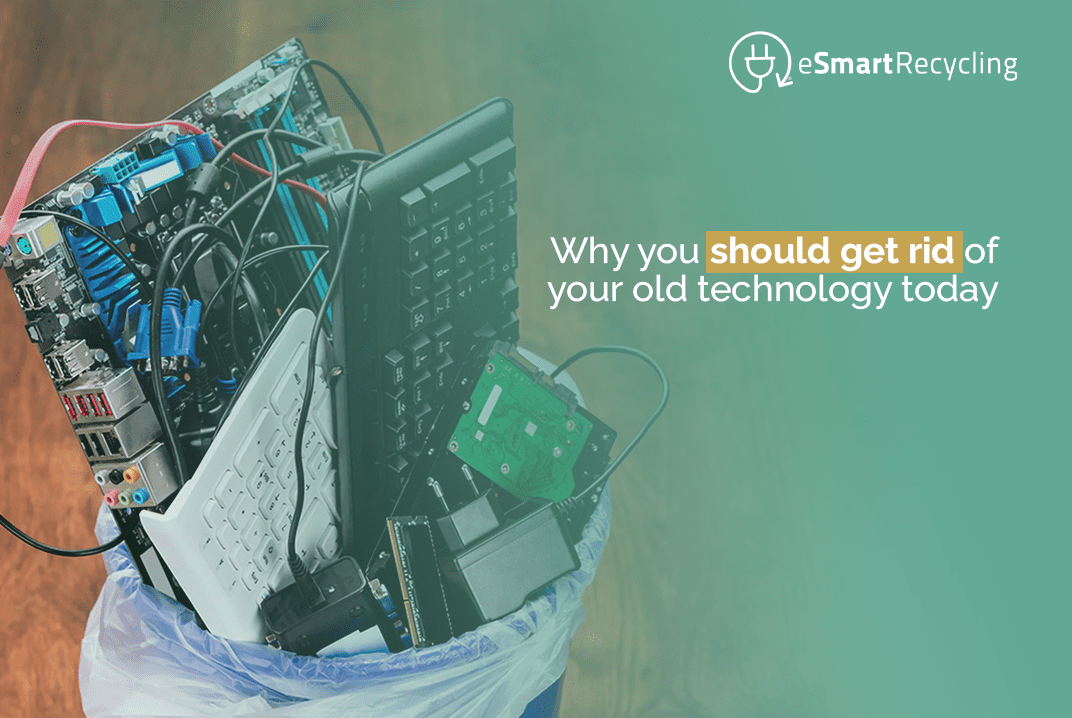
July 11, 2024
Living in a world where technology is constantly advancing and evolving, it’s important to keep up. The pace of modern technological change is rapidly increasing, making it harder to ignore the benefits of replacing old equipment and software with new options. As a society, we’ve grown accustomed to having clear advantages, so why should your office be any different? Upgrading your old technology could be the best investment your company can make this year.
What benefits will you gain?
At its core, technological advancements offer numerous benefits in efficiency, productivity, security, and cost savings that far exceed those of their older counterparts. The ability to work more effectively, securely, and cost-efficiently is something businesses can no longer ignore. If you want to remain relevant and competitive in the market, you need the latest tools available to stay ahead.
Increased productivity and efficiency
Older technology makes it harder to keep up with the fast pace of change, causing disruptions and, in turn, loss of productivity. New technology helps employees work faster, more effectively, and with better results. For example, with a newer computer, employees can take advantage of much faster processors and RAM, meaning programs open more quickly and multitasking is more efficient. Additionally, new software features, such as automated workflows, can help automate repetitive tasks and allow employees to focus on more productive work. With the right technology, employees can do more in less time, which helps increase productivity and company profits.
Better security and data protection
Older technology is more susceptible to security vulnerabilities, making it more prone to malware and other online threats. The latest technology offers better security features and protections, such as built-in encryption tools, enhanced firewalls, antivirus software, biometric identification, and more. Additionally, new updates and patches help maintain security and protect data. Upgrading to new hardware and software could save your company a lot of time and money in the long run.
Cost savings
Despite the initial cost of new technology, migrating to new hardware and software can generate long-term savings by reducing maintenance and support costs associated with outdated equipment. New technology also typically has a longer lifespan, meaning the total cost of ownership is significantly reduced. Moreover, new productivity features, security protections, and energy efficiency can make new equipment and programs a long-term cost saver.
What should you look for?
When purchasing new technology, consider which tools and features best fit your company’s needs. Think about which programs are necessary for your company to operate effectively. Also, consider important IT solutions for data protection. Look for energy-efficient products to reduce operating costs. Purchase reputable brands like Microsoft, Apple, and HP, as these products are usually of higher quality than their counterparts from other brands. Finally, take your time researching before buying to find the best deals and ensure the new technology meets your company’s needs.
The time to ditch old technology is now
As technology continues to evolve, businesses must stay relevant to keep up with market changes, and the best way to do this is to invest in new technology. If your company wants to remain competitive and efficient, now is the time to get rid of your old technology and embrace new equipment and software. With improved productivity, security, data protection, and cost savings, upgrading to more modern technology could be the best investment your company can make this year. Start looking for the right equipment today and take your business to the next level.

October 23, 2024
As we approach World Sustainability Day 2024, the urgency to address environmental issues has never been more pronounced. This annual observance, which focuses on sustainable practices and promoting ecological balance, is a reminder of our collective responsibility to protect the planet. The theme for this year emphasizes the need for immediate action to combat climate change, enhance biodiversity, and ensure a sustainable future for generations to come.
The Current State of Sustainability
Recent reports highlight a troubling reality: the world needs to catch up in achieving the Sustainable Development Goals (SDGs) set for 2030. According to the Sustainable Development Goals Report 2024, only 17% of assessable targets are on track for achievement, while nearly half show moderate to severe deviations from desired progress. This stark data underscores the necessity for intensified global efforts to realign our strategies toward sustainability.
The Role of Land Restoration
One of the focal points for this year’s observance is land restoration. The World Environment Day 2024, hosted by Saudi Arabia, will center around themes of land degradation and drought resilience. With nearly 3.2 billion people affected by land degradation, reversing this trend is crucial for ecological health, food security, and livelihoods. The initiative aims to restore one billion hectares of degraded land, which could significantly enhance carbon storage and biodiversity.
Climate Change and Biodiversity
The impacts of climate change continue to escalate, affecting ecosystems worldwide. Extreme weather events such as droughts, floods, and wildfires are becoming more frequent, threatening human and ecological communities. Inger Andersen, Executive Director of the United Nations Environment Programme (UNEP), emphasized the urgency of action in light of these challenges: “We are running against the clock”3. The interconnectedness of climate change and biodiversity loss further complicates our sustainability efforts; protecting one often means addressing the other.
The Importance of Data
Accurate data is essential for monitoring progress on sustainability initiatives. The Sustainable Development Goals Report 2024 indicates that high-quality data helps identify challenges and formulate solutions necessary for effective implementation. Countries are increasingly recognizing the need to invest in national statistical systems to produce timely data that can drive informed decision-making. For example, innovative approaches like remote sensing are being used in Azerbaijan to monitor biodiversity effectively.
World Sustainability Day 2024 serves as a rallying point for individuals, businesses, and governments alike. It is an opportunity to reflect on our practices and make commitments toward sustainable living. Whether through reducing waste, conserving energy, or supporting local ecosystems, every action counts. Engaging in community initiatives or advocating for policy changes can amplify our collective impact.
In conclusion, as we observe World Sustainability Day 2024, we must recognize both the challenges we face and the opportunities available to us. By prioritizing sustainability in our daily lives and supporting global efforts aimed at restoration and resilience, we can work together towards a healthier planet.
At eSmart Recycling, we wholeheartedly support World Sustainability Day through all our initiatives aimed at promoting sustainability and environmental awareness. Our commitment to responsible electronic waste recycling not only minimizes environmental impact but also fosters a culture of sustainability within communities. We will continue our efforts to build a greener future for all.

January 27, 2025
Corporate sustainability is a concept that measures the environmental, social, and governance impacts of a corporation’s business activities. Organizations that embrace sustainability are more likely to attract and retain top talent, leading to significant changes in the business world in recent years. From large multinational corporations to innovative startups, more businesses recognize corporate sustainability’s importance for their operations and long-term growth.
This article explores how corporate sustainability influences talent attraction and retention in today’s highly competitive job market.
What is Corporate Sustainability?
Corporate sustainability, also known as sustainable business or green business, refers to operating a company in a way that generates profit while minimizing negative environmental impacts. The primary goal is to ensure that companies implement strategies for growth not just for today but for the future.
Corporate sustainability also includes corporate social responsibility (CSR), which focuses on a company’s obligations to respect, support, and enhance the well-being of people, society, and the environment.
Key Factors of Corporate Sustainability
Corporate sustainability encompasses a wide range of factors, including:
- Environmental sustainability – Reducing waste, using cleaner energy sources, and conserving natural resources to minimize negative environmental impacts.
- Social sustainability – Improving working conditions, supporting local communities, and promoting ethical business practices.
- Economic sustainability – Ensuring long-term business growth while creating stable employment opportunities.
- Cultural diversity – Committing to diversity, equity, and inclusion within the workplace to foster a more inclusive corporate environment.
How Corporate Sustainability Attracts and Retains Talent
Studies have shown that corporate sustainability significantly impacts talent attraction and retention.
Modern employees value employers who demonstrate a commitment to positively impacting the world and prioritize work-life balance. According to a 2023 survey by the BlackRock Institute for Sustainable Investing, 78% of job candidates are more likely to work for a company that prioritizes sustainability, and 84% of millennial workers said they would stay longer at a job if they felt their employer was committed to environmental and social issues.
In addition, companies that integrate sustainability into their business model are more likely to attract top talent. Organizations with a strong commitment to sustainable business practices are perceived as more desirable workplaces, making them more competitive when hiring. As a result, corporate reputation and employer branding have become key factors in recruitment, with companies seen as responsible and ethical having a clear advantage in filling job vacancies.
Examples of Corporate Sustainability in Action
Many companies have already adopted policies that promote sustainability as a core part of their business strategy:
- Apple has committed to sourcing 100% renewable energy for its operations.
- Google provides employees with free healthy meals, yoga sessions, and bicycles to promote health and sustainability.
- Ben & Jerry’s offers employees up to 40 paid hours per year for volunteer work and provides an annual ice cream stipend to encourage local shopping and community support.
The Future Impact of Corporate Sustainability on Talent Attraction and Retention
Corporate sustainability has grown in importance in recent years and is expected to become even more crucial in the future. Research suggests that by 2030, over 50% of the workforce will be composed of millennials, a generation that prefers employers who not only talk about sustainability but actively implement it.
This means that companies will need to demonstrate a clear commitment to sustainability to attract and retain top talent. Additionally, businesses that prioritize sustainability will be better positioned to take advantage of a growing market trend. The demand for sustainable products and ethical business practices is increasing, giving companies with a strong sustainability strategy a competitive edge in their industries.
Why Corporate Sustainability Can No Longer Be Ignored
Corporate sustainability has become an essential factor in talent attraction and retention, and its importance is only expected to grow. Employers must take action today to showcase their commitment to environmental, social, and economic sustainability, or risk falling behind.
Companies that embrace sustainability benefit from higher employee satisfaction, an improved corporate reputation, and a competitive advantage in the market—making it a key driver for long-term success.

January 9, 2025
Sustainable companies are paving the way in today’s global market due to shifts in consumer behavior and the urgent need to address environmental and social issues. These businesses go beyond profits to consider the broader impacts of their operations, adopting sustainable practices to enhance their brand, attract and retain talent, and drive innovation. In this article, we’ll explore why sustainability is becoming increasingly critical for businesses and how sustainable companies are leading the charge in the marketplace.
A Market Paradigm Shift
In recent years, consumer demand for sustainable products and brands that act responsibly has continued to rise. A study by the Harvard Business Review revealed that 65% of U.S. consumers want to reduce their environmental impact and expect companies to take action.
This means that more customers are seeking businesses committed to sustainability—not just in their products but also in their practices and operations. This creates a significant opportunity for companies to stand out in an increasingly crowded market by adopting sustainability as a core way of doing business.
Sustainability-Driven Brands Have Smart Promotional Strategies
Sustainable businesses are also adapting their marketing strategies to appeal to environmentally conscious consumers. Eco-labels, sustainable sourcing, and transparency in brand values are becoming increasingly important to customers, and companies are leveraging these aspects to connect with them and build brand loyalty.
Sustainable brands aren’t just reaching consumers through digital marketing—they’re also creating emotional connections with their customers. Patagonia, for instance, has built its brand around responsible sourcing and a strong environmental message. This has allowed them to cultivate a passionate following that is willing to pay more for their products and invest in the company’s mission.
Caring for the Planet Means Attracting and Retaining Talent
As the search for top talent becomes more competitive, companies are finding additional ways to attract and retain the best employees. Research suggests that companies with a strong commitment to sustainability are not only more appealing to potential employees but also experience lower turnover rates.
A Deloitte report found that 24% of millennials would consider leaving a company that doesn’t have a strong sustainability commitment. Companies, therefore, have an added incentive to integrate sustainability into their HR strategies.
Sustainable Practices Can Drive Innovation
Another major benefit of adopting sustainability is that it can fuel business innovation. Companies that consider the broader impacts of their operations are more likely to develop innovative products and services that resonate with today’s environmentally conscious consumers.
Apple, for example, has committed to renewable energy and eliminated the use of several hazardous materials in its products. This dedication has led to the development of innovative, energy-efficient products that have helped them maintain their market leadership.
In today’s market, it’s the businesses committed to sustainability that are taking the lead. This is driven by shifts in consumer behavior, the growing demand for responsible brands, and the benefits sustainable companies bring in terms of branding, talent acquisition, and innovation.
If a company wants to remain competitive, it’s essential to find ways to adopt sustainability in its products, supply chains, and practices. Sustainable businesses are setting the standard and leading the market in today’s connected, tech-savvy, and environmentally conscious world.

October 9, 2024
As the year draws to a close, many businesses begin reviewing their budgets and long-term growth plans. One crucial aspect often overlooked is the need to recycle old technology. In today’s digital world, tech recycling is not only a great way for companies to save money but also essential for protecting the environment. As we head into the new year, businesses need to understand the benefits of tech recycling and why it should be done before year-end.
Environmental Impact
Recycling old technology can significantly reduce the amount of electronic waste that ends up in landfills. According to the United Nations, around 50 million tons of e-waste are generated annually, but only about 20% is recycled. This is a major problem because improperly disposed of e-waste can release harmful chemicals into the environment. Recycling old technology also helps fight climate change by reducing the need to mine raw materials for new tech products.
Cost Savings
Recycling old technology is also a great way for businesses to save money. Many companies don’t realize that they can make money by recycling old devices, as recyclers often pay for valuable materials that can be extracted. Additionally, recycling tech can be cheaper than buying new equipment, as it avoids the need to purchase new devices before the old ones have been fully utilized.
Data Security and Protection
Another critical reason to recycle old tech before year-end is data protection. Many companies fail to properly secure their old devices before disposal, leaving them vulnerable to data breaches. To prevent this, businesses should ensure that all old technology is thoroughly wiped of data before recycling. Many tech recycling companies now offer data-wiping services as part of their recycling programs.
Build Goodwill and Brand Loyalty
Consumers are becoming increasingly aware of the environmental impact of the products they buy. Companies that show a strong commitment to sustainability and environmental responsibility will be viewed more favorably by consumers. Recycling old technology is an excellent way to demonstrate to customers that a company is serious about reducing its environmental footprint.
Recycling old tech is a smart way for businesses to save money while doing their part to protect the environment and secure their data. As the year-end approaches, companies need to start considering the importance of tech recycling and the steps they can take to ensure it’s done correctly.
Taking the time to recycle old technology will not only save businesses money in the long run, but it will also help protect the environment and build consumer goodwill.
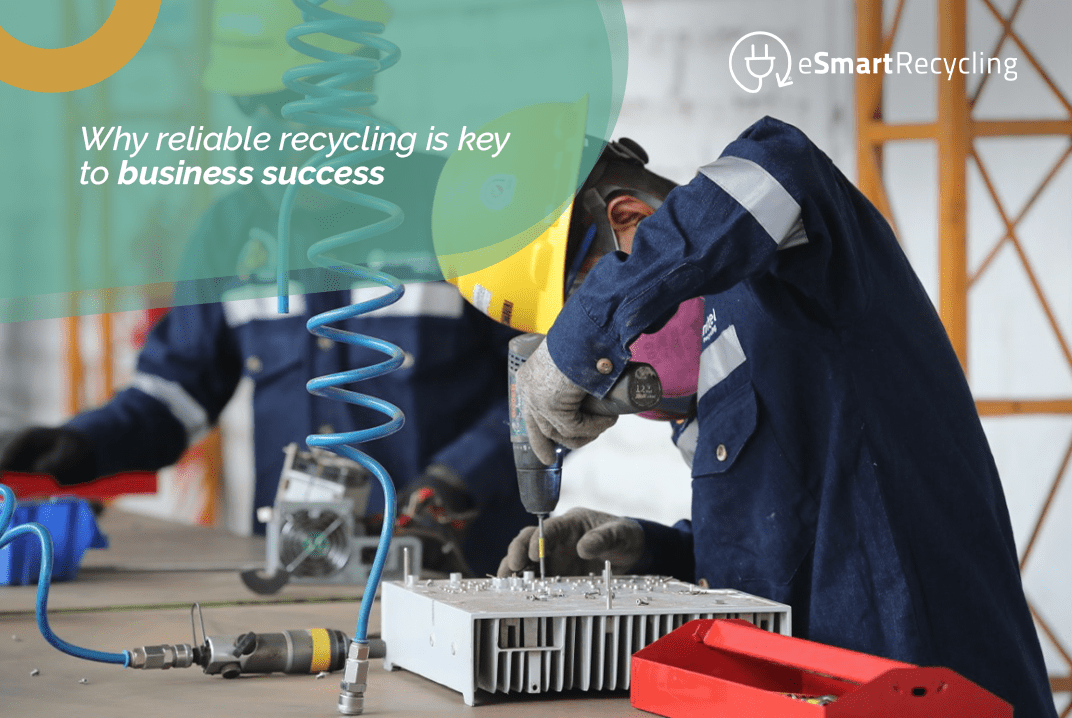
April 20, 2024
Businesses around the world have realized the importance of establishing operations that are efficient and sustainable. A significant factor in establishing sustainable business practices is reliable recycling. Reliable recycling helps reduce waste and can be a critical factor in a business’s success. This article explores why recycling is crucial for companies and how it can benefit their success.
Environmental impact
One of the most important reasons businesses should invest in reliable recycling is the positive environmental impact it can have. As we become more aware of our planet’s long-term ecological issues, recycling is an excellent tool for becoming a more responsible company. Reducing waste can also help businesses save money in the long run, as more waste means higher disposal costs. Reliable recycling can contribute to significant environmental goals, such as reducing energy consumption, increasing the use of renewable energies, and decreasing greenhouse gas emissions. In other words, reliable recycling can help the planet by minimizing waste, energy, and greenhouse gases.
Branding and public relations
Reliable recycling can be crucial to a company’s branding and public relations. In today’s environmentally conscious world, customers want to see that companies are taking responsibility for the environmental impact of their operations. By participating in reliable recycling, businesses can demonstrate to customers and the public that they are not just paying lip service to environmental stewardship. Engaging in reliable recycling shows a real commitment to sustainable business practices and can help businesses stand out in a saturated market.
Strengthening relationships and saving costs
Another critical reason businesses should invest in reliable recycling is the potential for cost savings and relationship strengthening. Reliable recycling can help enterprises mitigate rising waste disposal costs and offer cost savings in raw materials and greater operational efficiency. Furthermore, it can help businesses establish closer relationships with their supply chain partners. Many suppliers require their client companies to have effective recycling programs as a condition for continuing to do business. Therefore, having a solid recycling program can be vital for relationships and give businesses an advantage over their rivals in terms of supplier pricing.
Boosting innovation and product development
Finally, an often-overlooked advantage of reliable recycling is the potential to boost innovation and product development. Many companies are now seeking alternative materials to traditional raw materials to reduce waste and lower production costs. Investing in reliable recycling can be a source of new materials and innovative ideas, which can pave the way for new products and services. Thus, reliable recycling can boost a company’s environmental credentials and help it adopt a more innovative and forward-thinking approach.
The importance of reliable recycling in business success
Reliable recycling should be an essential consideration for any business. Investing in reliable recycling is good for the environment and can also be necessary for brand image and public relations. Additionally, it has the potential to save costs, improve relationships with supply chain partners, and can also be a source of innovation. Reliable recycling is a great starting point if you’re a business owner looking to improve your environmental credentials and make a positive impact.
April 30, 2024
Recycling electronic devices is a crucial step in conserving resources and the well-being of our planet. Electronic waste has become a serious global issue. Millions of tons of electronic waste are generated yearly, which can harm the environment if not properly managed.
Recent studies and life cycle assessments (LCA) have shown that recycling electronic devices is a more sustainable approach for the environment and can even yield economic benefits. This article will explain why recycling electronic devices is more eco-friendly than disposing of them, along with other important considerations.
Benefits of recycling electronic devices
It’s commonly known that recycling boosts sustainability efforts by reducing waste and conserving resources. In a traditional LCA of electronic devices, the environmental costs of extracting raw materials, manufacturing, distribution, use, maintenance, and end-of-life treatment are considered. An LCA also examines the recycling process of electronic waste, from collection to treatment, and analyzes the environmental impact of this process.
One of the main advantages of electronic recycling is that it reduces the amount of electronic waste sent to landfills. Various materials, including precious metals like gold and silver, can be recovered and reused when collected and processed correctly. This helps conserve resources and also prevents hazardous substances from contaminating landfills.
Additionally, there are potential economic benefits associated with electronic recycling. Many electronic devices contain precious metals and other valuable materials that can be recovered and reused. As a result, businesses and organizations that recycle electronic waste can enjoy cost savings by obtaining these materials for free or at a fraction of the cost compared to purchasing new ones.
Considerations for recycling electronic waste
Despite electronic recycling’s benefits, some important considerations are still worth exploring. One of the biggest challenges associated with electronic recycling is the logistics of collecting, processing, and distributing materials. Properly recycling electronic waste requires a robust collection, transportation, and treatment facility network and appropriate recycling strategies.
Another important consideration is the environmental impact of electronic recycling. LCA studies show that recycling electronic devices is more eco-friendly than disposing of them in landfills or incinerating them. However, the electronic recycling process itself also has its environmental impact. From the energy required for collection, transportation, and treatment to the pollution caused by the recycling process, electronic recycling is not free of environmental costs.
Despite the challenges and environmental impacts associated with electronic recycling, studies show that it remains a more eco-friendly option for the environment compared to other waste treatment options. Electronic recycling can reduce the amount of electronic waste in landfills while conserving valuable resources. Additionally, businesses and organizations can enjoy potential economic benefits from electronic recycling.
Therefore, we must make a collective effort to recycle our electronic devices properly. As an individual, you can take steps to ensure that your electronic devices are recycled professionally. You can look for recycling centers in your area that accept electronic waste and understand the collection, transportation, and recycling processes to ensure that materials are recycled effectively and responsibly. By doing your part to recycle electronic devices properly, you can help reduce the environmental impact of electronic waste and promote a greener future.
November 10, 2025
Managing electronic waste responsibly isn’t just about protecting the environment — it’s a solid, long-term business move. Here’s why, backed by real data, real examples, and the way we see it every day at eSmart Recycling.
The essentials: why it’s a business advantage
When a company takes electronic waste management seriously — from computers and servers to printers and cables — it benefits in several ways:
- Recovers value from materials like copper, gold, silver, and rare metals.
- Avoids legal or reputational risks tied to poor disposal practices.
- Gains trust through traceability and certifications (data destruction, environmental reports).
- Reduces disposal and hazardous transport costs.
- Accesses potential state or local recycling incentives.
Let’s break down why this matters.
A growing market — and a growing opportunity
The global electronic waste recycling market is projected to expand from around USD 25 billion today to over USD 130 billion by 2033, according to GlobeNewswire.
In the U.S. alone, the sector is valued at USD 24.7 billion in 2024 and could reach USD 45 billion by 2032, based on PS Market Research.
That growth isn’t just a headline — it reflects real business opportunities for organizations that collect, refurbish, or recycle electronics in a safe, compliant way.
Where profitability actually comes from
Value in recovered materials
Electronic devices contain valuable metals and minerals. In fact, one ton of printed circuit boards can hold more gold than a ton of mined ore, according to Iron Mountain.
When metal prices rise, so do profit margins — and the more precise your recovery process, the greater the yield.
Lower costs and scale benefits
For companies disposing of large volumes of tech equipment, traditional disposal methods are expensive — transportation, hazardous waste management, and processing costs add up fast.
Recycling partnerships can reduce those costs and even turn them into revenue streams. As volume increases and logistics improve, the cost per unit drops, creating room for scalability.
Real-world margins
Well-managed e-waste recycling businesses can reach operating margins of 10% to 20%, depending on volume, location, and commodity prices.
Risks — and how to manage them
E-waste recycling comes with challenges:
- Different state and local regulations.
- Strict data destruction requirements.
- High logistics costs without an efficient collection network.
- Price volatility in recovered metals.
- Informal or illegal export competition.
To manage these risks:
- Secure consistent volume through partnerships with companies and OEMs.
- Get certified under international standards.
- Maintain traceability and transparent audits.
- Diversify revenue streams — resale, refurbishment, reporting, consulting.
How we do it at eSmart Recycling
At eSmart Recycling, we operate in the U.S. under the R2v3 certification, the world’s most recognized standard for responsible electronics recycling.
This certification ensures every step — from collection to secure data destruction and material recovery — meets rigorous environmental, safety, and data protection standards.
- We audit all devices and perform certified data destruction.
- Around 30% of our revenue is reinvested in refurbishing devices we later donate to underserved communities.
- Every business client receives compliance and traceability reports to support their sustainability goals.
By combining technical compliance, social value, and financial sustainability, we maintain a circular model that benefits both the planet and our partners.
Closing the loop with purpose
Managing electronic waste properly isn’t just about avoiding fines or meeting regulations. It’s about showing responsibility toward something bigger — our shared resources, our customers’ trust, and the communities around us.
Every properly recycled device tells a different story: less pollution, more material recovery, and new opportunities for others to access technology.
At eSmart Recycling, we see it every day. And yes, when it’s done with purpose, recycling technology is good business.

December 10, 2024
In recent years, there has been a shift in how we talk about the environment, with the word “sustainability” occupying more space than ever. But what is sustainability, and why is everyone talking about it now? It’s time to delve into the topic and explore why it has become such a focal point.
What is Sustainability?
Sustainability is a broad term that refers to a holistic approach to preserving resources and natural environments for the long term. It encompasses various social, economic, environmental, and cultural factors. The central idea underlying the concept is to meet present needs without compromising the ability of future generations to meet their own. It is a complex and multifaceted issue, making it crucial for discussion and action.
Why Is This Topic Being Discussed Now?
In recent years, discussions around sustainability have significantly increased, largely due to the growing recognition of the devastating effects of climate change. The Intergovernmental Panel on Climate Change (IPCC) has warned that we have only a decade to limit the catastrophic effects of climate change and that industrialized nations must reduce their carbon emissions by 45% by 2030 to avoid a crisis. With this urgent deadline looming, many individuals and organizations have taken steps to enhance their commitment to sustainability, aware of the severe consequences of inaction.
What Are Some Common Questions About Sustainability?
The rise in conversations about sustainability has led to a series of common questions that are frequently asked and deserve examination. Questions like “What is Sustainable Development?” and “Why is sustainability so important for the future of our planet and a more sustainable world?” are often posed, and we will provide answers in the following sections of this article.
* This resource was provided in collaboration with Sustainability Reporter
What is Sustainable Development?
Sustainable Development refers to meeting present needs without compromising the ability of future generations to meet their own needs. It involves balancing goals for a better life and a healthy, inclusive society with the need to mitigate climate change impacts and preserve natural resources. As seen in organizations like the International Energy Agency (IEA), a transition towards cleaner energy sources and more sustainable production systems is necessary.
Why Is Sustainability So Important for the Future of Our Planet?
Sustainability is crucial for the future of our planet as it is the only way to mitigate the worst effects of climate change. According to data from the Energy Transitions Commission (ETC), by 2024, a green and sustainable revolution could reduce temperature increases by 90% and create up to 90 million jobs in the coming decades. Additionally, a significant shift towards renewable energy systems, energy-efficient buildings, and modernized infrastructure will bring numerous benefits, from improved health outcomes to better environmental and social results.
How Can I Increase My Commitment to Sustainability?
There are several ways individuals can take steps toward a more sustainable future. Checking product sustainability ratings and scores can empower people to make more informed purchasing decisions. Many major organizations, such as ReSkilling America Institute, offer programs that help develop and train the workforce while incorporating sustainability principles into their lessons.
Embracing Sustainability for the Future
The conversation around sustainability continues to grow as countries and individuals take real steps toward creating a more sustainable future. If we want to build a better future than what we see today, sustainability must play an important role in it. We can create a brighter and cleaner future by fully embracing sustainability principles and making proactive changes in how we use resources and energy.
Sustainability is an urgent issue that requires all of us to take proactive steps in response. Learning more about and adopting sustainability principles are essential first steps on this important journey, and the future will be more promising if we start working collectively toward creating a more sustainable world.
December 25, 2025
Your ESG plan—environmental, social, and governance—already drives how your company operates. But there’s one piece that often gets overlooked: what happens to your old tech. At eSmart Recycling, based in Tampa, Florida, we handle electronic recycling from start to finish: pickup, auditing, secure data destruction, valuation, and donation. Here’s why adding us to your 2026 ESG strategy can make a real difference.
How e-waste recycling strengthens the “E” in ESG
When companies discard computers, printers, routers, and cables, those devices often end up stored indefinitely or in landfills with no traceability. But electronic waste is one of the fastest-growing waste streams on the planet. In 2019, the world generated 53.6 million metric tons of e-waste, yet only 17.4 % was properly recycled.
Proper recycling prevents toxic elements like lead, mercury, or cadmium from leaking into soil and water.
When you work with us:
- Every device is audited, securely wiped, and processed with full traceability.
- You receive detailed reports showing landfill diversion rates and material recovery—perfect for ESG disclosures. Some recyclers now offer ESG-ready reporting covering metrics such as avoided emissions and recycling rates.
- You also reinforce your governance practices through verifiable data security and chain-of-custody documentation.
Strengthening the “S” and “G” pillars through tech reuse
The social benefit is simple but powerful: part of the equipment we collect is refurbished and donated to underserved communities. At eSmart Recycling, about 30 % of our revenue goes toward repairing and donating technology to kids, families, and schools that need it most.
On the governance side, our certified data destruction and transparent reporting give your company verifiable control over asset disposition. You get destruction certificates, audit trails, and measurable outcomes—exactly the kind of evidence investors and compliance teams expect in ESG reports.
How our partnership works
- Collection – We pick up your retired tech directly from your office or facility.
- Inventory and audit – Every device is recorded, checked, and evaluated for reuse or recycling.
- Secure data destruction – We erase all data following strict standards (HIPAA-compliant when applicable).
- Refurbish and reuse – A portion of devices are repaired and donated; the rest are responsibly recycled.
- Impact reporting – You receive a customized ESG report with metrics such as devices processed, recovered materials, emissions avoided, and donation results.
By 2026, those metrics—“X devices recycled, Y kg of materials recovered, Z families helped”—can appear directly in your sustainability disclosures and annual reports.
Why start planning now for 2026
Regulations, investor pressure, and consumer expectations are rising fast. Companies that already integrate responsible e-waste practices are ahead of the curve. According to IBISWorld, the U.S. electronic recycling industry is growing at a compound rate of 8 %, showing how essential this service has become.
Meanwhile, new ESG tools—like the carbon avoidance calculator by e-Stewards and Bloom ESG—help organizations track emissions prevented (Scope 4) through recycling and refurbishment. Partnering now ensures that by 2026, your company has verified, report-ready data instead of vague commitments.
Who benefits from working with us?
- Sustainability officers who need measurable data for ESG disclosures.
- IT and operations teams that manage sensitive assets.
- Compliance departments seeking certified, auditable vendors.
- Marketing and CSR teams are looking for authentic stories of environmental and social responsibility.
If your organization wants a partner who collects, audits, wipes, and redeploys technology—while supporting real people in the process—we’re ready. At eSmart Recycling, we help companies make their ESG strategy tangible, verifiable, and good for everyone involved.
November 5, 2025
Eco-friendly design —also known as ecodesign— has become essential in technology manufacturing. If it’s not considered early in a product’s lifecycle, companies face higher regulatory costs, wasted materials, reputational pressure, and the risk of falling behind clients who already value sustainability.
What does eco-friendly design mean today?
Eco-friendly design looks at every part of a device —materials, assembly, repairability, disassembly, recycling— to minimize its environmental footprint. It’s not just about making something “green.” It’s about ensuring the product is built to:
- Use recycled or non-toxic materials,
- Support repairs and upgrades,
- Allow better recovery at the end of life,
- Reduce energy use during operation.
A study shows that up to 80% of a product’s environmental footprint is determined during its design phase, since it influences everything from extraction to disposal.
When design doesn’t account for recyclability or reuse, the diversity of components and materials (“component diversity”) makes recovery extremely difficult.
Benefits for manufacturers and companies
Applying eco-friendly design helps both the planet and business operations:
- Lower operational costs: Many companies plan to increase their sustainability efforts due to savings in raw materials and competitive advantages.
- Regulatory compliance: Policies like the RoHS Directive or EU ecodesign standards limit the use of hazardous substances.
- Customer preference: Businesses and consumers now include environmental impact as part of their purchase criteria.
- A stronger circular model: Eco-friendly design makes it easier to reuse materials and reduce waste.
The green electronics manufacturing market is projected to grow from about USD 12.9 billion in 2024 to USD 24.2 billion by 2032. Another report estimates it will reach USD 15.33 billion in 2025 with a 23.8% annual growth rate.
These projections show that companies integrating eco-friendly design early on will have a stronger position in the years ahead.
Challenges to overcome
The shift comes with hurdles. Some of the main ones include:
- Higher upfront costs for recycled materials, modular design, and disassembly testing.
- Supply chain complexity, because every supplier must meet sustainability standards.
- Performance differences between some eco materials and conventional ones.
- The a need for collaboration between designers, manufacturers, recyclers, and regulators.
How to move forward: practical steps and examples
Here are a few ways companies can implement eco-friendly design in practice:
- Modular and repairable design: replace or upgrade parts without changing the entire device.
- Component standardization: fewer material types make recycling easier.
- Use of recycled or biodegradable materials, such as recycled plastics, halogen-free adhesives, or sustainable PCB substrates.
- Early-stage evaluation tools: the “GreenTool” from Finland’s VTT research center helps compare sustainable options during design.
- Take-back and internal recycling programs: when we collect used tech, the original design often determines how easily it can be refurbished.
- Transparency and certifications: sharing verified sustainability practices builds trust and accountability.
At eSmart Recycling, we experience this every day. When we receive devices for secure destruction or refurbishment, we can tell how much easier it is to recover and reuse technology that was originally designed with sustainability in mind.
Toward a more conscious tech industry
Eco-friendly design is becoming a standard requirement in technology manufacturing. Companies that embrace it early will be better prepared in regulatory, commercial, and operational terms. For sustainability leaders, this is the right moment to make design part of the product strategy — from the very beginning.
When a product is conceived with environmental awareness, its entire lifecycle —from use to recovery— flows more smoothly and leaves a better footprint for everyone.

May 19, 2025
In a world where sustainability is no longer optional but a strategic necessity, how companies handle their electronic waste makes a real difference. Choosing local and certified recycling doesn’t just protect the environment—it also strengthens corporate reputation, drives measurable social impact, and minimizes legal risks.
You Secure Your Sensitive Data
One of the biggest fears when recycling technology is the risk of sensitive data being exposed. A certified recycler ensures that data is destroyed securely, following international standards like R2v3.
A study by Blancco Technology Group found that 42% of second-hand hard drives still contained confidential data (https://www.blancco.com/resources/research-reports/left-behind-the-dangers-of-cloning-datacenter-drives/). Imagine if your company’s information ended up in the wrong hands. Certified recycling eliminates that risk and provides documented proof of secure data destruction.
You Support Your Local Economy
Local recycling strengthens businesses and communities right where you operate. Besides cutting down on carbon emissions from unnecessary transportation, it fuels job creation and supports local economic growth.
Many local recyclers also reinvest in community programs, such as donating refurbished computers to schools, libraries, or digital literacy initiatives. This way, your company not only recycles but helps plant seeds of opportunity where they are needed most.
You Meet Environmental Compliance Standards
Regulatory pressure around electronic waste management grows stronger each year. Laws like the Responsible Electronics Recycling Act and evolving ESG (Environmental, Social, and Governance) standards demand responsible, traceable, and auditable practices.
Partnering with a certified recycler makes audits easier, strengthens your sustainability reporting, and showcases your environmental commitment to clients, partners, and investors (https://www.morganstanley.com/articles/what-is-esg-investing).
You Create Tangible Social Impact
Beyond compliance, responsible technology recycling can be a powerful tool for social change. Many recycling programs help close the digital divide by donating refurbished devices to underserved communities.
By choosing local and certified recycling, every computer, tablet, or server you release can find a second life and change someone’s future.
You Cut Costs and Simplify Logistics
A local recycling provider offers greater logistical flexibility: faster response times, lower transportation costs, and the ability to handle large volumes more efficiently.
Some even provide on-site services for hard drive destruction or direct pickup from your office, helping you free up physical and mental space without disrupting your operations.
How to Choose the Right Recycler
Before you commit, make sure your recycler is certified by recognized standards like R2v3 or e-Stewards. Verify that they provide secure data destruction, full traceability reports, and clear policies on equipment reuse. It’s also smart to ask about their community impact initiatives—true responsible recycling starts with purpose, not just disposal.
December 19, 2023
In today’s technology-driven world, electronic devices have become an integral part of our lives. From smartphones to laptops and tablets, we depend on these devices for communication, entertainment, and work. However, as technology continues to evolve rapidly, so does the problem of electronic waste.
Discarded electronic devices pose a significant threat to the environment if not disposed of properly. This is where eSmart Recycling comes in. As a leading provider of eco-friendly electronic recycling solutions in Tampa, eSmart Recycling offers a variety of services that make recycling your devices convenient and practical.
Who is eSmart Recycling?
eSmart Recycling is a reliable electronic recycling company based in Tampa. With years of experience in the industry, we have established ourselves as a trustworthy and responsible solution for disposing of electronic waste. Our team of experts is committed to providing sustainable solutions that benefit both the environment and the community we serve.
What makes eSmart Recycling the right choice?
- Environmentally friendly practices: At eSmart Recycling, we understand the importance of minimizing the impact of electronic waste on the environment. We follow strict recycling protocols and comply with all relevant regulations to ensure that each device we handle is recycled responsibly. By choosing us, you can contribute to reducing electronic waste and promoting a greener future.
- Convenient drop-off locations: We have our Community Collection Partners in Tampa, making it easy to recycle your devices. Whether you are a business or an individual, our conveniently located collection points allow hassle-free disposal of your electronic equipment. We strive to make the recycling process as simple as possible, ensuring a seamless experience for our customers.
- Secure data destruction: Your privacy and data security are our top priorities. Before recycling any device, we ensure all data is completely erased. Our certified data destruction processes meet industry standards, giving you peace of mind that your personal information remains secure throughout the recycling process.
- Sustainable partnerships: We believe in creating a sustainable future through collaboration. That’s why we work with various organizations, including businesses, schools, and government agencies, to promote electronic recycling. Our partnerships allow us to reach a wider audience and raise awareness about the importance of responsible disposal of electronic waste.
How does eSmart Recycling operate?
- Device assessment: When you bring your device to one of our drop-off locations, our experts assess its condition. We determine whether it can be refurbished for resale or needs to be recycled. This assessment allows us to maximize the lifespan of devices and minimize waste.
- Responsible recycling: If we determine that your device cannot be refurbished, it undergoes responsible recycling. We dismantle the device and separate its components for proper recycling. Materials such as plastics, metals, and precious metals are extracted and sent to specialized facilities for processing.
- Secure data destruction: Before recycling any device, we ensure all data is permanently erased to protect your privacy. Our certified data destruction techniques leave no trace of personal or confidential information on your device.
- Environmental impact: eSmart Recycling believes in transparency. We provide detailed reports on the environmental impact of our recycling activities, including the amount of waste diverted from landfills, materials recovered, and reduced carbon emissions. We continually strive to improve our practices and minimize our environmental impact.
When can you recycle your devices with eSmart Recycling?
You can recycle your devices with eSmart Recycling at any time. Our drop-off locations are open during regular business hours and accept devices throughout the year. Whether you have an old smartphone, a broken laptop, or outdated computer equipment, we are here to help you dispose of your electronic waste responsibly whenever you need it.
Where can you find eSmart Recycling?
At eSmart Recycling, we have multiple convenient drop-off locations in Tampa, through our Community Collection Partners. You can easily find the nearest collection point by visiting our website or contacting our customer service team. Our goal is to make electronic recycling accessible to everyone in the Tampa community.
Why should you choose eSmart Recycling?
By choosing eSmart Recycling for recycling your devices, you are making a conscious decision to protect the environment and support a sustainable future. We prioritize responsible recycling practices, secure data destruction, and convenience for our customers. Additionally, our partnerships and community engagement initiatives ensure that our impact extends beyond the individual recycling of devices. Join us in making a difference by choosing eSmart Recycling today.
Recycle your devices responsibly with eSmart Recycling, the trusted choice for electronic waste disposal in Tampa.

May 16, 2024
Biodiversity has always been a crucial component of the environment. It has been a defining feature of the natural world, and its value cannot be overstated. Therefore, the field of biodiversity has become intertwined with the business world. Both have endless links that can be seen in how biodiversity influences and shapes business activities. This article will explore the main connections between biodiversity and business and why companies should care about improving and protecting biodiversity.
The benefits of biodiversity for businesses
Biodiversity offers a range of benefits to businesses. For example, it contributes to producing goods and services, supports the stability of ecological systems, and helps business leaders find innovative solutions, among other things. Biodiversity also helps businesses respond to market changes and reduces the risks associated with businesses based on natural resources, such as agriculture, fishing, mining, and forestry.
The negative impact of business activities on biodiversity
However, businesses also impact biodiversity. Their activities can reduce the number of species, disrupt ecological processes, and introduce non-native species in Western countries. These impacts can lead to the complete loss of entire ecosystems and the extinction of species, which can have far-reaching consequences for business activities.
For example, biodiversity loss can destabilize the natural foundations that support businesses and their related industries. This can result in decreased profitability, lower environmental and social performance, and increased legal and market risks.
Businesses that care about biodiversity
In recent years, businesses have become increasingly aware of the importance of biodiversity and have undertaken a series of actions to address it. Many global businesses have implemented policies and practices to enhance biodiversity, including operations, supply chains, and local communities. For example, natural resource extraction companies have begun implementing sustainable practices such as reforestation and conservation. Additionally, some businesses have started investing in reserves and natural parks as part of their corporate social responsibility efforts.
What can businesses do to protect biodiversity?
If businesses want to protect and enhance biodiversity, they can take several measures. For example, they can increase the transparency of their operations and supply chain to facilitate identifying and tracking impacts and outcomes on biodiversity. They can also provide training and education to their suppliers, customers, and employees on biodiversity-related issues. Additionally, businesses can adopt and implement legal and voluntary standards and guidelines to support biodiversity conservation and sustainable use.
A great example of a company taking active measures to protect biodiversity is Unilever, the global consumer goods company. The company has an extensive corporate sustainability program includes commitments to reduce its environmental impact and initiatives to protect biodiversity. The company has collaborated with local communities and NGOs to promote wildlife and flora conservation, restore habitats, and plant over 1,000,000 trees to increase biodiversity.
Protecting and enhancing biodiversity has become an important part of business activity. Companies have only begun to scratch the surface regarding the positive effects they can have on biodiversity. Moreover, protecting biodiversity is the right thing to do and can have real business implications. By taking the right steps, businesses can better understand and anticipate ecosystem responses to their activities and identify opportunities for developing new businesses and products. The bottom line is that businesses that care about protecting biodiversity can improve their environmental outcomes and increase competitiveness.
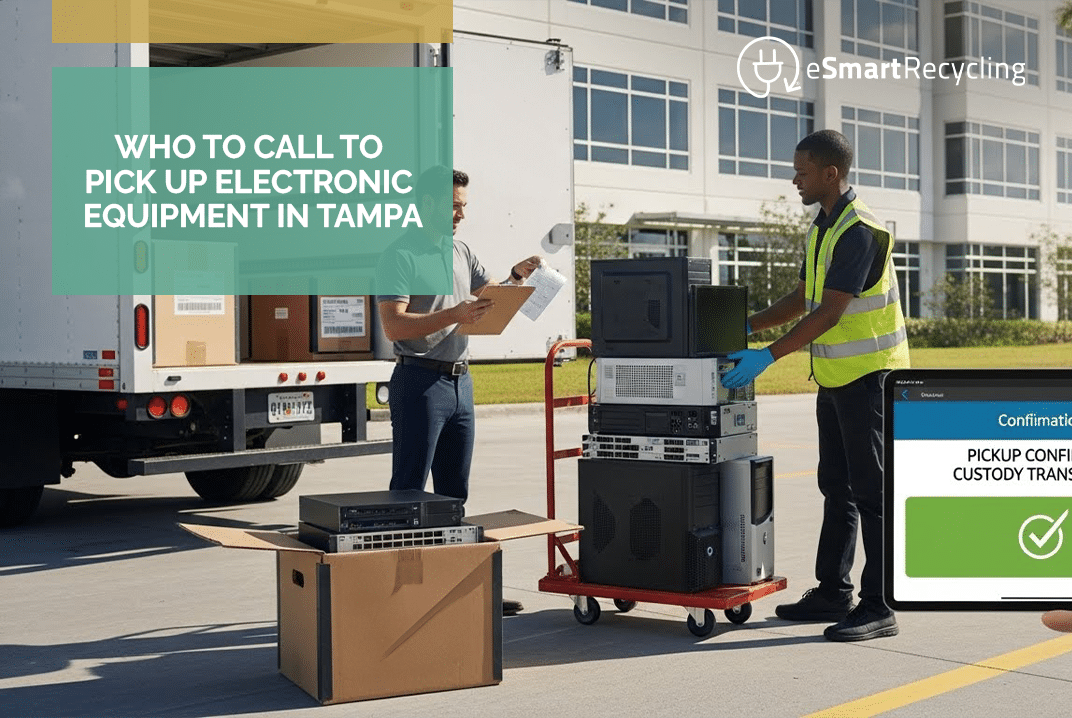
January 19, 2026
If your company needs electronic equipment picked up in Tampa, the answer is simple: call us. At eSmart Recycling, we handle the pickup, management, and proper documentation of electronic equipment your business no longer uses, following recognized standards in the U.S.
This is not just about moving boxes out of an office. It is about knowing who takes responsibility for those devices the moment they leave your facilities.
Why doesn’t every option work for businesses
Many companies begin by seeking quick fixes. City collection events, one-time donation drives, or general waste services often seem convenient. The issue is that these options are typically designed for households, rather than for organizations that require traceability, accountability, and clear records.
When equipment belongs to a business, different questions matter. Who picks it up? Where it goes. What happens to the data? What documentation remains afterward? Without clear answers, the responsibility stays with the company.
That is why electronic equipment pickup in Tampa is not only a logistical decision. It is an operational one.
What happens when you call us
When a company contacts us, the process starts with a straightforward conversation. We review what equipment needs to be removed and from where. This can include computers, monitors, printers, servers, networking gear, or peripherals.
We coordinate pickup directly at your office, so your team does not have to manage transport or technical handling. Equipment is logged, removed, and taken to our facility for proper processing.
From that point on, the responsibility shifts to us.
Why our certification matters
In the U.S., one of the most recognized standards for responsible electronics recycling is R2v3 (Responsible Recycling), developed by SERI (Sustainable Electronics Recycling International).
This certification defines how electronic equipment must be handled in business environments, including chain of custody, material management, and recordkeeping.
At eSmart Recycling, we operate under R2v3 certification. For companies, this means pickups are part of a documented process aligned with nationally recognized standards, not an informal handoff.
What happens to your data
Data security is often the main concern when companies consider removing electronic equipment. And that concern makes sense.
Devices such as computers, servers, and some office equipment can still contain sensitive information long after they stop being used. The National Institute of Standards and Technology (NIST) outlines accepted data sanitization methods in NIST SP 800-88 Rev. 1.
https://csrc.nist.gov/publications/detail/sp/800-88/rev-1/final
When you call us, data handling is addressed from the beginning. Equipment with storage media is managed through defined, documented processes that follow applicable guidelines.
The types of companies that usually call us
We work with corporate offices, schools, healthcare organizations, service companies, and businesses that are upgrading technology or relocating.
Sometimes the call comes from a company clearing out a storage room. Other times, it is tied to an internal audit or an upcoming inspection. In many cases, the goal is simply to close out a technology refresh properly.
Across all of these situations, the need is the same: someone must take clear responsibility for the pickup and disposal.
Why calling sooner makes sense
Waiting does not remove the issue. Equipment keeps taking up space, data still exists, and responsibility remains with the company.
The U.S. Environmental Protection Agency (EPA) encourages businesses to work with qualified electronics recyclers to ensure proper handling of end-of-life equipment.
Calling us allows your company to close the loop with documentation and without loose ends.
Questions companies usually ask before scheduling a pickup
Companies often ask whether equipment needs to be sorted in advance, if there is a minimum volume, or whether pickup will disrupt daily operations. In most cases, the answer is no.
We coordinate around your schedule and keep the process simple. The goal is to resolve the situation, not to add extra steps for your team.
So, who should you call in Tampa?
If your business is in Tampa and needs electronic equipment picked up in a clear, organized, and documented way, call us.
We take care of the pickup, responsible management, and the records many companies need for internal use.
When it comes to business electronics, knowing who to call makes all the difference.

April 8, 2026
If the answer is “I don’t know” or “I guess IT,” you’ve already found the problem.
Old technology builds up because no one owns the problem. IT says it belongs to facilities. Facilities says IT needs to handle the data first. Finance says someone needs to approve the expense. Meanwhile, the equipment just sits there.
Why does no one want to be responsible
The person who makes the decision takes on real risk.
What if there was sensitive data and a breach happened? What if someone needed something from those devices later? What if the process doesn’t meet regulations?
When the risk is high and ownership is unclear, delaying the decision becomes the safest option. That 2015 laptop can sit in the closet for another two years, and no one complains.
IT managers and the fear of a data breach
IT’s biggest concern isn’t the space old equipment takes up. It’s a data breach.
Those laptops contain corporate emails, access to internal systems, employee information, and maybe client data. Manually deleting files doesn’t work. Formatting isn’t enough either. There is software that can recover data you thought was gone.
IT knows this. That’s why they prefer keeping equipment locked away rather than risking it ending up in the wrong hands.
The problem is that IT doesn’t always have the budget to hire certified destruction services. And even if they did, coordinating pickups and certificates isn’t a priority when they have 50 open tickets and a system down.
IT can guarantee proper data destruction. Running the full process is another story.
Facilities and the space problem
Facilities sees the problem in terms of wasted square footage.
That room full of old equipment could be useful for storage, a meeting room, or just open space. But it’s occupied by technology no one uses.
Facilities coordinates pickups and manages vendors. But they don’t have authority over data security or budget for specialized services.
They can move boxes around. Approving certified hard drive destruction requires involving other departments.
Finance and budget control
Someone has to pay. And that someone reports to finance.
Finance wants to know: how much does it cost? Is there a return? Is it an operating expense or capital expense? Can we deduct anything?
These are valid questions. But while finance waits for a full business case, the equipment keeps piling up in that third-floor closet.
Finance approves the expense when they have the numbers. Inventorying laptops and coordinating pickups is not part of their role.
The uncomfortable truth
Recycling old technology crosses multiple departments, and no one has full ownership.
IT needs to ensure data security. Facilities need to free up space. Finance needs to approve the budget. Legal needs to verify compliance. Procurement needs to hire certified vendors.
When something requires five different people to act, the project stalls. Each one waits for someone else to take the first step.
How to break the cycle
Someone needs to own the process. Not every technical step, but making sure it gets completed from start to finish.
It can be IT, facilities, operations, or even sustainability if that role exists in your company. One person says, “I’ll take care of this,” and has the authority to involve other departments when needed.
That person coordinates. They don’t do everything.
IT defines the level of data destruction required based on compliance.
Facilities coordinates pickup logistics without disrupting operations.
Finance approves the budget with a clear quote from a certified vendor.
Procurement hires the vendor that meets technical and legal requirements.
One person moves the project forward. Everyone else contributes their part. The cycle gets completed.
What changes when there is clear ownership
We’ve worked with companies in Tampa that go years with equipment piling up. Then someone takes ownership, and the problem gets resolved in two weeks.
The difference isn’t budget or urgency. It’s having someone who asks what’s missing, involves the right people, and closes the loop.
At eSmart Recycling, we make this easier. Once there’s a clear point of contact in your company, we handle the technical and logistical side: transparent quotes, pickup coordination, full inventory, certified physical data destruction, component separation for recycling, compliance certificates, and environmental documentation.
Your point of contact just needs to approve the start and sign off at the end.
Start by assigning an owner
If you have old technology piling up in your company in Tampa, the first step is not inventorying equipment or requesting quotes. It’s assigning an owner.
It can be a 30-day project on someone’s calendar. It doesn’t have to become a permanent responsibility. Just someone who coordinates until the equipment leaves the building and the certificates are delivered.
Once it’s done, you can make it recurring. Every six months or once a year, the same person coordinates recycling for equipment that has been retired. It becomes routine instead of a crisis.
We’re located at 5100 Vivian Place, Tampa. You can contact us at (813) 501-7768 or info@esmartrecycling.com. We work directly with whoever you assign as your point of contact and simplify every step of the process.
Those devices are not going to disappear on their own. You also don’t need five departments agreeing on every detail.
You just need someone to own the process. The rest gets handled step by step.
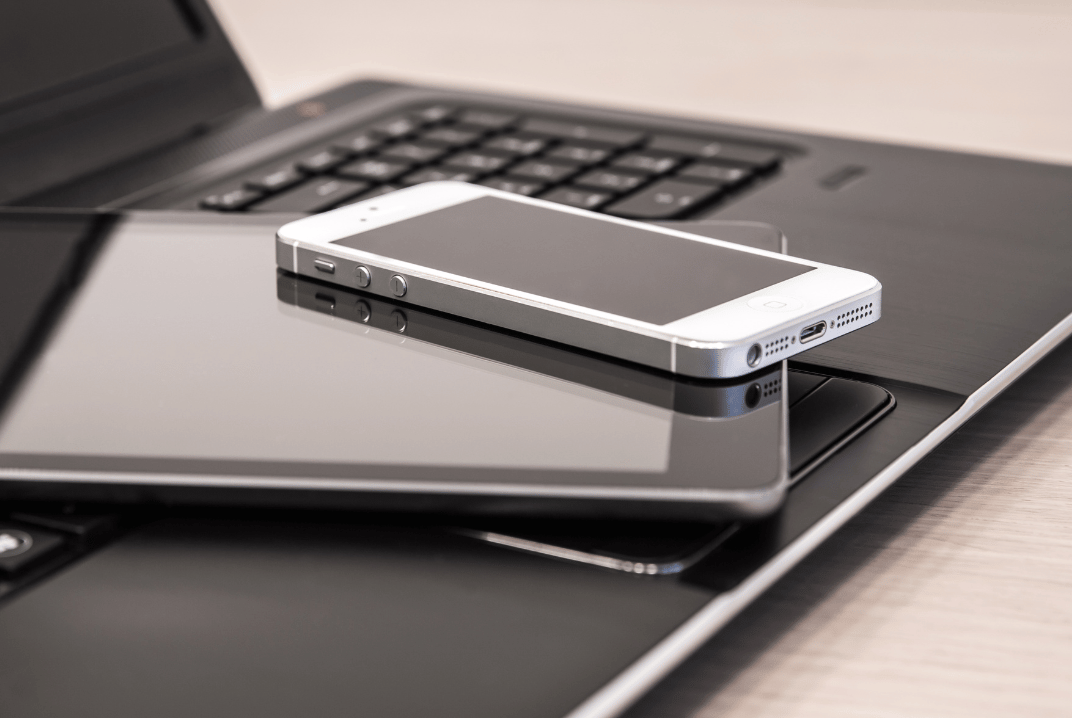
February 16, 2026
Many companies use technology every day, but not all stop to think about what happens to that equipment once it’s no longer useful. The question of which businesses should recycle electronic equipment comes up more often than expected, especially when computers, monitors, or servers start piling up in storage areas.
The short answer is that any business that uses technology will eventually need to recycle it. The more useful answer is understanding what types of businesses face this need most often and why.
Office-based businesses
Office-based companies are among the most common businesses that need electronic recycling. Desktop computers, laptops, monitors, phones, and accessories are replaced every few years as teams grow or systems change.
When equipment is replaced, it’s often stored “just in case.” Over time, those devices lose operational value and remain stored without a clear plan. In these environments, recycling helps keep offices organized, frees up space, and reduces data-related risks.
Technology firms and professional services
Technology companies, consulting firms, marketing agencies, and other professional services rely heavily on up-to-date equipment. Performance requirements tend to be higher, which leads to more frequent upgrades.
As a result, these organizations generate a steady flow of devices leaving active use. They are common types of businesses that recycle electronics on a regular basis, often treating recycling as part of their normal IT cycle rather than an occasional task.
Healthcare organizations and data-sensitive businesses
Healthcare providers, clinics, labs, and other organizations that handle sensitive information face a different level of responsibility. For these businesses, recycling is closely tied to data protection.
Computers and digital devices often contain patient records or confidential information. The Federal Trade Commission warns that improper disposal of electronics with stored data can lead to security and compliance issues. Their guidance on safe electronics disposal highlights why handling this equipment correctly matters:
https://www.ftc.gov/business-guidance/resources/disposal-old-electronics-what-you-need-know
For these organizations, working with electronics recycling services for businesses that include secure data handling and documentation is essential.
Educational institutions and nonprofits
Schools, universities, and nonprofit organizations use large volumes of technology across classrooms, offices, and community programs. Laptops, desktops, tablets, and networking equipment are regularly replaced as programs evolve.
When these devices reach the end of their use, recycling becomes necessary to prevent accumulation. Many educational and nonprofit organizations also look for recycling options that allow for reuse or donation when equipment still functions.
Industrial and logistics companies
Industrial and logistics businesses are not always associated with traditional office environments, but they rely heavily on technology. Computers for operations, servers, scanners, and network equipment support daily workflows.
When this equipment becomes outdated, it often ends up stored in warehouses or technical rooms. Over time, storage becomes cluttered and difficult to manage. Recycling helps these companies keep facilities safer and more organized.
Small and mid-sized businesses
Many small and mid-sized businesses assume electronic recycling is mainly a concern for large corporations. In reality, smaller organizations face the same challenges, often with less space to store unused equipment.
A small business with a few years’ worth of stored computers may struggle to decide what to do with them. This makes them just as much a part of the businesses that need electronic recycling, even if the issue appears less urgent at first.
Growing companies and businesses in transition
Companies experiencing growth, relocation, or restructuring often uncover equipment they no longer remember owning. Moves, mergers, or office changes tend to reveal old computers and devices that were set aside years earlier.
During these transitions, recycling electronic equipment helps close one chapter and begin the next with clearer inventories and fewer loose ends.
Recycling as an operational decision
For many businesses, recycling electronics isn’t only about environmental responsibility. It’s about data security, internal organization, and operational clarity.
When companies lack visibility into what equipment they have, where it’s stored, or what data it contains, the issue becomes operational rather than technical.
How we work with different types of businesses
We, at eSmart Recycling, work with a wide range of businesses, including offices, healthcare organizations, educational institutions, nonprofits, industrial companies, and growing businesses. Each type has different needs, but they all face the same question of what to do with technology that’s no longer in use.
We help companies review their equipment, understand their options, and recycle devices in a clear and documented way.
There isn’t a single type of business that needs to recycle electronic equipment. Any organization that relies on technology will eventually reach that point.
Recognizing the type of business and the volume of equipment involved makes it easier to take the right steps. Recycling at the right time prevents accumulation, reduces risk, and keeps technology management from becoming a lingering issue.

February 6, 2026
Businesses replace computers regularly, but recycling often gets postponed. Devices end up stored in closets, warehouses, or unused rooms with no clear plan. Over time, that pile grows and becomes harder to manage.
Knowing where to recycle computers in Tampa Bay helps close that process in an organized and secure way that aligns with internal company policies. It’s not just about getting rid of equipment, but about handling it correctly.
Why computer recycling matters for businesses
Business computers are not ordinary waste. They store internal information, system access credentials, emails, and, in many cases, customer data. When devices sit unused without control, the risk doesn’t disappear; it just gets delayed.
There’s also an operational side to consider. Storage space gets taken up, asset inventories become inaccurate, and IT teams lose visibility over what equipment still exists. That’s why choosing the right computer recycling Tampa Bay option is an operational decision, not just a logistical one.
Options for recycling computers in Tampa Bay
Tampa Bay offers several alternatives for computer recycling, but they don’t all serve the same needs.
Municipal recycling centers often accept certain electronics, but they usually don’t provide data destruction services or detailed documentation. For businesses, that level of service is often not enough.
Community collection events can be useful, but they tend to be occasional and limited in volume. They work for one-time situations, not for ongoing business needs.
Companies that specialize in electronics recycling in Tampa Bay operate differently. They focus on business volumes, scheduled pickups, data handling, and reporting, which are key factors for organizations that need structure and accountability.
What a business recycling option should include
Recycling computers at a company level involves more than dropping off equipment. A reliable option should include equipment pickup, controlled handling, and secure data destruction.
Documentation is another essential piece. Businesses often need records for internal audits, compliance reviews, or partner requirements. Without proper documentation, the recycling process remains incomplete.
The importance of data destruction
One common mistake is assuming that deleting files or resetting a computer is enough. In business environments, that approach falls short.
The Federal Trade Commission advises specific practices for disposing of electronics that contain sensitive information, warning that improper disposal can lead to data exposure and legal issues. The FTC guidance can be found here:
https://www.ftc.gov/business-guidance/resources/disposal-old-electronics-what-you-need-know
When evaluating where to recycle computers in Tampa Bay, data destruction should be one of the main criteria.
Recycling computers at scale
Some local options work well for a small number of devices, but recycling dozens or hundreds of computers requires a different setup.
In these cases, working with computer recycling services Tampa Bay that can handle volume, scheduling, and on-site pickup helps avoid operational disruption. Planning makes the process smoother for IT and operations teams.
What happens to computers that still work
Not every retired computer is unusable. Some devices can be reused or refurbished, depending on their condition.
Certain recycling providers evaluate incoming equipment and, when appropriate, redirect it toward reuse or donation programs. For many businesses, knowing that part of their technology continues to be useful adds value to the recycling decision.
Reporting and traceability
Another key factor is visibility after the equipment leaves the office. Businesses need to know what happened to their devices.
Recycling reports provide clarity on how equipment was handled and help maintain clean internal records. Without traceability, companies lose oversight of their retired technology.
Working with a local specialized provider
Choosing a local provider makes coordination easier. In Tampa Bay, working with a company that understands the needs of regional businesses simplifies communication and scheduling.
We, at eSmart Recycling, work with Tampa Bay businesses to manage out-of-use computers in a secure, organized, and documented way. We support companies from planning through process completion.
Knowing where to recycle computers in Tampa Bay is about more than finding a nearby location. It’s about selecting an option that supports security, organization, and internal policies.
When recycling is handled clearly and on a regular basis, computers stop being a stored problem and become part of a controlled process. For businesses, that means fewer risks and better control over their technology lifecycle.

March 31, 2026
Florida doesn’t stop growing. More people, more construction, more companies opening offices, more infrastructure going up. And with all that growth comes something that rarely gets mentioned: more technology that eventually becomes obsolete, more equipment nobody knows what to do with, more pressure on the systems that handle what’s no longer being used.
What happens in the middle
The conversation about sustainability tends to stay at the level of big declarations. Corporate commitments, 2030 targets, annual reports. But there’s a much more concrete, much more everyday moment that almost nobody talks about: the moment a company has to decide what to do with 200 old laptops, servers they no longer use, cables, and devices piling up in a room that’s been closed for months.
That moment isn’t a communication problem. It’s an operational one.
Where we work
At eSmart Recycling, we work exactly at that moment. We collect technology, audit the equipment, securely destroy the data, and reintegrate devices that still have useful life into communities that need them. It’s not a campaign. It’s a process.
The conversation that needs to happen
That’s the conversation our founder, Tony Selvaggio, will bring to the Green Tech: Sustainability as Infrastructure panel at Tampa Bay Tech Week on April 8th, at Embarc Collective, alongside other leaders who are building concrete systems to tackle these challenges from the inside.
- Panel: Green Tech. Sustainability as Infrastructure
- Date: April 8, 2026
- Time: 4–5 PM
- Location: Embarc Collective, Tampa
- Event: Tampa Bay Tech Week
Sustainability starts with a decision
Talking about sustainability is easy. The hard part is dealing with the room full of equipment that’s been waiting for months. Real sustainability doesn’t start with a corporate declaration. It starts when someone on the team says: We need to fix this today. And acts on it.

February 6, 2026
One of the most common questions businesses ask is not if they should recycle their computers, but when. Many companies keep older devices out of habit, store them “just in case,” or replace them without a clear plan for what comes next. Understanding how often businesses recycle computers helps bring order to technology decisions, reduce risk, and avoid unnecessary stockpiling.
There isn’t a single rule that works for every company. The right timing depends on how the equipment is used, the type of data it holds, and internal IT policies.
The typical lifecycle of business computers
In most organizations, desktop computers and laptops have an average business lifecycle of three to five years. This range is commonly referenced in corporate IT planning and manufacturer guidance. After that period, devices often begin to show slower performance, compatibility issues with updated software, and increased security risks.
At that stage, many companies replace the equipment but delay recycling it. Recycling at the right time prevents unused computers from sitting in storage with no clear control or visibility.
Clear signs it’s time to recycle computers
Beyond age, there are practical signals that indicate when companies should recycle old computers. One of the most important is the end of manufacturer support or security updates for the operating system. Devices without updates are more vulnerable to known threats.
Another sign is rising maintenance time and cost. When keeping a device running takes more effort than replacing it, holding onto it no longer makes operational sense. Performance limitations that interfere with basic job tasks are also a clear indicator.
Risks of delaying computer recycling
Storing unused computers may seem harmless, but it creates real risks. Data security is the biggest concern. A stored device can still contain sensitive information such as emails, credentials, internal files, or customer data.
The Federal Trade Commission warns that improper disposal of electronics with stored data can lead to security incidents and regulatory issues. The FTC provides guidance on safe electronics disposal here:
https://www.ftc.gov/business-guidance/resources/disposal-old-electronics-what-you-need-know
Beyond data, unused technology takes up physical space, complicates asset tracking, and often leads to uncertainty about what equipment is still active.
How recycling frequency varies by business type
Not all businesses use technology in the same way. Administrative offices with stable workloads often keep devices closer to the upper end of the lifecycle range. Companies in design, engineering, or software development usually replace and recycle computers more frequently due to higher performance demands.
Organizations that handle sensitive information, such as healthcare or financial data, often follow shorter timelines. In these cases, the decision is driven as much by security as by performance. Establishing a business computer recycling schedule helps avoid last-minute or inconsistent decisions.
What happens when companies replace but don’t recycle
A common pattern is replacing computers while keeping the old ones in storage. Over time, these devices become outdated, unmanaged, and easy to forget. This creates two problems: no one knows exactly how many devices exist or what data they contain, and when recycling finally happens, the volume is harder to manage.
Regular recycling prevents these buildups and keeps technology inventories under control.
Recycling as part of the IT policy
Many companies already have policies for purchasing and replacing equipment, but recycling is often missing from that process. Including recycling from the start helps close the loop.
When IT teams plan for electronic recycling for businesses alongside replacements, device tracking improves, and the administrative burden decreases. This also supports audits and internal reviews.
Devices that should be recycled with computers
When computers are retired, related equipment should be reviewed as well. Monitors, keyboards, mice, docks, cables, and accessories are frequently overlooked, even though they also require proper handling.
A complete recycling process considers the full workstation, not just the main device.
Replacement and recycling don’t always happen at the same time
A frequent question is when companies replace and recycle computers. In many cases, both actions happen together, but timing can vary. Some businesses recycle immediately, while others wait for accounting cycles or project milestones.
What matters is setting a clear maximum timeframe between replacement and recycling so devices are not forgotten.
Working with a specialized recycling provider
Partnering with a specialized provider simplifies the process. At eSmart Recycling, we help businesses decide when to recycle, which equipment to include, and how to manage data securely.
This support turns recycling into a routine part of operations rather than a lingering task.
Knowing when to recycle computers is about more than device age. It’s about security, organization, and clear internal processes. Companies that define timelines and procedures avoid accumulation, reduce risk, and keep their technology under control.
If your business has already replaced equipment or is planning to do so, reviewing what devices are still stored is a strong first step. Recycling at the right time keeps IT operations cleaner and prevents future issues.

September 27, 2024
Your company might have state-of-the-art security measures in place to prevent hacker attacks, but those efforts are futile if you overlook a critical vulnerability: obsolete electronic devices that aren’t properly recycled. Cybersecurity threats have evolved in recent years, making it essential to reassess your company’s security protocols to address the potential risks associated with outdated and unused hardware.
In this article, we’ll explore the security risks tied to obsolete hardware and the importance of recycling old devices properly to ensure the highest level of security for your company.
Security Risks Associated with Obsolete Hardware
Outdated hardware can pose a significant security risk to your company. As technology advances, older devices can’t keep up with the latest security protocols. These devices become more vulnerable, making them easy targets for hackers and malicious software. Moreover, older devices are less likely to have the necessary security updates and patches installed, leaving them unprotected from potential attacks.
Unintended Data Exposure
One major security risk tied to obsolete hardware is the unintended exposure of data. If a device is not properly removed from your company’s network, it could accidentally reveal sensitive company information. Even if the device is wiped before disposal, there’s still a chance hackers could recover data from the device if it wasn’t discarded properly.
Increased Vulnerability to Malware Attacks
Obsolete hardware is also more prone to malware attacks. Old devices often cannot support the latest security protocols, making them easier to exploit. This vulnerability can leave your company’s network more exposed to malware, ransomware, or other types of cyberattacks.
The Importance of Properly Recycling Old Devices
Properly recycling old devices is essential to ensure the security and privacy of your company’s data. When old devices are not recycled, they could end up in landfills where malicious actors can easily access them. To prevent this, it’s important to ensure that all old devices go through proper data wiping before being discarded or recycled.
Data Wiping
Data wiping is the process of removing all traces of information from a device. This can be done manually or with specialized software. It’s crucial to make sure the data wiping process is thorough to ensure that your company’s data isn’t at risk of being compromised.
Hacker attacks remain a constant threat to businesses, but sometimes the biggest risk comes from obsolete devices that aren’t properly recycled. To ensure the highest level of security for your company, it’s crucial to reassess your security protocols to address the potential risks posed by outdated hardware. By establishing a recycling program and ensuring that all old devices are properly wiped before disposal or recycling, you can help protect your company’s data from unintended exposure and malware attacks.
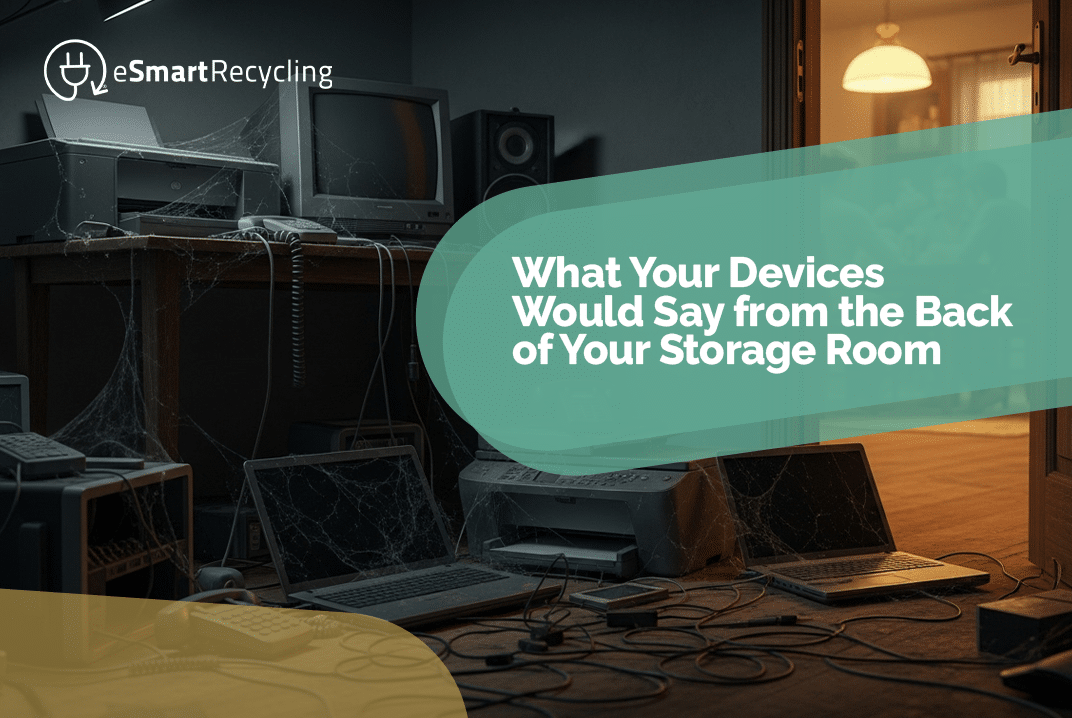
September 14, 2025
If your old servers, routers, and forgotten devices could talk, they would probably say: “I can still be useful—just give me a proper ending.” The truth is that what’s collecting dust in your storage room isn’t just old hardware: it represents an opportunity to boost sustainability, reduce costs, and optimize resources. Let’s look at what these silent devices are really telling us and why it matters for U.S. businesses in 2025.
The reality behind electronic waste
In the United States, about 2.7 million tons of consumer electronics (such as TVs, computers, and phones) were generated in 2018. While that’s less than 1% of total municipal solid waste, it shows the clear impact of technology piling up.
Globally, the number is even more alarming: in 2022, around 59.4 million tons of e-waste were produced, and only less than 20% was formally recycled.
What’s worse, in 2022 alone, 12 million tons of valuable metals were lost because they were not properly recovered.
Why this matters for U.S. businesses
- Recover valuable resources: Devices like laptops and smartphones contain gold, copper, silver, and lithium. Recycling them reduces the need for mining.
- Reduce environmental risks: Stored equipment may contain toxic substances that can contaminate air, water, or soil if not managed responsibly.
- Meet ESG and circular economy goals: Current U.S. legislative efforts are focused on strengthening e-waste recycling infrastructure to secure access to critical minerals and promote sustainable supply chains.
What would those devices be “saying”?
A narrative perspective helps:
- “I still have value” – Many devices can be reused as spare parts or dismantled for components.
- “Don’t ignore me” – Storing them without a plan means wasted space, hidden costs, and obsolete hardware.
- “Recycle me, recover me” – Proper recycling turns old units into new raw materials while reducing environmental impact.
Clear examples of business action
- Donation or internal reuse: Still-working devices can be reassigned to remote offices, donated to communities, or repurposed in other departments.
- Certified recycling: Use certified programs such as e-Stewards or R2, or work with trusted partners to guarantee environmentally responsible disposal.
- Corporate incentives: Some companies, like ecoATM, set up kiosks where employees can drop small devices in exchange for cash.
Why now, in 2025?
- The growing e-waste volume is driving both regulatory pressure and reputational risks. Businesses with strong electronic waste practices will gain a competitive edge.
- U.S. lawmakers are pushing recycling as a way to reduce dependence on China for critical materials.
- Companies embracing circular economy models can cut costs, enhance their ESG performance, and position themselves as leaders in sustainability.
At the end of the day, those forgotten devices in your storage room are not just waste—they’re a pending decision. They can sit there, taking up space and losing value… or they can become raw materials, new opportunities for your business, and a tangible contribution to sustainability. The difference lies in the action you take today.
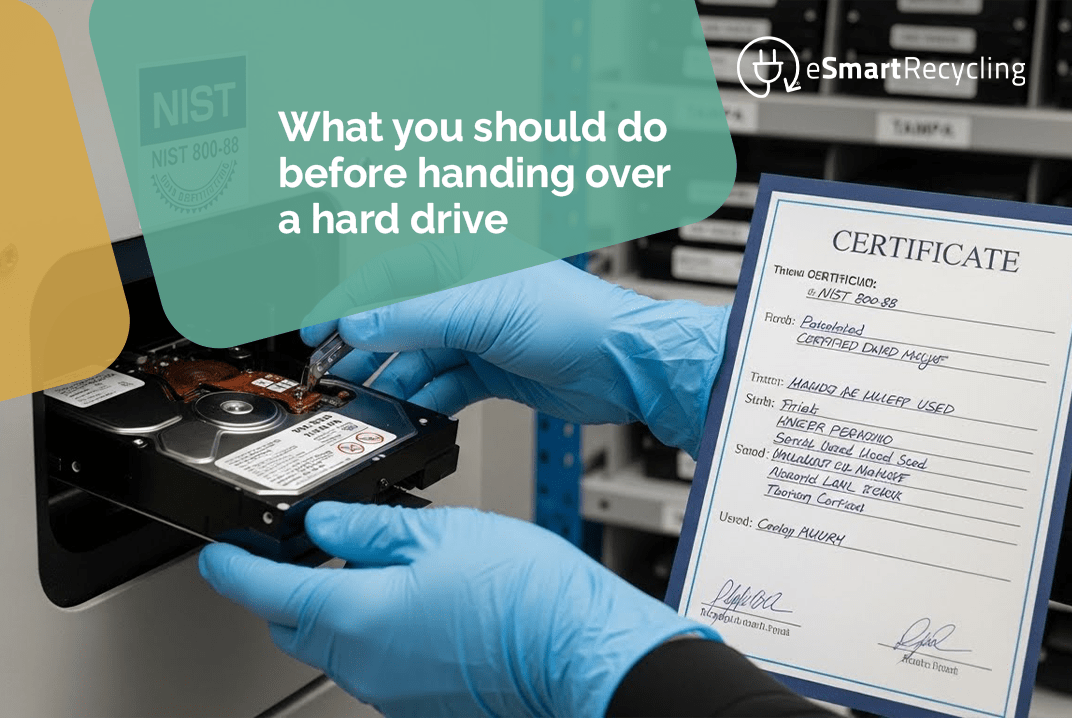
January 5, 2026
When a company retires old devices, one of the questions that always comes up is what to do with the hard drive before handing it over. It’s a small component, but it can hold years of documents, passwords, internal records, and sensitive files that shouldn’t be exposed. In Tampa, many organizations refresh their equipment regularly, and they want to handle these units without putting their information at risk.
A hard drive can be processed safely if it follows reliable methods. In the United States, there are clear guidelines for this, along with certified companies that provide full traceability. Before delivering any device, it helps to understand how the process works and what steps guarantee that the information is no longer accessible.
How to properly erase a hard drive before handing it over
A strong reference for secure data removal is NIST Special Publication 800-88, a guide from the National Institute of Standards and Technology that explains how to sanitize different types of storage.
This standard outlines methods based on the type of drive:
- Mechanical hard drives (HDDs) can be wiped using approved overwrite techniques.
- Solid-state drives (SSDs) require different procedures because their cells store information differently.
If a drive no longer powers on, its content still exists. In those cases, the solution is documented physical destruction, which ensures that nobody can attempt to recover information with specialized tools.
Here in Tampa, companies often deliver drives that go through accounting, support, sales, or administrative teams. Each department leaves traces of sensitive data, and erasing it correctly helps avoid privacy incidents or issues during internal audits.
Why is handing over a hard drive without wiping it risky
A hard drive that looks harmless can still contain information even after a basic format. That type of formatting doesn’t remove data permanently. This is why healthcare, education, and financial organizations rely on NIST 800-88 to ensure data cannot be reconstructed.
Hard drives can store old logins, saved passwords, customer files, and local application data. When devices are handed over without proper treatment, the organization becomes vulnerable to unintended leaks.
Secure wiping closes that chapter before recycling, donating, or retiring a device.
What an R2V3-certified company does with a hard drive
Organizations certified under the R2V3 standard follow audited processes that ensure each drive receives proper handling.
This usually includes:
- Recording the drive and its serial number
- Verifying the type of storage
- Applying the correct wiping method
- Documenting the result
- Physical destruction when needed
We follow this framework in Tampa because it allows us to record each step and deliver clear reporting. For business devices, this level of control helps IT teams comply with internal requirements and external regulations.
How to confirm that a hard drive was completely erased
A common question is how to check if the wiping worked. The most reliable way is through documentation that includes:
- Method used
- Final result
- Serial number of the device
- Date of the process
This helps verify that the wiping follows recognized standards. When we speak with IT teams in Tampa, this kind of documentation is usually what gives them confidence before handing over or recycling hard drives.
Options for handling hard drives in Tampa
Tampa offers different ways to deliver hard drives, but not all options meet the same requirements. Some companies need traceability for internal policies; others need wiping certificates; others request physical destruction.
Certified facilities and tech recycling services
Facilities certified under R2V3 provide audited processes and reliable methods. This is the best option for organizations handling sensitive data or large quantities of drives.
Community programs
Some Florida counties organize drop-off events for electronics, but these events focus on household waste and usually don’t include documented data handling.
Pickup services
Many companies in Tampa request on-site pickup for large volumes, which avoids transport risks and keeps everything contained.
Frequently asked questions about hard drives in Tampa
Can you wipe a hard drive from a computer that still works?
Yes. If the drive is functional, a secure wiping method based on NIST can be applied.
What if the drive is damaged?
If wiping isn’t possible, it must be physically destroyed. The process is still documented.
Can I mix hard drives with other devices?
Yes. Sorting is handled during intake. Data-bearing units receive specific treatment.
Is formatting enough to erase a hard drive?
No. Basic formatting does not remove information. Secure wiping requires recognized sanitization methods.
How we handle hard drives in Tampa
At eSmart Recycling, we process hard drives every day. Some arrive in good shape; others come damaged or non-functional. All of them go through documented processes guided by the R2V3 standard.
Each unit receives:
- The appropriate wiping method
- Serial number and result documentation
- Physical destruction when necessary
- Traceability for internal audits
This approach allows companies to deliver equipment confidently, knowing their information stays protected. Once the data processing is complete, materials follow their appropriate route for recycling or reuse.
Tampa keeps growing and accumulating technology that is no longer used. Handling a hard drive properly before handing it over is a simple way to prevent risks and close processes responsibly.

October 23, 2024
In today’s world, more and more companies claim to be sustainable. However, many of these businesses lack a full understanding of what sustainability truly means.
This article explores the three key aspects of sustainability in the business context: environmental, social, and economic sustainability. We’ll also provide examples of companies successfully implementing sustainable practices and offer tips for businesses aiming to build a more sustainable future.
Environmental Sustainability
Environmental sustainability refers to minimizing actions and behaviors that negatively impact the Earth and its resources. Companies practicing environmental sustainability often focus on reducing energy consumption, implementing waste management processes, and using raw materials sustainably.
An example of environmental sustainability is Apple, committed to reducing its carbon emissions by using renewable energy and offsetting emissions through reforestation projects. Environmental sustainability must be a core element of business operations to be a sustainable company.
Social Sustainability
Social sustainability addresses the well-being of employees, stakeholders, and the community. Companies can demonstrate social sustainability by offering fair wages, creating safe work environments, supporting diversity and inclusion initiatives, and investing in community development projects.
Patagonia is a well-known example of social sustainability. The company pays all employees a living wage, provides on-site childcare, and donates 1% of sales to environmental organizations. By investing in its employees and communities, Patagonia shows that social sustainability can be profitable and lead to business success.
Economic Sustainability
Economic sustainability means generating a satisfactory financial return for investors while maintaining environmentally and socially sustainable practices. An economically sustainable business achieves long-term financial goals while addressing the environment’s and its employees’ needs.
Unilever exemplifies economic sustainability. The company has successfully integrated environmental and social sustainability into its operations without negatively impacting its bottom line. Through energy-efficient practices and collaborative research into sustainable products, Unilever proves that profitability and sustainability can go hand in hand.
Building a Truly Sustainable Business
To build a truly sustainable business, companies must commit to all three pillars of sustainability: environmental, social, and economic.
Setting clear and measurable goals across these areas is crucial. By regularly monitoring progress, businesses can ensure they are moving toward a genuinely sustainable future.
Involving employees and customers is also key. By gathering feedback from staff and providing transparent information to customers about sustainable practices, businesses can demonstrate their commitment to sustainability.
As sustainability becomes an increasingly important concept for businesses, focusing on environmental, social, and economic sustainability is essential. By committing to these areas, setting measurable goals, and engaging employees and customers, companies can create a more sustainable future for themselves and their communities.
If you need further assistance in creating sustainable practices for your business, consider reaching out to a sustainability consultant to guide you on the path to a sustainable future.

January 5, 2026
When a laptop stops being useful, the same question pops up everywhere in Tampa: What should you do with it without leaving it stored forever or putting your information at risk? Even if it hasn’t been turned on in years, that device still keeps documents, photos, notes, passwords, and moments of your daily life. Before dropping it off anywhere, it helps to know how to handle it properly.
There are several ways to give it a responsible and secure destination. Some options allow you to recycle it, others let you donate it, and others help you deal with your data before handing it over. Here in Tampa, we see these situations every day, and it’s clear that an old laptop needs more than a quick handoff. It needs proper treatment, especially when it comes from a business with internal rules to follow.
How to handle your old laptop before giving it away
The first step is making sure the data is not accessible. In the United States, one of the most reliable references for data sanitization is NIST Special Publication 800-88, a guide used by public and private institutions for secure destruction of stored information.
This document explains how to treat mechanical hard drives and SSDs, which store data differently and require specific approaches. If the laptop no longer turns on, the storage still needs to be destroyed in a controlled way so nobody can extract any information.
Here in Tampa, this step is essential. Many companies hand in devices that have gone through different departments, and every user has left sensitive content behind. Whatever path you choose—donation, recycling, or refurbishment—your data must be handled correctly.
Where to take old laptops in Tampa
Tampa has several places that accept electronic devices, but not all of them provide proper documentation or data control. For businesses, that detail matters.
The most common options include:
Certified recycling facilities
Companies certified under standards like R2V3 follow audited processes, including:
- Device inspection
- Serial number registration
- Storage verification
- Data wiping or physical destruction
- Classification and material handling
This is the framework we follow in Tampa. It allows companies to receive clear reports about each laptop and how its data was handled. For business equipment, this level of control is often the safest option.
County or community programs
Some Florida counties offer collection days for electronic waste. Availability depends on local schedules and usually focuses on household items.
These programs can work for personal devices, although they may not offer data handling services.
Donation programs
Certain organizations accept laptops that can still be repaired. The key is making sure the receiving organization confirms whether they can wipe or destroy the data. If not, it should be done beforehand.
Many donations fail because the device still contains sensitive information, which can put both the donor and the recipient at risk.
What happens to your laptop after you drop it off
An old laptop can take different routes:
- Refurbishment: if it still has usable life, it’s repaired and prepared for reuse.
- Donation: Some refurbished laptops can serve families, students, or community groups.
- Parts recovery: when repairs aren’t possible, usable components are extracted.
- Recycling: if the laptop is too damaged, materials like metals and plastics are recovered.
At eSmart Recycling, part of what is recovered from these devices helps us repair and deliver technology to families and children who still need access. That work only begins once the data is handled correctly—always the top priority for business clients.
Questions we hear often in Tampa
Can I drop off a laptop without a charger?
Yes. The charger is not required.
What if the laptop is physically damaged?
It’s evaluated anyway. If it can’t be repaired, usable parts are removed or it goes straight to recycling. Data-bearing components are handled with sanitization or destruction.
Can I drop off multiple laptops without sorting them?
Yes. The inventory is done during intake. For businesses, this process is fully documented.
Is it possible to get a certificate for data wiping?
Yes. With procedures based on NIST 800-88 and an audited process like r2v3, data sanitization can be documented properly.
Can laptops be donated directly?
It depends on their condition. If they can be repaired and used safely, yes. If not, they are recycled.
What Tampa businesses look for when retiring laptops
Conversations with IT teams usually revolve around:
- Security, to ensure data does not remain accessible
- Traceability, to keep control of the equipment delivered
- Compliance, to guarantee the process is backed by verifiable documentation
A company certified under R2V3 provides this structure. In Tampa, we follow that standard, so every device is handled with methods that are reviewed and reliable.
Why Tampa needs reliable places to drop off old laptops
Tech usage in the city keeps growing. Offices replace equipment more often, and many devices end up stored for years without a plan. Once it’s time to remove them, challenges appear: unclear handling, missing data procedures, and high volumes.
A structured process prevents rushed decisions and allows technology to be reused or recycled properly. Dropping off an old laptop doesn’t have to be complicated. It just needs a place that can handle it well, track it, and protect the data.
How we work with old laptops in Tampa
At eSmart Recycling, we receive laptops every day. Some arrive clean, others arrive with years of activity stored inside. All of them go through the same steps:
- Secure data handling
- Device registration
- Functional evaluation
- Repair when possible
- Responsible recycling when repair is not an option
Our R2V3 certification guides all these steps. It’s the framework that allows companies to hand over their equipment with confidence, knowing that their data stays protected and their devices are handled according to strict and transparent rules.
An old laptop can still give a lot, but only when it’s processed correctly. Tampa has places for that, and our work is to make sure each device finds a safe and responsible destination.

September 20, 2024
Thanks to rapid technological advancements, businesses often find themselves with a variety of equipment, some of which may be considered obsolete. This raises the question: what should a company do with this outdated equipment? It can be challenging to figure out how to properly dispose of it while ensuring compliance with relevant regulations. In this guide, we’ll explore several ways companies can responsibly and cost-effectively dispose of obsolete equipment.
Assess the situation
The first step a company should take when dealing with obsolete equipment is to assess the situation. Business owners and managers need to determine which equipment is outdated and decide on the best strategy for disposal. For instance, a company may choose to sell certain obsolete equipment, donate it to a nonprofit organization, or even recycle it.
Selling obsolete equipment
One of the most common ways to dispose of outdated equipment is by selling it. Numerous platforms can assist companies with this, including eBay, Craigslist, and Bidding for Good. Businesses can also consider working with a company that specializes in the resale of used equipment. There are platforms specifically dedicated to helping companies sell their equipment, such as EquipNet. It’s important to ensure that the company receives the full value of the equipment and complies with any relevant regulations or laws.
Recycling obsolete equipment
Companies should also consider recycling their obsolete equipment. Recycling offers many benefits, such as being better for the environment, and it helps businesses get rid of unwanted or outdated items. At eSmart Recycling, we specialize in ensuring that obsolete equipment is recycled properly and securely.
Other options
There are several other ways companies can dispose of obsolete equipment. For instance, some businesses may opt for a buyback program if the equipment is still in good working condition. Alternatively, companies can consider repurposing the equipment or selling it for spare parts. The key is to ensure that the company complies with all relevant regulations when disposing of or repurposing equipment.
It can be a challenge for businesses to know what to do with obsolete equipment. Companies should carefully assess the situation to determine the best strategy. Common options include selling, donating, recycling, or repurposing the equipment. Businesses need to ensure they are complying with all relevant regulations or laws when taking any of these actions. Ultimately, the goal should be to dispose of equipment responsibly and cost-effectively.
In the end, businesses should remember that there are many different ways to get rid of obsolete equipment. With careful planning and due diligence, they can easily find a solution that meets their needs and aligns with their company values. It’s important to note that a company’s decision on how to handle outdated equipment can impact its overall efficiency. As the saying goes, one company’s outdated equipment may be another’s treasure. Exploring the different ways to make the most of old equipment is always worthwhile, especially for tech-driven companies. This will only become more important as technology continues to expand and evolve.
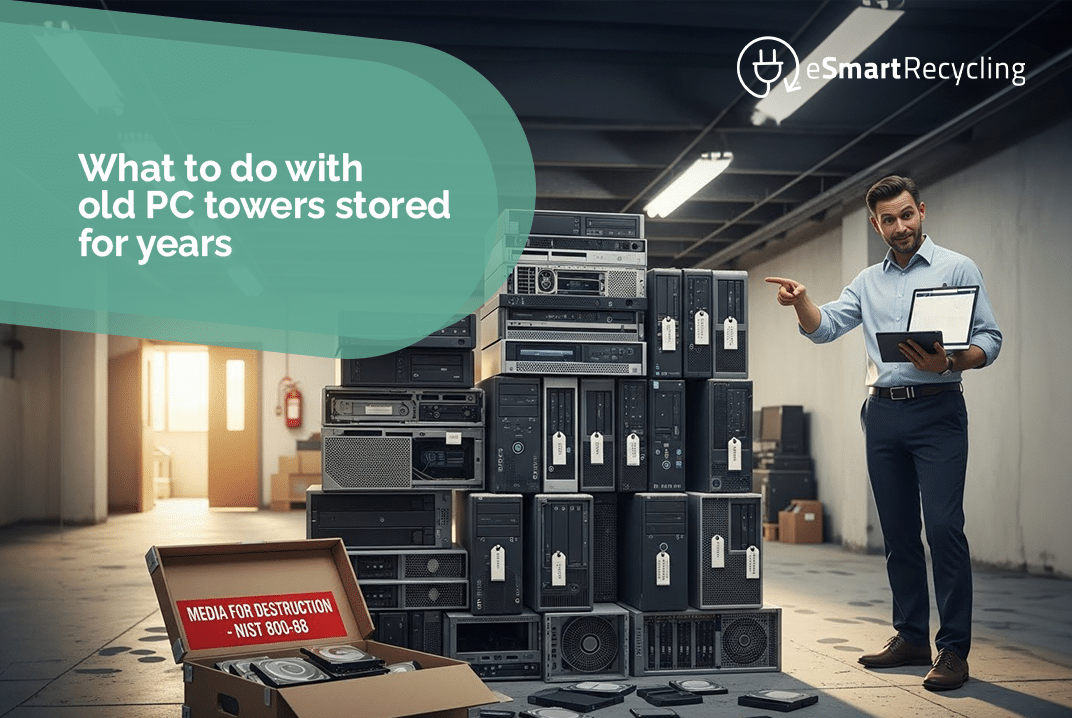
January 19, 2026
If your company has old PC towers that have been sitting in storage for years, you are not alone. Many offices end up with stacks of desktop towers kept after upgrades, moves, or changes in IT strategy. They are rarely used again, yet they keep taking up space and quietly carry responsibility with them.
So, what should a business actually do with PC towers that have been stored for years? The short answer is to remove them through a certified, documented recycling process. The longer answer explains why waiting rarely helps and how to handle them properly.
Why PC towers tend to stay in storage for so long
Desktop towers often survive several technology cycles. Laptops replace them, cloud services reduce on-site hardware, and offices shrink or relocate. Yet the towers remain.
They are stored “just in case.” In case someone needs spare parts. In case a system must be rebuilt. In case data is still needed. Over time, those reasons fade, but the equipment stays.
What many companies overlook is that keeping old towers does not make the situation safer or simpler. It only postpones a decision that eventually has to be made.
What risks old PC towers can still carry
Even if a PC tower has not been powered on for years, it may still contain hard drives, solid-state drives, or other storage media. Those components can hold files, credentials, system configurations, or personal data.
The National Institute of Standards and Technology (NIST) addresses this issue in its data sanitization guidance. NIST SP 800-88 Rev. 1 explains that storage media must be properly sanitized before disposal or recycling to reduce data exposure risks.
https://csrc.nist.gov/publications/detail/sp/800-88/rev-1/final
From a business standpoint, the age of the equipment does not eliminate responsibility. Data does not disappear on its own.
Why throwing PC towers away is not an option
PC towers are electronic waste. They contain metals, plastics, circuit boards, and components that require proper handling. Disposing of them through regular trash or informal channels is not recommended for businesses.
The U.S. Environmental Protection Agency (EPA) encourages companies to recycle electronics through qualified recyclers to ensure responsible material management and reduce environmental risk.
For organizations with sustainability reporting, internal audits, or compliance requirements, improper disposal creates gaps that are difficult to justify later.
When keeping old towers no longer makes sense
There is a point where storage stops being a safety net and becomes a liability. Towers take physical space, create clutter, and require tracking, even if no one touches them.
From an operational perspective, if a PC tower has not been used in years and has no defined future purpose, keeping it rarely adds value. Recycling it through a documented process closes the loop and removes uncertainty.
This is often the moment when companies decide to act.
What responsible recycling looks like for old PC towers
A proper process starts by identifying which towers are no longer needed. This includes confirming whether they contain storage devices and whether those devices require certified data sanitization or physical destruction.
The equipment is then collected through a controlled pickup process and transported to a certified facility. There, devices are audited, storage media are handled according to accepted standards, and materials are processed responsibly.
Documentation is a key part of this process. Many businesses need records that show when equipment left their control and how it was managed afterward.
Why certification matters for stored equipment
In the U.S., one of the most recognized standards for responsible electronics recycling is R2v3 (Responsible Recycling), developed by SERI (Sustainable Electronics Recycling International).
R2v3 certification sets requirements for the chain of custody, data handling, downstream processing, and recordkeeping. It applies whether the equipment was used yesterday or stored for a decade.
At eSmart Recycling, we operate under R2v3 certification. For companies, this means old PC towers are handled through a structured, documented process designed for business environments.
What happens when companies work with us
When businesses contact us about PC towers that have been stored for years, the first step is clarity. We review what equipment needs to be removed and what type of storage may be involved.
We coordinate pickup directly from the company location, log the equipment, and transfer it to our facility for proper processing. From that point forward, responsibility for those towers is clearly defined.
This clarity is especially important for IT teams, facilities managers, and sustainability leads who want to resolve long-standing storage issues without creating new ones.
Regulations and guidance businesses should keep in mind
While there is no single federal law focused only on PC towers, broader guidance applies. The Federal Trade Commission (FTC) emphasizes the responsibility of businesses to dispose of electronics containing sensitive information securely.
https://www.ftc.gov/business-guidance/resources/disposal-rule-facts-businesses
For regulated industries, proper disposal supports internal policies and reduces exposure during audits or reviews.
Common questions companies ask about old PC towers
A frequent question is whether towers that no longer work still need special handling. The answer is yes. Functionality does not determine whether data is present or whether components require responsible recycling.
Companies also ask if towers can be recycled together with other electronics. In most cases, they can. Certified recyclers are equipped to manage mixed loads safely.
Another question is whether the process will disrupt operations. When coordinated properly, pickup and recycling can be scheduled with minimal impact.
Why acting now is easier than waiting longer
The longer PC towers sit in storage, the easier they are to forget and the harder they are to explain later. Acting now removes clutter, reduces uncertainty, and simplifies recordkeeping.
According to the EPA, working with qualified electronics recyclers supports better management of retired equipment and helps businesses maintain orderly operations.
Recycling old PC towers is not about rushing. It is about closing a chapter that has been open for too long.
Turning long-stored equipment into a closed process
For companies, the best answer to years of stored PC towers is a clear, documented recycling process. Certification, experience, and transparency matter more than convenience alone.
With the right partner, dealing with old PC towers becomes a straightforward task rather than a lingering question.
May 24, 2026
Old USB cables, HDMI cords, chargers, and extension cords all require a specific recycling process. Throwing them in the regular trash can contaminate soil and water with lead, cadmium, and PVC. In Tampa Bay, you can drop them off at eSmart Recycling’s warehouse at 5100 Vivian Place or request a pickup for larger volumes. You do not need to sort them by type or prepare them in any special way.
That drawer everyone has. The one full of cables you no longer recognize, the phone charger you replaced two years ago, three HDMI cables from different eras, and an extension cord that barely works anymore. They stay there because throwing them away feels wrong, but you also do not know what to do with them.
Why cables should not go in the regular trash
The plastic coating around most cables, typically made from polyethylene or PVC, can release contaminants such as lead and dioxins when exposed to heat and landfill conditions.
PVC can take 30 years or more to break down and eventually fragments into microplastics that end up in soil and water systems. That means the phone cable you used in 2019 could still be sitting in a landfill decades from now.
Curbside recycling programs are also not designed to handle cables. Tossing them into standard recycling bins can damage sorting machinery and contaminate other recyclable materials.
What is inside a cable that is worth recovering?
More than most people realize.
Most USB cables, HDMI cords, Ethernet cables, chargers, and power cords contain copper inside, a material that can be recycled indefinitely without losing its properties.
According to the United Nations’ Global E-waste Monitor 2024, the metals found in global e-waste streams, including copper, gold, iron, and rare earth elements, are worth an estimated $91 billion.
A June 2025 analysis by McKinsey projected a global copper shortage of 3.6 million metric tons by 2035 and identified e-scrap as one of the largest underused sources of recoverable copper. Every cable recycled correctly is copper that returns to the production cycle instead of remaining buried underground.
What types of cables does a certified recycler in Tampa Bay accept?
At eSmart Recycling, we accept:
- USB cables of all types: USB-A, USB-C, Micro-USB, Lightning
- HDMI cables, DisplayPort cables, and video adapters
- Laptop, tablet, and phone chargers
- Ethernet and networking cables
- Extension cords and power strips
- Audio cables and computer accessories
There is no need to separate or clean them. We receive them exactly as they are.
How to drop off or schedule cable recycling in Tampa Bay
Option 1: Direct drop-off
You can bring your cables directly to our warehouse at:
5100 Vivian Place, Tampa, FL 33619
There is no cost. Whether you have one cable or an entire box full, the process is the same.
Option 2: Scheduled pickup
If your business has a large volume of cables and electronic equipment for recycling, you can schedule a pickup. We coordinate removal directly from your office or warehouse anywhere in Tampa Bay, including documentation of the recycling process.
Can I recycle cables together with other devices?
Yes. Cables are processed together with the rest of your e-waste, including:
- Laptops
- Monitors
- Printers
- Routers
- Keyboards
- Computer accessories
You do not need to separate shipments. If you are recycling complete devices along with loose cables, we process everything together.
Frequently asked questions about cable recycling in Tampa
Are cables really considered e-waste, or can I place them in normal recycling bins?
They are considered e-waste. Cables contain metals such as copper and coatings that may include hazardous chemicals. They should not go into curbside recycling bins.
How many cables do I need before it is worth bringing them in?
There is no minimum requirement. You can bring a single cable or a full box.
Does eSmart Recycling charge for cable drop-off?
No. Cable and accessory drop-off at our Tampa warehouse is free.
What happens with the data stored in smart chargers or intelligent cables?
Most cables do not store data. If you have concerns about devices with integrated storage, such as certain USB hubs, we audit them before processing.
Do you accept damaged or broken cables?
Yes. Even broken cables still contain recoverable materials. You do not need to bring only working cables.
That drawer is not going to clean itself out. But you also do not have to make the process complicated. Bring the cables. We handle the rest.

December 27, 2024
Christmas is a time of giving, and it often includes the gift of new technology. If you’re one of the lucky ones who received an upgrade during the holidays, you may now face the daunting task of figuring out what to do with your obsolete devices. Whether it’s an old TV, a dusty desktop computer, or a cracked phone, we’ve got you covered. In this guide, we’ll explore practical and sustainable options for getting rid of outdated technology responsibly.
The Current State of Technology
Technology evolves at a breakneck pace, with new devices and features launching almost daily. In 2024, even slightly older gadgets can quickly become obsolete, even if they still function perfectly. While this rapid progress is exciting for tech enthusiasts, it also creates challenges for responsibly disposing of older devices.
Donate Your Old Technology
One of the most meaningful things you can do with your old technology is to donate it. Many charities and organizations, like Goodwill, the Salvation Army, and the National Cristina Foundation, accept used electronics. These organizations can refurbish your devices for someone in need or recycle the components responsibly. Some even provide tax-deductible receipts for your donations, making it a win-win for everyone.
Return to Retailers or Manufacturers
Another option is to return your outdated device to the store where you purchased it. Retailers like Best Buy and Apple have electronic recycling programs, making it easy to dispose of your old tech safely. Some manufacturers also offer buyback programs, where you can trade in your old device for store credit or cash, helping you save on your next purchase.
Resell or Trade-In
If your device is still in working condition, consider selling or trading it in. Platforms like eBay, Craigslist, and Facebook Marketplace are great for listing electronics. Many manufacturers and retailers also offer trade-in programs, allowing you to exchange your device for credit toward a new one. Additionally, local buy/sell/trade groups or pawn shops can be excellent avenues for selling your tech.
Recycle Responsibly with Us
If your device is beyond repair or resale, the best thing you can do is recycle it. Recycling with us at eSmart Recycling ensures your technology is handled responsibly and sustainably. As a certified R2v3 recycler, we meet the highest global standards for environmental responsibility, data security, and worker safety.
We specialize in recycling laptops, desktops, servers, and other electronics. When you recycle with us, you’re not only protecting the environment by keeping hazardous materials out of landfills but also supporting community initiatives. By choosing eSmart Recycling, your obsolete devices can help bridge the digital divide by providing technology to schools, nonprofits, and individuals in need.
Why Choose Us for Your E-Waste Recycling?
- Certified Recycling: Our R2v3 certification ensures your devices are dismantled properly, and all materials are managed responsibly.
- Community Impact: Your recycled electronics support programs that empower underserved communities through access to technology.
- Convenience: We offer multiple drop-off locations to make recycling easy and accessible for everyone.
Make the Most of Your Old Tech
No matter the type of device you’re parting with, you have plenty of sustainable and responsible options. By donating, returning to retailers, reselling, or recycling with us, you can ensure your outdated technology doesn’t end up in a landfill.
When upgrading to new devices, consider the environmental and social implications. Many manufacturers now prioritize sustainability, and refurbished devices can be both functional and affordable. Whatever path you choose, don’t let that old gadget gather dust.
With the right approach, your obsolete tech can help others, reduce waste, and contribute to a healthier planet. And with eSmart Recycling by your side, you can trust that your recycling efforts are making the maximum positive impact.
Recycle with us. Choose sustainability. Make an impact.
June 3, 2025
Technology in the workplace becomes outdated faster than we realize. Laptops, tablets, and phones that once powered your business end up collecting dust in closets and storage rooms. But letting old tech pile up isn’t just a space issue — it’s a security risk and a missed opportunity to make a real social impact. So, what should you do with outdated electronics?
Step One: It’s Not Just “Electronic Trash”
Before taking action, it’s important to understand that old devices still hold value. Not just in their physical components (which can be recycled), but also in the sensitive data they store. Proper handling can give these devices a second life and help bridge the digital divide in underserved communities.
According to the EPA (Environmental Protection Agency), more than 2.7 million tons of electronic waste were generated in the U.S. in 2022. Shockingly, only about 35% of it was properly recycled.
Why Throwing Them Away Isn’t an Option
Simply tossing electronics into regular trash is not responsible — or legal in many U.S. states. Devices often contain hazardous materials like lead, mercury, and cadmium. CalRecycle highlights that in California, several types of e-waste must be recycled to protect public health and the environment.
Beyond legal risks, improperly discarded electronics pose serious data security threats. Even after deleting files, data can often be recovered unless professionally wiped or destroyed.
Responsible Options for Your Old Devices
If you’re ready to take action, here are some solid options:
1. Donate to Certified Organizations
Several nonprofits accept used equipment, refurbish it, and distribute it to schools, libraries, or families in need. Just make sure the organization properly handles data wiping.
2. Certified Recycling Services
Partnering with a certified recycler (look for certifications like R2v3) ensures that your devices are securely processed, your data is properly destroyed, and you receive detailed documentation.
At our company, we not only recycle but also transform old devices into real opportunities through social impact programs.
3. Sell to Recommerce Platforms
High-end devices — like MacBooks or iPhones — may still have resale value.
This option can help recoup some investment but may not be practical for large-scale corporate disposals.
What to Consider Before Choosing an Option
- Data Security: Always prioritize certified data destruction.
- Environmental Impact: Choose options that guarantee responsible recycling.
- Social Impact: Ask if your action could help others gain access to technology.
- Costs and Benefits: Look into potential tax deductions or cost recovery.
Freeing up your company’s space from old technology isn’t just a matter of tidying up — it’s a chance to demonstrate responsibility and make a measurable difference. Every device you let go of leaves a positive mark on the community.

May 12, 2025
In today’s corporate world, accumulating old technology is a real risk: it takes up valuable space, jeopardizes data security, and can hold back your sustainability goals. So, what should you do with servers, laptops, and other IT equipment you no longer use? Let’s break it down clearly and practically.
Why You Shouldn’t Store Obsolete Equipment
Old devices often retain sensitive data, even if they seem useless. A study by Blancco Technology Group found that 42% of discarded hard drives still contained accessible information.
Storing outdated equipment also generates invisible costs: wasted office space, increased risk of non-compliance with regulations like GDPR or CCPA, and unnecessary security vulnerabilities.
Option 1: Certified Data Destruction and Recycling
The best practice is not simply tossing or selling old tech without a plan. The correct way is to securely wipe all data and responsibly recycle the materials.
At eSmart Recycling, we specialize in the secure removal, certified R2v3 data destruction, and responsible recycling of your IT equipment.
Plus, we provide an Impact Report showing exactly how many people your recycled technology helped. Your company not only regains space and eliminates risks but also contributes to measurable social impact, aligning perfectly with your ESG goals.
Option 2: Donating Technology (the Right Way)
Donating used equipment is a great way to extend its life cycle. However, you must do it carefully: data must be completely erased, and devices properly tested to ensure they function well.
Remember, donating without securely wiping data could expose your company to serious legal risks.
Option 3: Selling Through IT Brokers
Another option is to sell your equipment through IT asset brokers. These firms buy large volumes of used hardware for refurbishing or recycling.
However, always ensure you work with certified partners who guarantee proper data destruction as part of their process.
What Happens if You Just Throw Them Away?
Throwing servers or computers into regular trash bins is illegal in most U.S. states and could lead to hefty fines. Plus, e-waste contains hazardous materials like lead, mercury, and cadmium that pollute soil and water. According to the EPA, proper electronic recycling is essential to protect the environment and recover valuable resources.
How to Start the Process in Your Company
Don’t wait for the problem to pile up. Set up an internal policy for managing obsolete IT that includes:
- Regular assessments of equipment.
- Clear procedures for secure data destruction.
- Partnerships with certified providers for pickup and recycling.
At eSmart Recycling, we take care of the entire process, making it easy, secure, and meaningful to let go of your accumulated tech.

April 7, 2026
There are 50 laptops piled up in that third-floor closet. Or maybe 80. No one has counted them in months. Someone suggested recycling them last year, but the conversation stopped there. Meanwhile, they take up space, collect dust, and still hold data from employees who no longer even work at the company.
If this sounds familiar, you’re not alone. Companies in Tampa deal with this constantly, and most don’t know where to start.
Why do companies accumulate old technology?
It’s not a lack of environmental awareness. It’s not just disorganization either. The real issue is simpler: no one wants to be the person responsible for making that decision.
What if we delete something important? What if someone needs those devices later? How do we know the data was properly destroyed? Who coordinates the pickup? Do we have to pay for this?
Each question leads to another meeting that never turns into action. Meanwhile, the equipment stays there.
What to do when you have more than 50 computers
First, take a breath. You don’t need a perfect plan. You just need to start.
Assign an owner for the process. One person who coordinates everything. It can be someone from IT, facilities, or even finance. What matters is that someone says, “I’ll take care of it,” and follows through.
Create a basic inventory. You don’t need serial numbers yet. Just count how many laptops, desktops, monitors, printers, and servers you have. An estimate is enough.
Decide what to do with each category. Some equipment may have resale value. Others go straight to recycling. Some require certified data destruction for compliance. Group them by type and condition.
Schedule a pickup. We at eSmart Recycling handle large volumes all the time. You don’t need to move anything yourself. We pick up at your office, audit everything, and document the entire process.
Data: the real fear behind the delay
Let’s be honest. The real blocker isn’t space or logistics. It’s the fear of a data breach.
Those laptops contain emails, employee files, financial information, and client data. Deleting files manually is not enough. Data recovery software can bring back information you thought was gone.
Physical hard drive destruction is the only way to guarantee that data cannot be recovered. We shred drives into pieces smaller than a coin. Literally impossible to reconstruct.
If your company handles medical, financial, or regulated data, this is not optional. HIPAA, SOX, and other regulations require certificates of destruction. We are R2v3 certified, meet these standards, and document every step of the process.
What to expect when you work with us
The process is more straightforward than you think.
Day 1: We coordinate pickup at your office. We bring secure bins if needed. We collect the full volume in one trip.
Day 2–3: We audit and inventory every item in our Tampa warehouse. If resale is agreed for some equipment, we evaluate and assign value.
Day 3–5: We physically destroy hard drives. We separate components for certified recycling. Metals, plastics, circuit boards—everything is processed according to environmental standards.
Day 5–7: We deliver certificates of data destruction, compliance reports, and environmental documentation. Everything ready for audits.
You don’t need to be present at every step. We handle the full process.
How much does it cost to recycle 50+ computers in Tampa
It depends on volume, type of equipment, and whether you need additional services like urgent pickup or specific certifications.
We work with transparent pricing. You request a quote, we give you the exact cost, you schedule, and that’s it. No surprises later.
What may seem expensive at first can save you thousands in fines if there’s a data breach, or in storage costs if you keep using valuable space.
Benefits no one talks about
Recycling this equipment frees more than just physical space. It frees mental space, too.
The IT manager stops worrying about that closet. Facilities recover usable square footage. Finance closes that pending inventory line. And if your company tracks sustainability goals, this contributes to ESG reporting.
Also, through the Digital Education Foundation, we redistribute refurbished equipment to underserved communities. We’ve delivered around 3,000 devices, benefiting more than 12,000 people. Your old technology can have a second life.
Where to start today
If you have 50 or more old computers in your company in Tampa, the first step is simple: call us and request a quote.
You don’t need everything figured out before reaching out. We guide you through the process, explain options, and help you decide what to do with each category of equipment.
We’re located at 5100 Vivian Place, Tampa. You can contact us at (813) 501-7768 or info@esmartrecycling.com.
The hardest part is deciding to start. After that, the process takes care of itself.
Those 50 laptops are not going to disappear on their own. But you don’t need a perfect plan to deal with them. You just need to take the first step.
Recycling old technology isn’t complicated. It’s a call, a pickup, and a set of certificates. Everything else gets handled along the way.
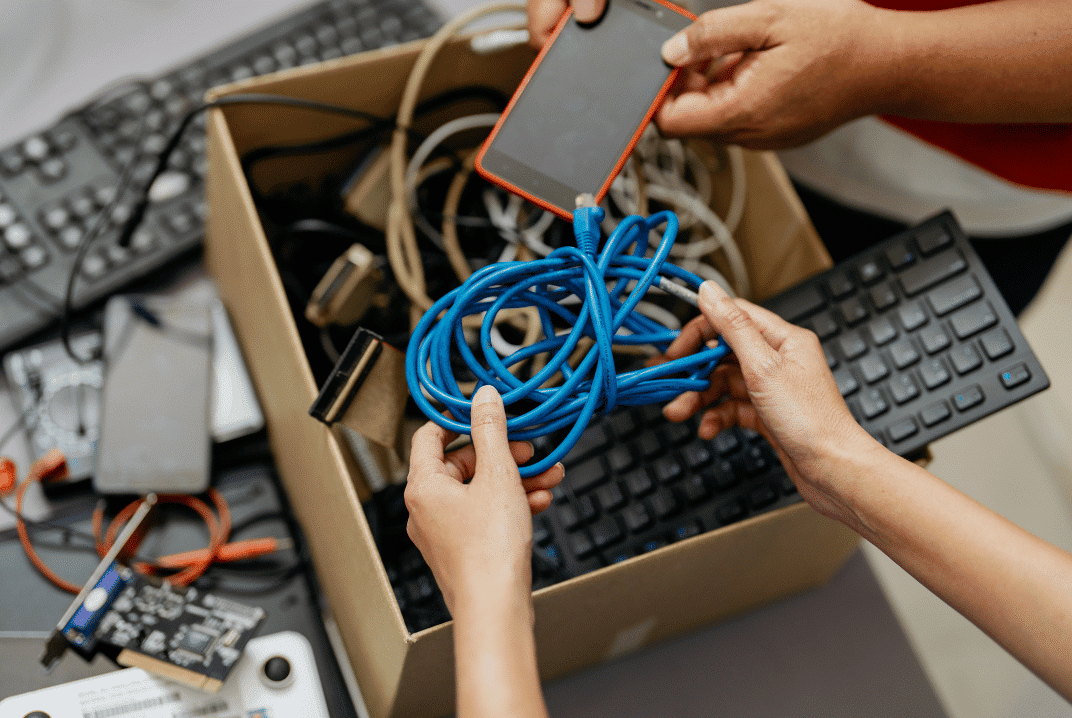
March 10, 2026
When a business decides to recycle its electronics, the most common question isn’t “where do I drop them off?” — it’s “how do I know my data is actually safe?” That’s a fair thing to wonder. A recycler that cuts corners on data destruction isn’t just a bad vendor. It can become a source of serious legal and reputational problems.
Here’s what every organization should verify before handing over a single device.
Certifications: the first sign they know what they’re doing
Not every electronics recycler operates under the same standards. Two certifications matter most when it comes to data security and environmental responsibility:
R2v3 (Responsible Recycling) is the most recognized standard in the U.S. for e-waste recyclers. R2v3-certified recyclers follow strict protocols for data destruction, including wiping or shredding hard drives and documenting the process, ensuring that data cannot be recovered or misused.
NAID AAA is another key certification, especially relevant for organizations in healthcare or finance. It guarantees that the provider follows audited data destruction processes with a verifiable chain of custody.
If a local recycler can’t show either of these certifications, that already tells you something.
A certificate of destruction is not optional
One of the most common mistakes businesses make is handing over equipment without asking for documentation of what happened to it. A certificate of data destruction is the formal record proving that information was eliminated in an irreversible way.
Proper documentation is a requirement of HIPAA. All electronics and digital records leaving an organization need to be inventoried and recorded to establish a proper chain of custody. A solid provider delivers a certificate of destruction with a detailed serial number report for your records.
Even if your company isn’t in the healthcare sector, having that document is a basic security practice. If there’s ever an internal audit or an external investigation, that paper matters a lot.
Deleting is not destroying: know the difference
There’s a frequent mix-up between “deleting files” and “destroying data.” They’re not the same thing. Merely deleting or reformatting is not sufficient — data remnants remain recoverable, creating breach risk and potential legal exposure if disclosed.
Accepted methods include secure erasure following NIST SP 800-88 guidelines, degaussing, and physical destruction through shredding. For SSDs and flash media, physical shredding or cryptographic erasure is the recommended standard.
A serious recycler can explain exactly which method they use and why. If they can’t, or if they only talk about “formatting,” it’s time to look elsewhere.
Chain of custody: Who actually touches your equipment?
From the moment a device leaves your office until it’s fully processed, there’s a chain of responsibility. Any broken link in that chain is a risk point.
Before signing anything, it’s worth asking: Is transport secure and documented? Do employees have background checks? Does the destruction happen at the recycler’s facility, or does the equipment get sent to unmonitored third parties?
When evaluating a vendor, inspect their facilities when possible, ask about employee background check policies, review their data breach history and response protocols, and evaluate their knowledge of applicable regulatory requirements.
These aren’t uncomfortable questions. They’re basic questions that any responsible provider expects to hear.
What happens to the equipment after recycling
Data security is the priority, but it’s not the only thing that matters. Where does the equipment physically go once it’s processed? That question matters for two reasons: environmental compliance and social responsibility.
A common practice among low-cost recyclers is exporting toxic waste to developing nations. A certified recycler adheres to international conventions, such as the Basel Convention amendments, to ensure waste is treated domestically or responsibly.
At eSmart Recycling, we do more than process equipment securely. Around 30% of the revenue generated goes toward repairing and redistributing devices to communities with limited access to technology. Every device that comes through our hands has a chance to keep being useful to someone else.
Frequently asked questions
Can any company call itself a certified recycler? No. Certifications like R2v3 and NAID AAA require periodic external audits. You can verify a recycler’s status directly in the public records of SERI (Sustainable Electronics Recycling International) for R2, or at i-SIGMA for NAID.
Do I need a special agreement if my company handles medical data? If your organization falls under HIPAA, yes. When using a third-party vendor, a signed Business Associate Agreement (BAA) is essential to define safeguards, permissible uses, breach notification, and audit rights.
What if we just throw old equipment in the trash? Beyond the data risk, there are regulatory consequences. Improper disposal can trigger federal Superfund (CERCLA) liability, hefty regulatory fines, and irreparable brand damage.
Is formatting a hard drive before handing it over enough? No. As mentioned above, residual data is recoverable with accessible tools. Certified destruction is the only way to guarantee the information can’t be reconstructed.
What to look for in a local recycler in Tampa
If your business is in the Tampa Bay area and evaluating certified e-waste recycling providers, these are the minimum points you should confirm before signing any agreement:
That they hold at least one recognized certification (R2v3 or NAID AAA), that they issue a certificate of destruction with serial numbers for every device processed, that they can explain their data destruction method in detail, that equipment transport is secure and documented, and that they can provide verifiable references from other clients in the area.
At eSmart Recycling, we work with businesses, schools, and institutions across Tampa Bay. We handle data destruction with HIPAA compliance, issue certificates of destruction, and make sure every piece of equipment is audited and inventoried before it leaves your hands. If you have devices piling up and don’t know where to start, we can help you manage the whole process from beginning to end.
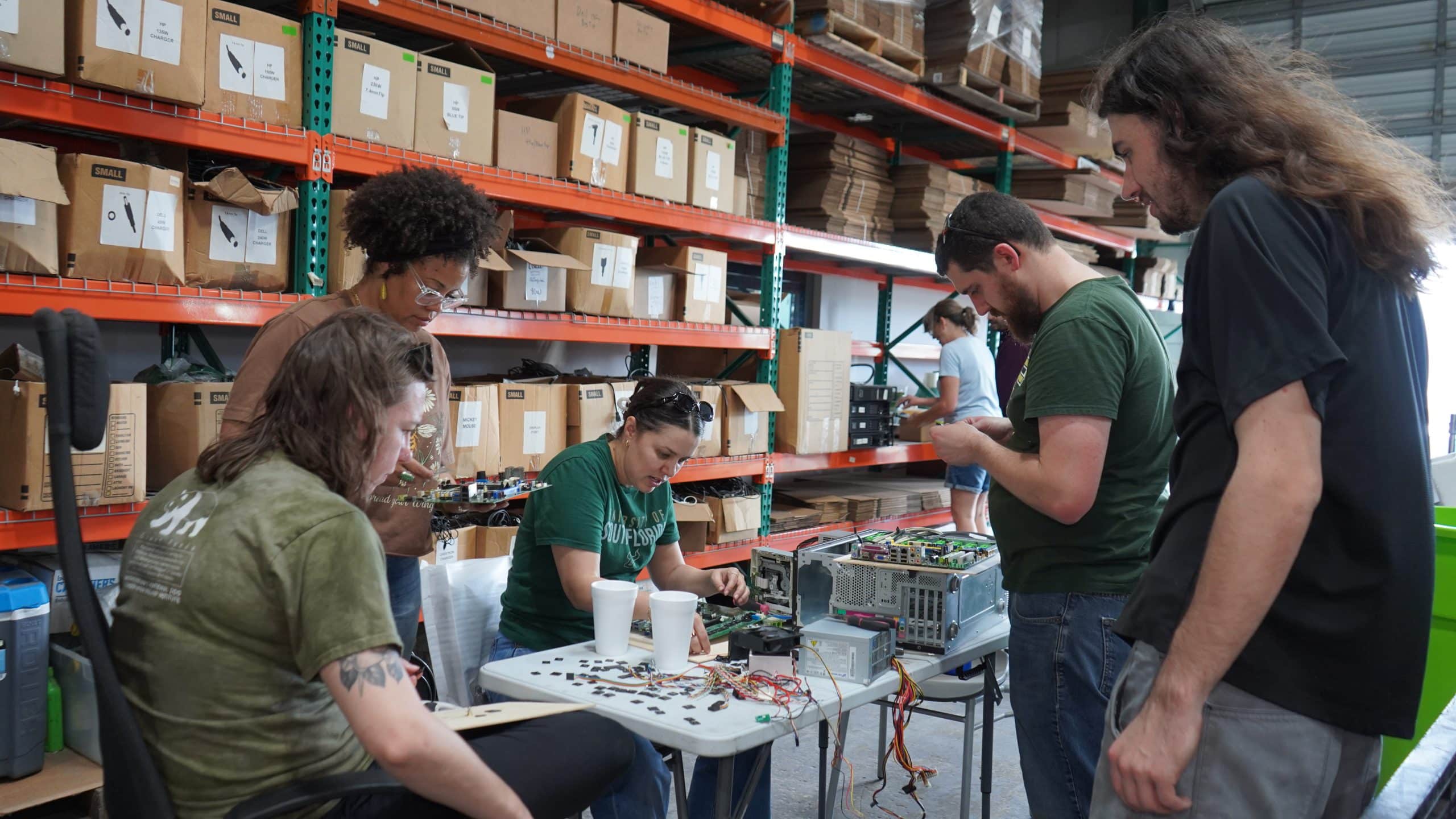
March 20, 2026
Most people have never seen what happens to a laptop after it gets dropped off at a recycling facility. They hand it over, get a receipt, and that’s it.
On March 7th, a group of STEM educators from Tampa decided they actually wanted to know.
The NSF MISTTIC Master Teaching Fellows and educators from USF spent an afternoon at eSmart Recycling’s facility with one goal: to get their hands on the stuff most people never touch.
Lunch, introductions, and straight to work
After introductions, the group split into two. One team sat down with old clocks and electronics and started taking them apart piece by piece. The other picked up soldering irons and worked directly on circuit boards. The actual material, in their hands.
And then something happened that wasn’t on the agenda: the conversations. Someone asked what happens to the data on a hard drive when a company donates old computers. Someone else wanted to know how much of a circuit board is actually recyclable. Good questions. The kind that comes from people who don’t look at technology the same way anymore.
A 30-year veteran in STEM education put it simply: “They have to touch the dusty old equipment. That’s where the real learning happens.”
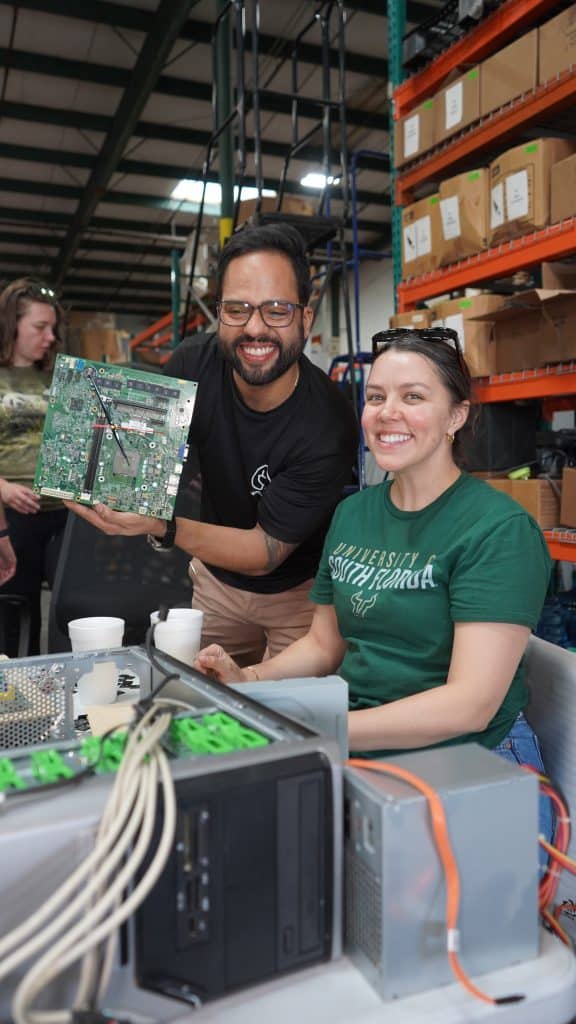
What eSmart Recycling actually does, for those who haven’t been inside
The facility in Tampa handles electronics from individuals, businesses, and institutions across the region. Equipment gets audited, data gets destroyed, certified, documented, traceable, and whatever can be refurbished goes back out to communities that need it.
When someone asked about data security during the visit, Tony Selvaggio was direct: every device that enters the warehouse goes through a destruction process. “All of the information is 100% safe.” eSmart holds the certifications to back that up.
It’s not glamorous work. But it’s the work that matters every time a school, a hospital, or a company needs to get rid of old technology without creating a security risk or leaving a pile of e-waste behind.
The program behind the visit
The visit was part of the launch of STEM Everywhere, a program led by Scoutlier that brings hands-on STEM and cybersecurity education to local high schools through a lending-library model of learning kits. The idea behind it is straightforward: “STEM is everywhere. It’s not in that one class they might not take.”
eSmart Recycling is the sustainability partner in that program. Matthew Cohen, science department head at Chamberlain High School and one of the NSF MISTTIC fellows, described what made this collaboration feel different: “We’re finally figuring out a way to solve the problem ourselves.” Starting a year and a half ago, he wasn’t sure what he was diving into. What surprised him most was realizing how many resources already existed. They just needed to be connected.
That’s exactly what this partnership is trying to do.
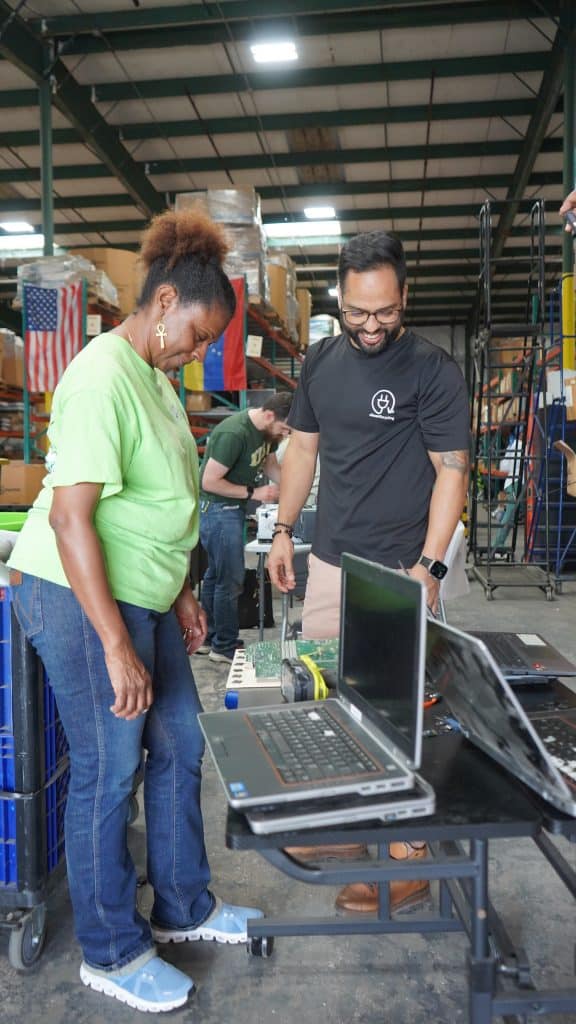
Why it matters that teachers were the ones in the room
A researcher with three decades in STEM education shared her take: “Elementary kids need to be in these spaces so they can recognize that right here in their neighborhood, there’s an opportunity to take apart and reverse engineer the tools and technologies they use every day.”
And when they get that chance, Matthew Cohen has seen what happens: “When children are allowed to take on responsibility, they take it very seriously. The ideas they come up with will blow your mind.”
Tony Selvaggio’s hope for all of it goes beyond the classroom: “I hope that youth will enter a workforce with a different chip in their head.” Not just as consumers of technology, but as people who understand what’s inside it, how to secure it, and what to do with it when it’s done.
The educators who walked into eSmart Recycling on March 7th left with a clearer picture of something most people never think about. And that’s probably the most useful thing a teacher can have.
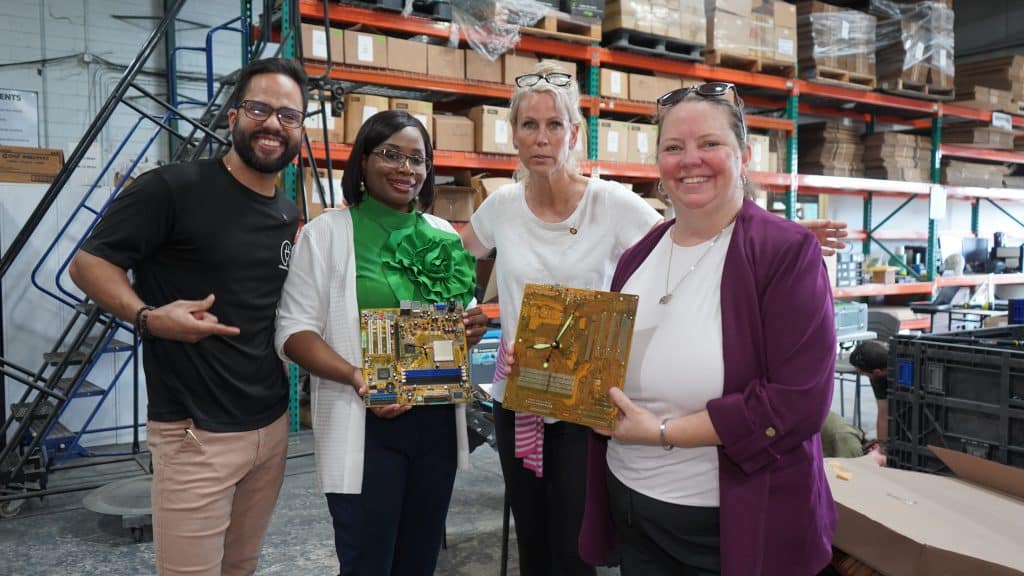
May 24, 2026
R2v3 is the most rigorous standard for corporate electronics recycling, developed by Sustainable Electronics Recycling International (SERI). It certifies that a provider protects the data stored on incoming devices, handles hazardous materials properly, and subjects its operations to annual independent audits. For a company in Tampa Bay, choosing a recycler without R2v3 means taking on a level of data risk that certified documentation is designed to eliminate.
That retired server has been sitting in the back room for nine months. Nobody touched it because nobody wants to be responsible for what happens next. That is exactly the moment when your vendor’s certification stops being a procurement detail and becomes the only thing protecting your company during an audit.
What does an R2v3 certification actually audit?
R2v3 requires recyclers to identify and track the materials and equipment they process, prioritize reuse and refurbishment before recycling, maintain certified environmental and health-and-safety management systems, and comply with all applicable labor, environmental, and data security laws.
R2v3-certified facilities also undergo strict annual audits performed by an independent third-party certification body. These audits verify that the company follows industry best practices for data security, electronics recycling, and sustainability.
What that means in practice is simple: this is not a certification a company earns once and hangs on a wall forever. Every year, an outside auditor reviews the entire process. If the provider changes how it handles materials or data and no longer meets the requirements, the certification can be revoked.
Companies regularly hand over old computers without properly wiping them, send servers to recyclers without verifying destruction methods, or dispose of hard drives without considering the sensitive information stored inside them.
Every one of those mistakes has consequences. Cybercriminals and identity thieves actively search for improperly discarded IT assets, monitoring e-waste collection points and online auctions. Some even pose as electronics recyclers.
The numbers behind that risk are very real. The average cost of a data breach in U.S. companies reached $10.22 million in 2025, marking a 9% increase and a new record high.
Documented cases include:
- Morgan Stanley was fined $60 million by the OCC after improperly decommissioned data center equipment containing unencrypted customer information was found on devices that should have been destroyed.
- The UK National Health Service (NHS), where hard drives containing patient data from a dismantled server were later sold on eBay, resulting in a £325,000 fine.
Morgan Stanley was fined $60 million by the OCC after improperly decommissioned data center equipment containing unencrypted customer information was found on devices that should have been destroyed.
The UK National Health Service (NHS), where hard drives containing patient data from a dismantled server were later sold on eBay, resulting in a £325,000 fine.
In both situations, the failure point was the same: a vendor without a certified process capable of proving exactly what happened to each device after it left the company.
This is the part every IT manager should fully understand before speaking with legal teams or the CFO.
An R2v3-certified recycler generates:
- Serialized inventory reports: every device is logged by serial number before processing.
- Certificates of data destruction: linking each drive to its destruction method, date, and responsible technician.
- Chain of custody reports: documenting every stage from pickup to final downstream processing.
- Environmental impact reporting: measuring recovered materials and avoided CO₂ emissions, useful for ESG reporting.
Serialized inventory reports: every device is logged by serial number before processing.
Certificates of data destruction: linking each drive to its destruction method, date, and responsible technician.
Chain of custody reports: documenting every stage from pickup to final downstream processing.
Environmental impact reporting: measuring recovered materials and avoided CO₂ emissions, useful for ESG reporting.
A recycler without certification may provide little more than a receipt. That is not enough protection during a compliance audit or regulatory investigation.
How to verify whether a Tampa Bay provider has an active R2v3 certification
SERI maintains a public searchable directory of accredited facilities worldwide. Any company can verify whether a recycler currently holds an active certification, which facility is certified, and when that certification expires.
At eSmart Recycling, we are listed there. If you have doubts, verify it before you call.
What is the difference between R2v3 and the previous R2:2013 standard?
In 2020, SERI introduced R2v3 as a significantly more comprehensive version of the standard, focused on improving downstream accountability, strengthening data security, and aligning ITAD practices with circular economy goals. All companies certified under R2:2013 were required to migrate to R2v3 before 2024 to maintain certification.
Does R2v3 cover data destruction or only material recycling?
Both. R2v3 requires secure data sanitization processes that comply with regulations such as HIPAA while also establishing strict procedures for handling hazardous electronic materials.
How many R2v3 recyclers operate in Tampa Bay?
Very few. The certification requires ongoing annual audit and maintenance costs, which naturally filters out vendors without formal operational processes. Checking the SERI directory before choosing a recycler is one of the simplest ways to reduce risk.
Does a small company really need an R2v3-certified provider?
Yes. Data risk does not scale with company size. A hard drive containing customer information from a ten-person business can create the same type of breach exposure as one from a thousand-person corporation. The provider’s certification matters regardless of how many devices you recycle.
How can we schedule a pickup with eSmart Recycling in Tampa?
You can contact us directly through eSmart Recycling Contact Page or by calling (813) 501-7768. We coordinate pickups across Tampa Bay and provide full documentation once the process is complete.
That server sitting in the back room is not going to disappear on its own. But the documentation proving who processed it and how absolutely can show up during an audit. Reach out to us, and we will help you handle it correctly.
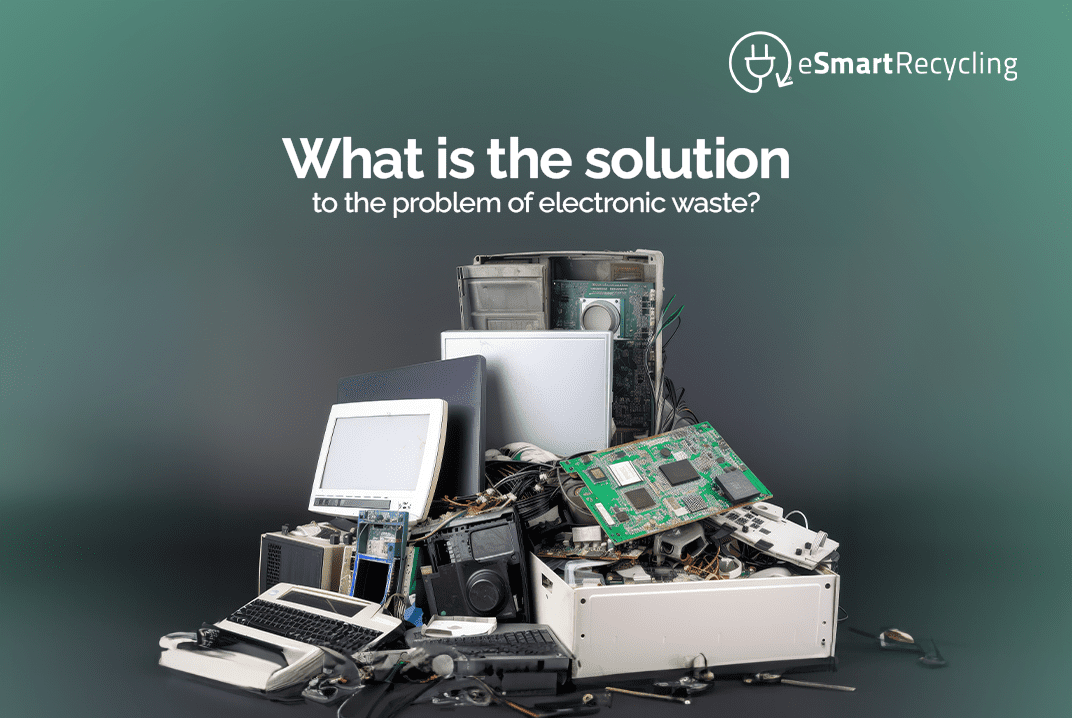
June 4, 2024
Electronic waste, also known as e-waste, is a global environmental problem posing potential risks to human health and the environment. Nearly 50 million tons of electronic waste are generated annually, creating a significant issue that worsens. Finding the right solution to the problem of electronic waste is crucial for the long-term health of our planet.
What is electronic waste?
Electronic waste is a term for unwanted electronic or electrical devices, such as computers, mobile phones, refrigerators, and computer equipment. Many government agencies estimate that over 50 million tons of electronic waste are incinerated in landfills yearly. Since electronic waste contains hazardous materials like lead, cadmium, beryllium, mercury, and other heavy metals, it is important to handle it responsibly.
What are the dangers of electronic waste?
Electronic waste can cause air pollution, groundwater contamination, and soil pollution. When incinerated, it releases harmful chemicals into the air that can harm the respiratory system. Additionally, if not properly disposed of, electronic waste can leach hazardous materials into the soil and groundwater, posing risks to surrounding plants, animals, and people.
How can electronic waste be managed and minimized?
There are several solutions to the problem of electronic waste, including recycling, reuse, and refurbishment. Many countries, including the United States, have recycling programs that allow consumers and businesses to dispose of their electronic waste in an environmentally friendly manner. Companies like Apple and Samsung have also created take-back programs enabling consumers to recycle their old electronics.
In addition to recycling, promoting electronic waste reduction, reuse, and refurbishment is important. For example, computer manufacturers can create devices with longer lifespans, laptops can be refurbished and donated to charities, and almost any electronic device can be repurposed into something new.
What role can the government play?
The government can also help minimize electronic waste. Many countries have laws and regulations requiring companies to comply with proper reporting and disposal requirements for electronic waste. Additionally, the U.S. Environmental Protection Agency (EPA) has created the Sustainable Materials Management Program to help reduce the impact of electronic waste on the environment.
What is the solution?
The solution to electronic waste combines recycling, reuse, refurbishment, government regulation, and education. Companies and individuals must take responsibility for the electronic waste they generate, creating products and disposing of them in environmentally friendly ways. Additionally, the government must create and enforce laws and regulations that help minimize the impact of electronic waste.
Electronic waste is a significant environmental issue that must be addressed. Several solutions, such as recycling, reuse, refurbishment, government regulation, and education, can be implemented. By taking steps to minimize the electronic waste we generate, we can make a difference in the long-term health of our planet.

August 31, 2023
Electronic waste, commonly referred to as e-waste, has become a significant environmental concern in recent years. As technology continues to rapidly advance, the disposal of outdated electronic devices poses several challenges. Improper disposal can lead to harmful consequences for both the environment and human health.
An effective solution to tackle the growing e-waste problem is through e-waste audit recycling. This process involves the thorough assessment and management of electronic waste, aiming to minimize its negative impact. But what exactly is the purpose of e-waste audit recycling? Let’s dive deeper into the reasons behind this crucial practice.
1. Environmental preservation
One of the primary goals of e-waste audit recycling is to preserve the environment. Electronic devices often contain hazardous materials such as lead, mercury, and cadmium. When improperly discarded, these toxic substances can seep into the soil and groundwater, endangering ecosystems and polluting water sources.
Conducting regular e-waste audit recycling ensures that electronic devices are disposed of appropriately. Through proper recycling techniques, harmful elements can be safely extracted, preventing potential damage to the environment. Recycling also reduces the need for extracting new raw materials, further conserving natural resources and minimizing energy consumption.
2. Reduction of landfill burden
The disposal of e-waste in landfills poses a significant burden on our already limited waste management systems. Electronic devices take up valuable landfill space and can release hazardous substances into the environment over time. By recycling e-waste, the volume of waste sent to landfills decreases, easing the strain on disposal sites.
E-waste audit recycling encourages the deconstruction and separation of different components of electronic devices. Valuable materials, such as precious metals and rare earth elements, can be recovered from these devices through recycling. This not only reduces landfill burden but also creates opportunities for resource recovery and reuse.
3. Data security
When disposing of electronic devices, it is essential to ensure the complete removal of any sensitive data they may contain. Unauthorized access to personal or proprietary information can lead to severe consequences, including identity theft or corporate espionage.
E-waste audit recycling incorporates secure data destruction methods, guaranteeing the eradication of confidential information. Specialized processes, such as data wiping and physical destruction of storage media, ensure that no data can be retrieved from discarded devices. This safeguards individuals and organizations against potential privacy breaches.
4. Compliance with regulations
E-waste audit recycling is not solely driven by environmental and data security concerns but is also guided by regulatory requirements. Many countries and regions have implemented strict laws and regulations governing the proper disposal and management of electronic waste.
By conducting e-waste audits and adhering to these regulations, individuals and businesses demonstrate their commitment to environmental sustainability. Compliance helps establish a responsible corporate image and ensures legal conformity, minimizing the risk of penalties or legal liabilities.
Audit report with eSmart Recycling
At eSmart Recycling, we understand the importance of responsibly managing electronic waste. As a trusted leader in e-waste audit recycling, we offer comprehensive solutions to help individuals and businesses effectively dispose of their electronic devices.
Our team of experts conducts thorough e-waste audits, ensuring every device is handled with the utmost care. With advanced recycling processes, we extract valuable materials, mitigate environmental impact, and maintain stringent data security protocols.
Partnering with eSmart Recycling not only guarantees compliant and eco-friendly e-waste disposal but also supports the global efforts towards a sustainable future.
E-waste audit recycling serves a crucial purpose in preserving the environment, reducing landfill burden, ensuring data security, and complying with regulations. It is an effective solution to tackle the growing e-waste problem and supports the responsible management of electronic waste.
By prioritizing e-waste audit recycling, we can minimize the adverse effects of electronic waste, conserve natural resources, and contribute to a cleaner and healthier planet.

May 28, 2025
Today, “sustainable recycling” goes far beyond simply sorting waste or dropping off old electronics at a recycling center. In the digital era, where a device’s lifespan is often just two or three years, tech recycling carries a new weight: it must not only prevent pollution, but also create social and economic value.
According to The World Economic Forum, the world generated about 62 million tons of electronic waste in 2023, yet less than 20% was formally recycled. This highlights an urgent challenge: recycling isn’t just about getting rid of things—it’s about responsibly reintegrating materials back into the economy.
What exactly is sustainable tech recycling?
When we talk about sustainable recycling for technology, we mean practices that:
- Ensure proper waste management to prevent soil, water, and air pollution.
- Protect sensitive data before equipment is disposed of.
- Maximize the reuse or recovery of valuable components before destruction.
- Create social impact, such as providing technology access to underserved communities.
For example, programs like Dell’s Asset Recovery Services help companies recycle outdated hardware securely, ensuring data protection while giving valuable components a second life.
Why traditional recycling isn’t enough anymore
In the past, “recycling” mostly meant handing materials over to a collection center. Today, that’s not enough. Many electronic devices contain heavy metals like mercury, lead, and cadmium, which are highly toxic if mishandled (EPA).
Additionally, in the digital age, “waste” brings not just environmental consequences but also financial and ethical ones. Letting unused devices pile up means:
- Wasted office or storage space.
- Potential for data breaches if devices aren’t properly handled.
- Missed opportunities to help bridge the digital divide.
What does truly sustainable tech recycling look like?
Real sustainable technology recycling weaves together three critical elements:
1. Certification and traceability
Organizations certified under standards like R2v3 guarantee that electronics are processed safely and responsibly. These certifications allow companies to show tangible proof of their environmental and social commitment.
2. Secure data erasure
An essential part of sustainable recycling is ensuring complete data destruction. Solutions like Blancco provide certified data erasure software to make sure sensitive information doesn’t fall into the wrong hands during the recycling process.
3. Measurable social impact
Some initiatives don’t just recycle; they refurbish devices and donate them to schools or underserved communities. That way, a forgotten laptop can become a powerful tool for education and growth.
Sustainable recycling is a movement, not a moment
Sustainable recycling demands a shift in mindset: seeing recycling not as the end of a product’s life, but as the beginning of a new, conscious cycle.
Today, when you let go of old technology, you’re not just clearing out storage—you’re fueling the circular economy, protecting sensitive information, and helping close social gaps. At eSmart Recycling, we believe that every recycled device can become a catalyst for change.

August 31, 2023
Sustainable development is a widely-discussed topic that holds great significance in our modern world. With increasing concerns about the environment, depletion of natural resources, and the need for long-term solutions, understanding sustainable development is crucial.
In this article, we will explore the concept of sustainable development, its fundamental principles, and the key components that make up this vital approach to our future.
Defining sustainable development
Sustainable development can be defined as the practice of meeting present needs without compromising the ability of future generations to meet their own needs. It aims to strike a balance between economic growth, social progress, and environmental protection. It prioritizes responsible resource management and seeks to minimize the negative impact of human activities on the planet.
The four pillars of sustainable development
Sustainable development rests on four essential pillars:
1. Environmental sustainability
Environmental sustainability focuses on preserving and restoring the natural environment. It emphasizes actions that reduce pollution, protect biodiversity, and conserve natural resources. This pillar encourages sustainable practices such as recycling, using renewable energy sources, and promoting ecosystem preservation.
2. Economic sustainability
Economic sustainability looks at the long-term viability of economic activities. It promotes the idea of a robust and inclusive economy that generates sustainable jobs, ensures fair distribution of wealth, and fosters innovation. Economic sustainability encourages investments in renewable energy, efficient technologies, and responsible business practices.
3. Social sustainability
Social sustainability puts people at the forefront. It focuses on ensuring that all individuals have access to basic needs like food, water, healthcare, education, and equal opportunities. It promotes social justice, human rights, gender equality, and inclusive communities. Social sustainability aims to create a harmonious society that cares for its members and future generations.
4. Cultural sustainability
Cultural sustainability recognizes the importance of preserving diverse cultural traditions, heritage, and identities. It values the interconnectedness of cultures and encourages respect and understanding among different communities. Cultural sustainability acknowledges that vibrant cultures are essential for fostering collective identity, creativity, and social cohesion.
The principles of sustainable development
Several key principles guide sustainable development:
1. Intergenerational equity
Sustainable development promotes fairness between current and future generations. It recognizes that resources should be used responsibly to ensure that future generations can also meet their needs. It encourages sustainable practices that safeguard the planet for the long term.
2. Precautionary approach
The precautionary approach requires decision-makers to take preventive measures when facing uncertain risks. It encourages the avoidance of actions that could harm the environment or public health, even in the absence of conclusive scientific evidence. It prioritizes minimizing potential negative impacts.
3. Integration and collaboration
Sustainable development relies on cooperation between governments, businesses, organizations, and communities. It emphasizes the importance of integrated decision-making processes that consider social, economic, and environmental aspects. Collaboration is crucial to achieving a holistic and balanced approach to development.
4. Participation and engagement
Sustainable development recognizes the importance of involving all stakeholders in decision-making processes. It values the voices of individuals, communities, and organizations affected by development efforts. Collaboration and engagement ensure that diverse perspectives are considered, fostering inclusivity and empowering marginalized groups.
Understanding sustainable development is essential in order to address the pressing challenges of our time. It requires a comprehensive approach that balances economic progress, social well-being, and environmental preservation. By prioritizing the four pillars of environmental, economic, social, and cultural sustainability, we can work towards a future that is equitable, resilient, and thriving for both current and future generations.

October 28, 2023
Sustainable construction, also known as eco-friendly building or green construction, refers to the practice of building structures in an environmentally friendly and resource-efficient manner. The concept of sustainable construction focuses on minimizing the negative environmental impact of buildings while simultaneously enhancing the health and well-being of their occupants. This article aims to shed light on the meaning, benefits, and significance of sustainable construction.
Understanding Sustainable Construction
Sustainable construction is an approach that promotes the design, construction, and operation of buildings with a focus on sustainability. It encompasses various practices and technologies aimed at minimizing resource consumption, reducing waste, and enhancing energy efficiency. Core principles of sustainable construction include efficient use of water, energy, and materials, as well as creating a healthy and comfortable living environment.
Benefits of Sustainable Construction
The advantages of sustainable construction are numerous. Firstly, it significantly reduces energy consumption by utilizing renewable energy sources, such as solar panels and wind turbines, thereby cutting down on greenhouse gas emissions. This not only leads to financial savings but also aids in combating climate change.
Secondly, sustainable buildings promote water conservation by incorporating efficient plumbing fixtures, rainwater harvesting systems, and wastewater treatment technologies. By reducing water consumption, sustainable buildings alleviate pressure on water resources, especially in arid regions.
Thirdly, sustainable buildings enhance indoor air quality by using non-toxic materials and implementing proper ventilation systems. This ensures occupants breathe clean and fresh air, reducing the risk of respiratory diseases and allergies.
Moreover, sustainable buildings prioritize the use of sustainable and locally sourced materials, thereby boosting the local economy and minimizing the environmental impact associated with transportation.
Sustainable construction designs also focus on maximizing natural light and incorporating green spaces, enhancing occupants’ productivity, mental well-being, and overall quality of life. These buildings prioritize the comfort and health of their users.
Understanding LEED and Sustainable Construction
LEED (Leadership in Energy and Environmental Design) is a globally recognized certification system for sustainable buildings. Developed by the U.S. Green Building Council (USGBC), LEED provides a framework for designing, constructing, and operating eco-friendly buildings. It assesses a project’s overall sustainability based on various criteria, including energy efficiency, water conservation, indoor environmental quality, and site selection.
A LEED-certified building is a testament to its commitment to sustainability and eco-friendly practices. It ensures the construction project has met specific criteria and standards set by the USGBC.
Goal of Sustainable Construction
The goal of sustainable construction is to create a sustainable built environment that reduces the ecological footprint without compromising the comfort and functionality of buildings. The ultimate aim is to minimize the negative environmental impact of the construction industry through resource conservation, waste reduction, and enhancing the health and well-being of occupants.
Sustainable buildings not only contribute to environmental sustainability but also offer economic benefits. They result in lower operational costs due to reduced energy and water consumption, as well as decreased maintenance expenses. Additionally, they have a higher market value and attract environmentally-conscious tenants and buyers who appreciate the long-term benefits and positive impact of sustainable buildings.
Sustainable construction is a concept that aims to build sustainable and eco-friendly buildings that minimize resource consumption, reduce waste, and prioritize the health and well-being of occupants. With the global focus on environmental conservation and sustainability, sustainable construction practices have become essential for creating a better future for our planet and its inhabitants. By embracing the principles of sustainable construction, we can contribute to a more sustainable and resilient built environment for future generations.